

Valérie Damaseau on St. Martin’s Flag Initiative : Identity, Visibility and “Finally Standing Fully in Who We Are”

MARIGOT, Saint Martin--For Commissioner of Tourism and Culture Valérie Damaseau, the “My Saint Martin Flag” initiative is not simply about choosing colors, shapes or a design that can fly above public buildings. It is about a people deciding, collectively and deliberately, how they want to be seen, how they want to remember themselves, and how they want future generations to understand the island they inherit.
Damaseau said the timing of the project is not accidental. Nearly 20 years after St. Martin became an Overseas Collectivity in 2007, she believes the territory has reached a stage of political, cultural and civic maturity where creating its own institutional flag is both natural and necessary.
“This moment is not accidental; it is the result of Saint-Martin’s evolution,” Damaseau said. Since 2007, she explained, the territory has progressively strengthened its autonomy, governance and ability to define its own voice.
But for Damaseau, the deeper issue is not administrative. It is emotional, cultural and historical. St. Martin, she noted, remains one of the only territories in the Caribbean without its own institutional flag. In a region where flags often emerged from independence, emancipation or other major historical ruptures, she said St. Martin has a different opportunity. It can create a symbol intentionally, together, and from a place of strength rather than urgency.
That distinction sits at the heart of the initiative. Damaseau is careful not to present the flag as a reaction against anyone or anything. Instead, she frames it as a positive act of self-definition, a chance for St. Martiners to say who they are in their own words and through their own symbol.
The project is built around three stated goals: affirming identity, strengthening visibility and bringing the community together. Of those, Damaseau said the most urgent is affirming identity.
“Saint-Martin is a unique territory with a unique story,” she said. “We are Caribbean, French, multicultural, multilingual, resilient, and globally connected through a strong diaspora. Yet for too long, much of our identity has been described externally rather than expressed collectively by our own people.”
For her, that is the gap the flag initiative is meant to address. It is not just about recognition by others, but about St. Martiners recognizing themselves.
Damaseau said the process is about reclaiming the narrative of St. Martin with confidence and dignity. A people who choose their symbols, she said, affirm their consciousness, cultural sovereignty and willingness to write their own story.
That idea gives the project a weight beyond ceremony. A flag, in Damaseau’s view, is not simply a decorative object. It is a marker of memory and belonging. It tells people, especially young people, that their culture, history and values are visible and worthy of preservation.
“Affirming identity does not mean rejecting others,” she said. “It means understanding ourselves clearly enough to stand proudly in the world.”
That balance is important throughout Damaseau’s explanation. St. Martin’s identity, she said, includes openness, but openness should not be confused with an absence of identity. The island has long welcomed people from around the world, adapted to others and built a reputation for hospitality. But she said that same openness has sometimes led St. Martiners to forget to affirm themselves.
“This flag is an opportunity to say: yes, we are open, yes, we welcome everyone, and we are also from here,” Damaseau said.
She identified several elements that must not be lost in the process: resilience, Caribbean identity, diversity and humanity. She also pointed to bilingualism as a defining part of St. Martin’s reality, noting that the natural movement between French and English is not a barrier, but a bridge. The island’s ability to rebuild after hurricanes, economic pressure and health crises also forms part of the identity she believes the flag must carry.
Damaseau stressed that the future institutional flag is not intended to erase or replace existing symbols, songs, cultural expressions, colors or traditions. She said St. Martin already has a rich cultural identity that lives through its people, music, Carnival, cuisine and heritage. She also acknowledged the Unity Flag shared with the southern side of the island as a meaningful symbol of oneness, shared history and cultural connection.
Still, she said the existence of one island and one shared cultural space does not remove the reality of two separate systems of governance.
“The reality is that free circulation and shared identity do not eliminate institutional realities,” she said. “And those realities require clear institutional representation.”
That point is one of the strongest themes in Damaseau’s answers. She repeatedly draws a line between division and representation. The future flag, she said, is not about creating distance from St. Maarten or weakening the bond across the island. It is about giving the French Collectivité of Saint-Martin a clear institutional symbol while continuing to honor the deep family, cultural and historical ties shared with the southern side.
“We remain connected by history, family, culture, and Caribbean brotherhood,” she said. “But just as our governance is distinct, our institutional representation must also be distinct.”
In her view, that distinct representation matters not only inside government, but also outside the island. It matters when young people travel, when athletes compete, when artists perform, when cultural delegations represent the territory, and when St. Martin appears in regional or international spaces where other territories stand under their own flags.

“It is what our young people carry when they leave this island and want to say: I am from Saint-Martin,” Damaseau said. “That is something we as Saint-Martin has never had. Until now.”
The Commissioner is also aware that identity projects can stir strong feelings. She said disagreement should not be treated as a threat, but as proof that people care. Different residents carry different memories, histories, sensitivities and expectations about what St. Martin represents. Her role, she said, is not to silence those differences, but to create a structure where they can be expressed respectfully.
That is why the Collectivité chose a participatory process rather than a simple announcement. Damaseau said transparency, dialogue, listening and education are essential. The goal is not uniformity of opinion, but collective ownership of the process.
“A strong symbol is not born from imposed consensus,” she said. “It is born from meaningful engagement.”
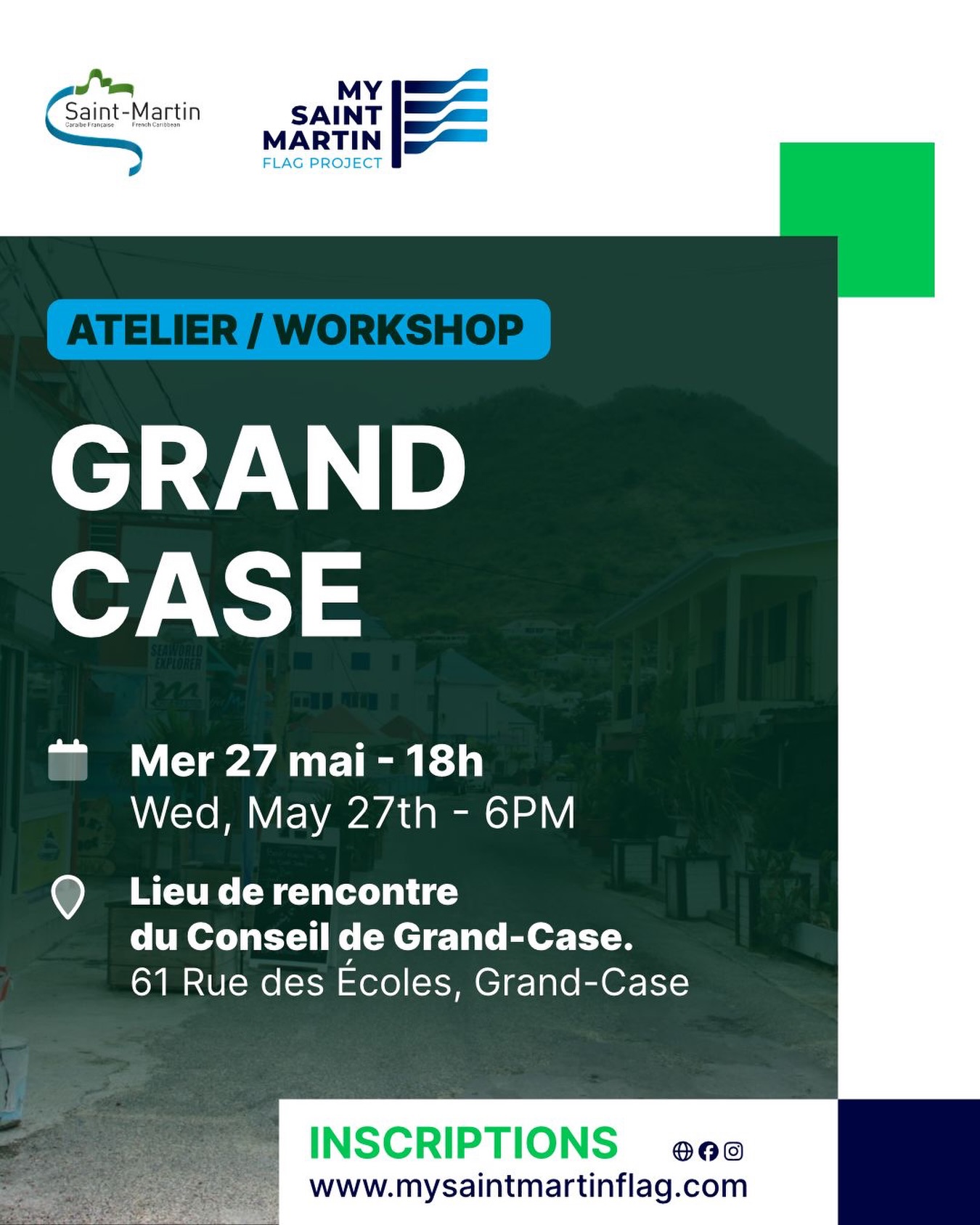
The slogan “Vee Flag, Vee Story, Vee Choice” reflects that philosophy. According to Damaseau, the process begins with a consultation phase from May through June. During that period, residents and members of the diaspora are invited to participate through online consultations and territorial workshops in French Quarter, Grand Case, Sandy Ground and Marigot.
Those workshops are meant to ask fundamental questions: Who are we? What values define us? What symbols, colors, stories and aspirations should be reflected in the future institutional flag?
The online consultation is equally important, Damaseau said, because St. Martin’s identity does not live only within the territory’s physical borders. Students abroad, young people overseas and members of the diaspora are also being asked to contribute. Their voices, she said, carry the same importance as those physically present on the island.
In July, the ideas, testimonies, symbols and recommendations gathered from the consultations will be analyzed and consolidated into a draft reference document. Damaseau described this document as the people’s blueprint for the flag. It will identify recurring themes, values, cultural markers and visual directions expressed by the population.
That document will then guide the design competition from August 1 to September 30. Artists, designers and creatives will not be asked to work from personal inspiration alone, but from the collective voice of the people.
In October, submissions will be reviewed and the public will again be invited to participate through a consultative vote to select the top three final designs. In November, the finalists will publicly present their concepts, explain the symbolism behind their proposals and engage with the population. The public will then select its preferred winner before the final institutional adoption process.
The final adoption is expected to take place through the Territorial Council. The official raising of the future institutional flag is envisioned for December 7, a date Damaseau described as deeply symbolic because it commemorates the 2003 referendum in which the people of St. Martin voted in favor of becoming an Overseas Collectivity.
By linking the flag raising to that date, Damaseau said the new symbol would be connected directly to democratic expression, political maturity and the collective identity of the people of St. Martin.
The process is also designed to be intergenerational. Schools, youth organizations, cultural associations, historians, artists and elders are expected to play central roles. Damaseau said a people’s flag cannot be created in isolation from the people themselves.
Schools are being encouraged to participate because the initiative is also about civic education. Young people, she said, should understand what a flag represents, how symbols are created, and why history and identity matter. Youth organizations bring the perspective of the next generation, while cultural associations, historians and elders help anchor the process in memory, heritage, oral history and authenticity.
District Councils will also help mobilize communities at the neighborhood level to ensure that every district feels represented.
For Damaseau, transparency will determine whether the final choice has legitimacy. She said the process is structured in phases, with each step documented before the next begins. Workshop contributions will be recorded and integrated into a public consultation report. The design contest will be guided by a brief drawn from community input. The vote will be public and consultative. Final adoption will go through the institutional bodies of the Collectivité, following a legal and verifiable process. She also said a legal team and court bailiff are assisting throughout.
“This is not a project that happens behind closed doors,” she said. “It is a project that happens in front of everyone, by design.”
Damaseau said the flag must speak to St. Martin’s past, present and future. If it ignores the past, it loses roots. If it ignores the present, it loses authenticity. If it ignores the future, it loses purpose.
That is why she rejects the idea of a flag as a static object. The future symbol, she said, must honor the resilience and sacrifices that shaped the island, reflect the lived reality of St. Martiners today, and project what the territory hopes to become.
She also sees the flag as cultural, institutional, political and practical. Culturally, it reflects identity and heritage. Institutionally, it represents the Collectivité and its maturity as an Overseas Collectivity. Politically, not in a partisan sense, it affirms that St. Martin has a voice, history and place within both the Caribbean and the French Republic. Practically, it gives athletes, artists and cultural delegations something to carry internationally.
“A flag is never just decoration,” Damaseau said. “It is a declaration of existence.”
She also addressed directly the concern that a new flag could be misunderstood as a move toward separation from France. Damaseau said the intention is clearly institutional and cultural, not separatist.
“Saint-Martin is a French Overseas Collectivity and that is not in question,” she said. “What is in question is how we exist within that identity, with our own voice, our own story, our own symbol.”
She noted that France itself recognizes regional and territorial identities, pointing to places such as Brittany, Corsica, Martinique and Guadeloupe, each with its own symbols. Having a territorial flag, she said, is not an act of defiance, but an act of belonging. It complements, rather than replaces, the broader French identity.
As Commissioner of Tourism and Culture, Damaseau said she feels a profound responsibility to ensure the process is worthy of the people it represents. She said the project should not belong to one administration or one political moment. Its legitimacy must be built into the foundation, not added at the finish line.
Her definition of success is also clear. While the final design matters, Damaseau said the real measure of success will be participation.
If residents across every district, generation and social background take part, she said, St. Martin will already have achieved something historic before a single flag is selected. She is especially interested in hearing from the “silent majority,” including people who may not usually attend public meetings or participate in political debates, but who still care deeply about identity, belonging and the future of the island.
If thousands of St. Martiners participate through workshops, schools, cultural organizations, online engagement, community discussions and public voting, Damaseau said the project will gain something more important than a flag. It will gain legitimacy, collective consciousness and emotional ownership.
“A flag imposed can exist institutionally, but a flag built through widespread public participation lives emotionally within its people,” she said.
That emotional ownership is what Damaseau hopes young St. Martiners will feel years from now when they see the flag raised. She hopes they feel pride, belonging, responsibility and, most importantly, that they feel seen.
She wants them to know that their identity matters, their culture matters and their island matters. She wants them to understand that previous generations believed enough in them to create something lasting and dignified for the future.
Damaseau also understands that some residents may question whether a flag should be a priority when social, economic and infrastructure challenges remain urgent. She said those daily realities are serious and must not be dismissed. But she argued that societies do not live by infrastructure alone. They also live through meaning, identity, cohesion and hope.
“Symbols cannot replace roads, schools, jobs, or housing,” she said. “But symbols help create the social unity necessary to collectively tackle those challenges.”
In the end, Damaseau said the final flag should tell the world that St. Martin is a small island with a powerful soul, shaped by resilience, dignity, diversity, creativity and Caribbean excellence. To St. Martiners themselves, she wants it to say something even more direct: they are not invisible, their story matters, their culture matters, their voice matters, and together they were capable of creating a symbol that reflects where they come from and where they are bold enough to go next.