

The price of an open door: Inside the immigration moratorium debate

As St. Maarten confronts growing concerns about population density, housing, traffic and public services, some residents are calling for a temporary halt to immigration. But could government legally close the door, would it solve anything, and what might happen if the island continues growing without a clear plan?
Imagine St. Maarten announcing tomorrow that, for the next three years, almost nobody new will be allowed to settle on the island. Employers would be unable to recruit most workers from abroad, new residency applications would face restrictions, and government would use the breathing room to address housing shortages, traffic congestion and overloaded infrastructure.
For some residents, that possibility may sound like a sensible response to an island increasingly struggling with the consequences of development and population growth. For others, it raises troubling questions about economic survival, individual rights and who would have the authority to decide which families and workers deserve a place in St. Maarten.
The debate is no longer simply about whether the island is becoming overcrowded, but whether immigration should be deliberately restricted to give the country time to catch up. Such proposals deserve examination because, while governments can regulate immigration, imposing a blanket moratorium is considerably more complicated than announcing that the island is full.
The numbers behind the concern
Last week's Weekend Read, "More people, same land," examined how St. Maarten's population has transformed within approximately 34 square kilometres. The 2022 Census counted 41,902 residents, compared with 33,609 in 2011, representing an increase of nearly 25% in eleven years.
Population density reached approximately 1,232 people per square kilometre, while the latest official estimate placed the population at 42,449 on January 1, 2025. Although recent growth has slowed considerably, decades of expansion have left the island with demands that its roads, housing supply and public infrastructure have struggled to accommodate.
The demographic picture is particularly revealing because only 31.1% of residents counted in 2022 were born on the Dutch side of the island. That figure reflects St. Maarten's long history as a destination for people seeking employment and opportunity, but birthplace does not establish nationality, immigration status or how recently someone arrived.
Equally important, approximately 48% of the relatively small population increase recorded during 2024 came from net migration, while 52% came from births exceeding deaths. This means immigration contributes to growth, but stopping new arrivals would not automatically stop population growth or eliminate existing infrastructure problems.
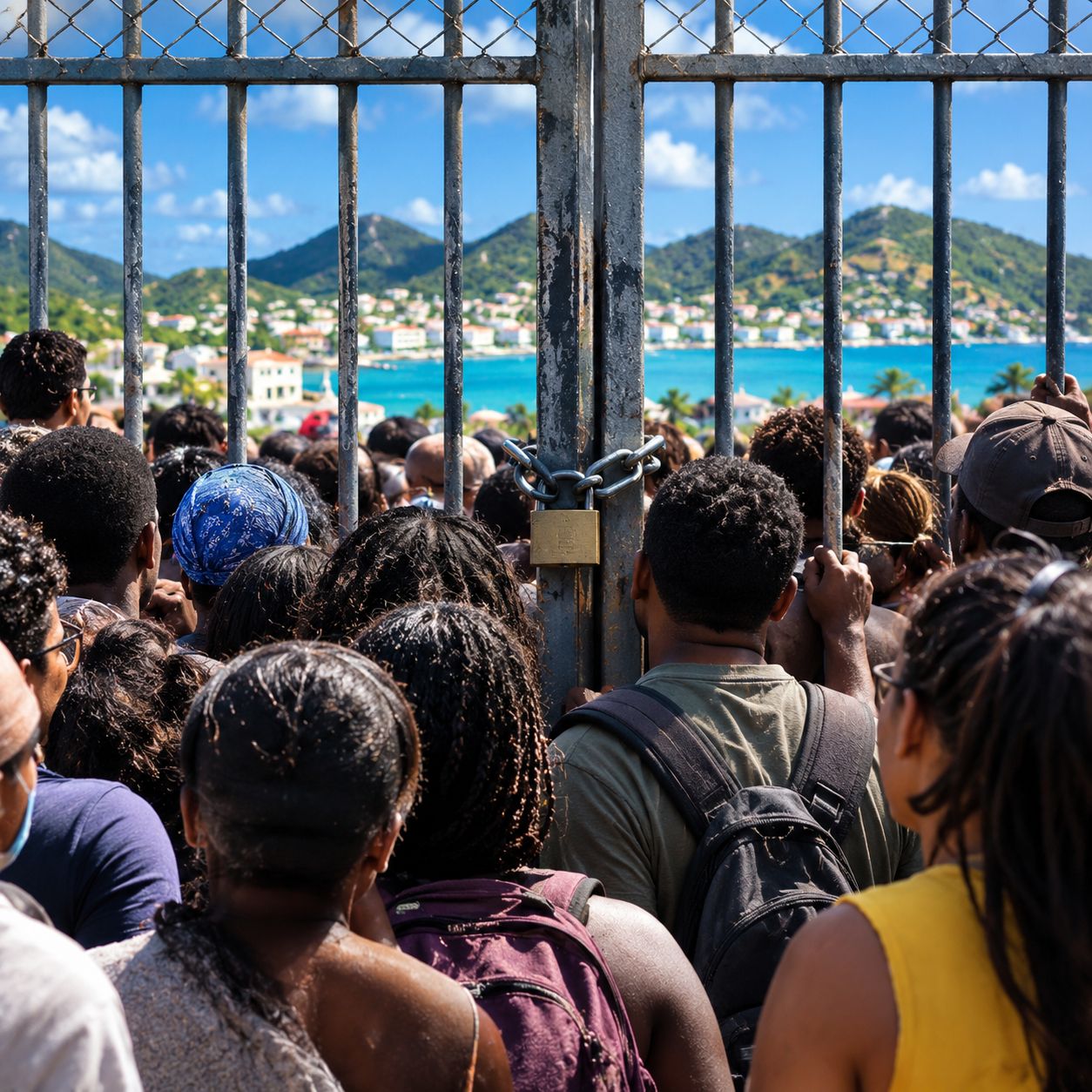
Can St. Maarten legally close its doors?
The first misconception to address is that St. Maarten is simply a Dutch territory without meaningful authority over immigration. Since October 10, 2010, it has been an autonomous country within the Kingdom of the Netherlands, with responsibility for administering much of its own immigration system.
The country's National Ordinance on Admission and Expulsion, commonly called the LTU, governs entry and residence, with the Minister of Justice responsible for important residency decisions. Parliament can legislate within St. Maarten's constitutional authority, although a sweeping moratorium would require careful examination of existing law and possibly legislative amendments.
There is another complication: not everyone seeking to settle in St. Maarten has the same legal status. Dutch nationals born in specified parts of the Dutch Caribbean, and certain other categories, enjoy exemptions or admission rights under the LTU, while other Dutch nationals may qualify for admission through different legal provisions.
Consequently, government could not simply impose the same blanket prohibition on every arriving person without considering rights already established by law. The Kingdom also retains supervisory responsibilities concerning rules governing the admission and expulsion of Dutch nationals, making some proposed restrictions matters requiring Kingdom-level consideration.
What about the United Nations?
International law does not generally give every foreign national an unrestricted right to settle wherever they choose, meaning immigration limits are not automatically unlawful. Governments routinely establish entry requirements, work-permit systems and residency conditions, provided their policies comply with applicable laws and international obligations.
However, human rights protections create important boundaries, especially concerning family life, lawful residence, discrimination and protection against removal to places where people face torture or inhuman treatment. Although the 1951 Refugee Convention has not been extended to St. Maarten, the country remains bound by relevant obligations under the European Convention on Human Rights and other applicable international treaties.
A lawful policy would therefore need exceptions, individual assessments and opportunities to challenge decisions where required. A moratorium that disregarded existing rights or treated applicants arbitrarily could face serious legal challenges, regardless of how popular it might be politically.
Other islands have tried controlling the flow
Bermuda provides an example of how a small island can regulate overseas recruitment without completely closing its borders. Its 2026 work-permit policy identifies 48 occupational categories closed to overseas recruitment and another 18 subject to restrictions, while allowing employers to recruit internationally when necessary.
The Bermudian government adjusted some restrictions during 2026 to accommodate labour shortages, particularly in hospitality and aviation. That experience demonstrates both the practical operation of selective controls and their limitations, since restrictions must be continually adjusted to economic circumstances.
Singapore follows another model, using sector-based quotas and financial charges to regulate foreign employment while allowing additional recruitment where economic priorities justify it. Its government openly acknowledges the competing risks of excessive migration placing demands on infrastructure and overly restrictive policies weakening businesses.
Neither example proves that immigration controls alone reduce housing costs or solve congestion, and their economic circumstances differ considerably from St. Maarten's. What they demonstrate is that governments can manage particular categories of immigration through targeted, reviewable systems rather than treating every potential arrival identically.

What would a St. Maarten moratorium actually look like?
A practical proposal might involve a temporary two- or three-year limit on specified categories of new employment-based residence permits, rather than a complete prohibition on immigration. Essential positions in healthcare, education, utilities, construction and other areas facing documented shortages could receive exemptions, while legally protected residence categories would need separate treatment.
Employers could be required to demonstrate that qualified residents are unavailable before recruiting overseas, with permits linked to transparent labour-market assessments. Government would also need published criteria, independent oversight, regular reviews and a fair appeals process to prevent political favoritism or inconsistent decisions.
Crucially, such a system would have to identify what it intends to achieve, whether reducing net migration, protecting employment opportunities or allowing public infrastructure to catch up. Without measurable objectives and an agreed end date, a temporary moratorium could become a permanent restriction without evidence that it is solving the original problem.
The benefits, and the price
Supporters could argue that limiting new immigration would slow additional demand for rental housing, utilities, healthcare, classrooms and road space while encouraging employers to train and recruit more residents. Government might also gain time to improve planning, strengthen enforcement and determine which economic activities the island can realistically accommodate.
However, restrictions could also leave hotels, restaurants, construction companies, hospitals and other employers struggling to recruit essential personnel. Reduced labour availability could delay projects, increase operating costs, affect service quality and ultimately raise prices for consumers.
There is a demographic concern as well, because the 2022 Census showed that St. Maarten is ageing, with residents aged 65 and older representing approximately 14% of the population. Restricting working-age arrivals without strengthening local workforce participation could eventually increase pressure on employers and the working population supporting public services.
One island, two countries: The border that changes everything
Perhaps the greatest obstacle to an immigration moratorium is St. Maarten's unique geographical reality: it shares an open border with French Saint Martin, which operates under French and European Union laws. While St. Maarten can restrict new residency and work permits, it has no authority over who France allows to settle on the northern side, and the two territories have no permanent immigration checkpoints between them.
This creates a practical dilemma because people legally residing on the French side can move across the island without routinely encountering border controls, even though that does not automatically give them permission to live or work on the Dutch side. Someone living in Marigot could work in Cole Bay with the appropriate authorization, meaning a residency moratorium would not necessarily reduce traffic, cross-border activity or demand for certain services.
Enforcement presents another challenge. In November 2024, the Law Enforcement Council reported that only five of 21 earlier recommendations concerning border control and immigration enforcement had been fully implemented, raising questions about government's capacity to administer even tighter restrictions.
Any meaningful immigration policy would therefore require cooperation with French Saint Martin, France and the Kingdom of the Netherlands, particularly regarding population movements, information sharing and employment enforcement. A moratorium might control who receives permission to settle on the Dutch side, but it cannot independently control population developments across the entire island.
The central reality is that St. Maarten can regulate its immigration system, but it cannot manage the consequences of migration as though the French side does not exist. Any serious population strategy must account for an island that functions as one interconnected society, even while governed by two countries.

What happens if nothing changes?
Without better planning, continued population growth and development could intensify competition for housing, particularly affordable rentals, while additional vehicles increase pressure on already congested roads. Schools could face greater demand for classrooms and staff, healthcare providers could encounter longer waiting times, and police, emergency responders and social services could be required to cover increasingly concentrated communities.
Electricity, water distribution, wastewater management and garbage collection would also need investment to accommodate additional households and businesses. Meanwhile, pressure to build on scarce land could threaten hillsides, drainage corridors, remaining green spaces and areas needed for future public facilities.
The consequences would not necessarily be immediate or inevitable, because well-managed development can accommodate population growth when infrastructure expands accordingly. But if approvals continue without credible assessments of housing, transport and service capacity, St. Maarten risks allowing demand to outpace improvements, leaving residents to experience the consequences.
Importantly, immigration is not the only source of these demands, with tourism, commercial development, vehicle ownership and decisions about where buildings are constructed also contributing. A government that restricts immigrants while continuing to approve developments without adequate infrastructure could discover that the underlying problem remains largely unchanged.
So, is a moratorium justified?
The evidence establishes that St. Maarten faces significant planning challenges, but it does not establish that the country has reached a scientifically determined maximum population. Nor does it demonstrate that a complete immigration freeze would produce better outcomes than carefully targeted limits combined with investment in housing, infrastructure and public services.
The strongest case emerging from the available data is for a transparent national assessment of immigration, population capacity and economic needs before government commits to a particular restriction. Such an exercise should establish how many additional residents different sectors can accommodate, which skills are genuinely needed, and what public investment must accompany future growth.
Ultimately, the issue is larger than deciding who gets in or who gets locked out. It is whether St. Maarten has the information, legal authority and administrative capacity to make those decisions fairly, while protecting the country it is responsible for governing.
Closing the door may appear straightforward. Deciding when to close it, whom to exempt, when to reopen it and what to accomplish in the meantime is where the real test of government begins.