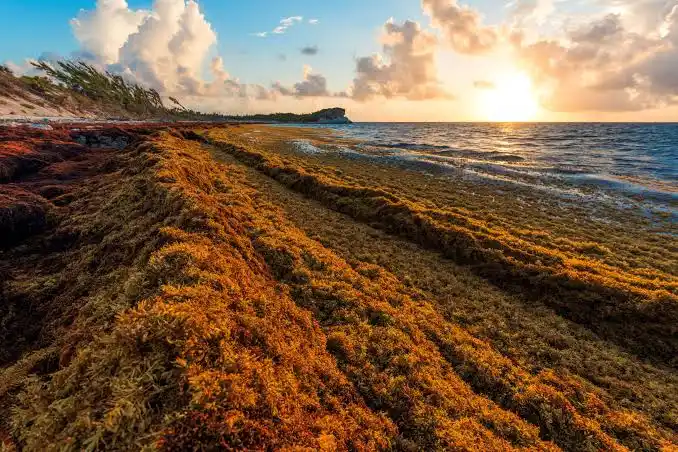
The French goes to war with Sargassum
.jpg)
The French-side government is preparing to place nearly one kilometre of floating barriers in the sea, moving part of its sargassum response away from repeated beach cleanups and towards intercepting the algae before it smothers the coastline.
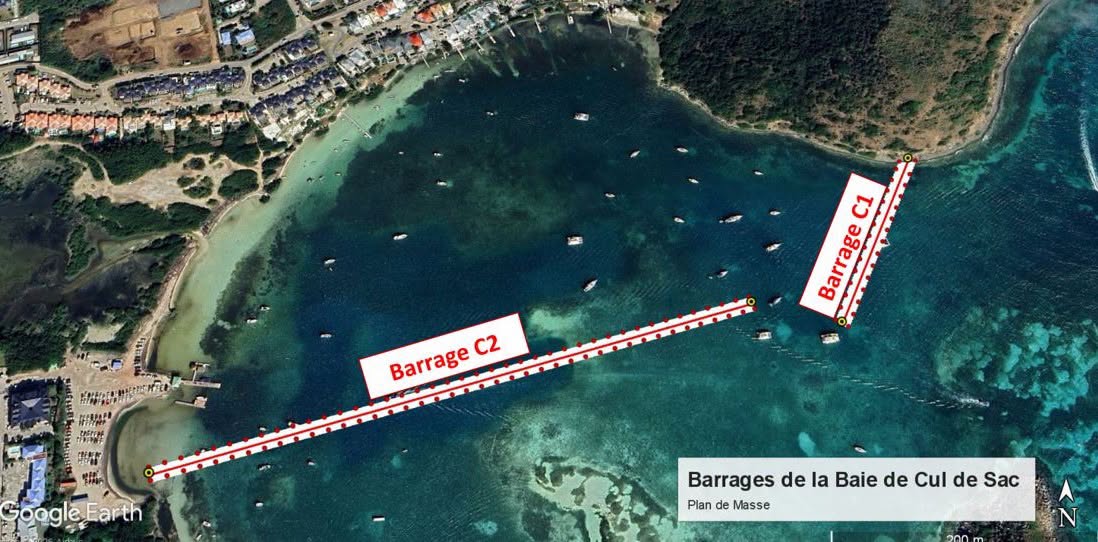
The first diversion barriers are scheduled to be installed in Cul de Sac Bay in August, followed by a second system in October at Embouchure Bay, near the mouth of the Fish Pond. The barriers are designed to redirect incoming sargassum towards designated collection points, where it can be removed before entering sensitive coastal areas or decomposing along the shore.
The Collectivité de Saint-Martin is financing €576,550 of the €896,550 project, with the French State contributing €320,000. Four barrier sections are planned, covering approximately 700 metres in Cul de Sac and another 227 metres near the Fish Pond. The system will require new navigation arrangements, while boat owners are being reminded of the longstanding prohibition on anchoring in Cul de Sac Bay.
The project follows feasibility studies completed in 2025 to determine the most suitable type of barrier and the safest locations. The first installations will serve as an experiment, allowing technicians to assess how the barriers perform under local currents, winds and wave conditions before deciding whether the system should be adjusted or extended elsewhere.
Second Vice-President Bernadette Davis, who is responsible for the living environment and ecological transition, has cautioned against expecting the barriers to eliminate the problem.
“There is no miracle solution. We hope that these diversion barriers will be significant and more effective than simple collection in protecting the population. While other territories have abandoned their efforts, Saint-Martin has chosen to act. The installation of the diversion barriers is a first for our island,” Davis said.
The intervention follows years of rising expenditure and increasingly heavy landings. Since 2022, the Collectivité has committed more than €3 million to the sargassum response. In 2025 alone, approximately 16,000 tonnes were collected, requiring continuous removal, transportation and treatment. Local authorities employed contractors to clean affected beaches daily, while residents in areas such as Cul de Sac, Mont Vernon and Oyster Pond regularly dealt with the smell of decomposing algae.
The barriers form part of a wider strategy involving the monitoring of approaching masses, offshore diversion, shoreline collection and the treatment of harvested algae. That broader approach is becoming necessary because recent research suggests that the Caribbean is no longer dealing with an occasional seasonal nuisance.
It may be facing a self-sustaining environmental crisis.
article continues below....
A problem that learned how to feed itself
Floating sargassum is natural and plays an important ecological role in the open ocean. Its mats provide shelter and feeding grounds for fish, crabs, shrimp and other marine organisms.
The scale of the phenomenon changed around 2011, when unusually large blooms began appearing across the tropical Atlantic between West Africa and Brazil. The area became known as the Great Atlantic Sargassum Belt, producing masses that travel towards the Caribbean, Central America, the Gulf of Mexico and Florida.
The blooms have since become larger, more frequent and longer lasting. Scientists recorded an estimated 37.5 million metric tonnes across the Atlantic basin during the 2025 peak, while monitoring by the University of South Florida indicates that 2026 is also a major sargassum year.
Researchers from the Georgia Institute of Technology now argue that the belt may have developed a mechanism that helps sustain its own growth.
A floating sargassum mat functions as an ecosystem, sometimes described as a “sargassumsphere.” Marine organisms living within and around it feed, produce waste and break down older material. Those processes collect and recycle nutrients around the mat, helping new sargassum grow.
Scientists developed a model using nitrogen measurements from sargassum collected near the US Virgin Islands. The model reproduced the blooms recorded between 2011 and 2022 and predicted the development of the 2023 and 2024 blooms, strengthening the theory that the system is increasingly feeding itself.
The finding changes the way Caribbean governments must view the problem. Waiting for the algae to reach land and then removing it with excavators may no longer be financially, environmentally or operationally sustainable.

The danger begins when it reaches shore
At sea, sargassum supports life. When huge quantities are trapped in shallow bays or piled along beaches, the same algae can become destructive.
Thick masses can block sunlight, reduce oxygen in coastal waters and smother seagrass, coral and other marine habitats. They can obstruct fishing grounds, ferry routes, marinas and harbours, while making beaches unusable for residents and visitors.
Once the algae begins to rot, it releases gases including hydrogen sulphide and ammonia. Exposure can cause headaches, nausea, dizziness, eye irritation and breathing problems, particularly for people living or working close to heavily affected areas. Environmental agencies also warn that sargassum can contain arsenic, accumulated metals and other pollutants, making disposal and reuse more complicated than simply turning the algae into compost.
The economic cost reaches beyond collection contracts. Sargassum can disrupt tourism, fishing, boating and coastal businesses, while forcing governments to repeatedly clear the same areas after each new arrival.
That is why the diversion barriers represent more than another cleanup project. They are an attempt to change where the battle is fought.
Instead of allowing the algae to enter enclosed bays, settle on beaches and begin decomposing, the system aims to guide it towards places where machinery can collect it more efficiently. The barriers will still require maintenance, monitoring and removal during severe weather, particularly when winds exceed 30 knots or waves rise above two metres.
There is also potential value in what is collected. Researchers and entrepreneurs are experimenting with sargassum for biofuel, processed soil products, construction panels and bricks. However, those uses require testing and treatment to remove salt, metals and other contaminants.
The barriers will not stop the Atlantic belt from forming, and they will not prevent every landing. Their value will be measured by whether they protect residents, keep navigation routes open, reduce the quantity reaching shore and lower the cost of repeated cleanups.
Saint-Martin is preparing for a future in which sargassum does not simply return occasionally. The growing scientific warning is that it may now keep coming back because the system sustaining it is already established.