

Slower Caribbean tourism growth, smarter targeting and what it means for St. Maarten
.jpg)
GREAT BAY--Caribbean tourism is still growing, but the easy rebound years appear to be over. A new Caribbean Travel Trends 2026 report by Amadeus and the Caribbean Hotel and Tourism Association (CHTA) shows a region entering a more competitive, data-driven phase, where destinations can no longer rely only on broad appeal, traditional peak seasons or familiar source markets to keep visitor numbers climbing.
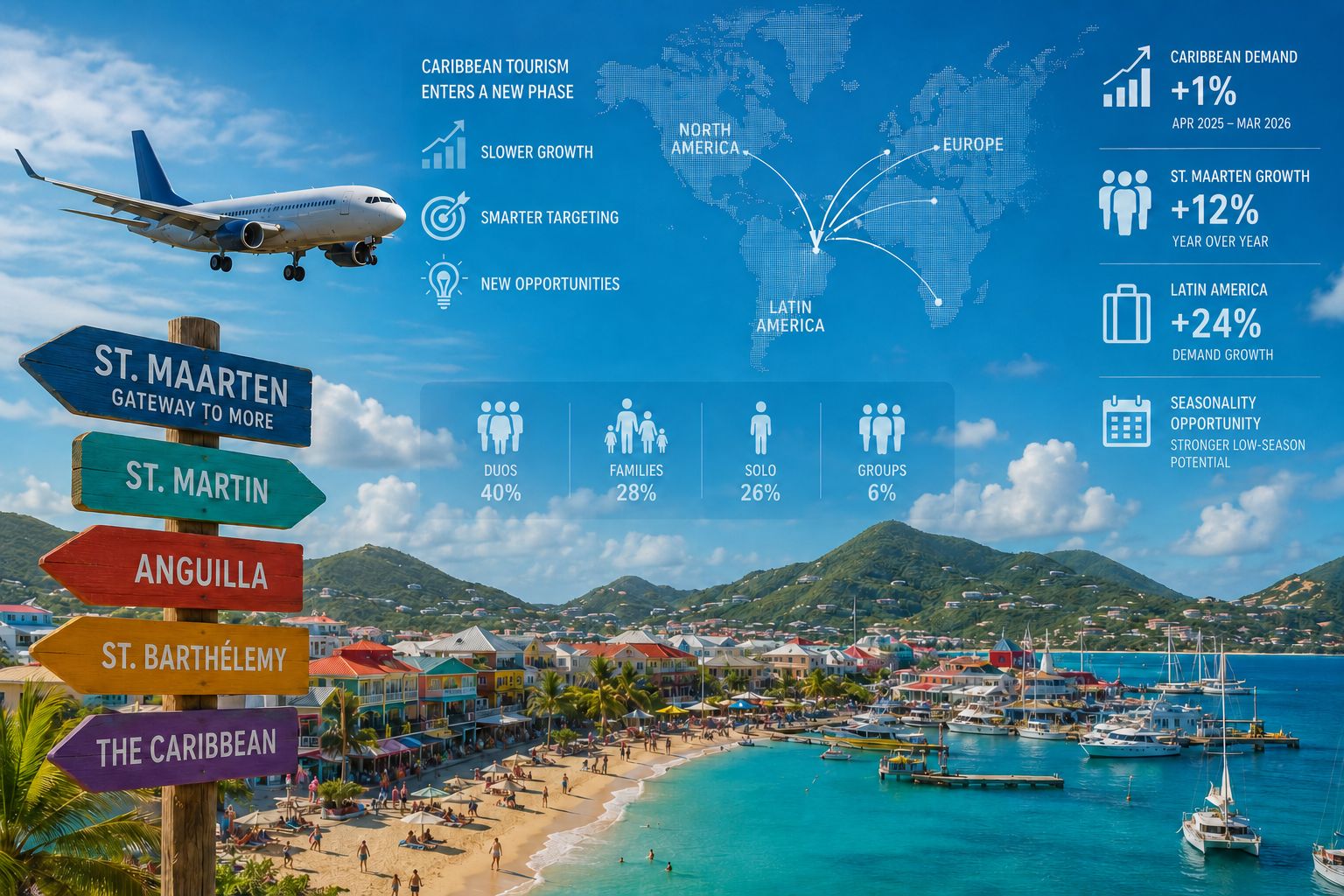
The report, based on Amadeus market research data as of April 2026, finds that overseas travel demand to the Caribbean grew by just 1 percent between April 2025 and March 2026. That marks a major slowdown compared to the post-pandemic recovery surge, when demand grew by 21 percent in 2023 over 2022 and by 8 percent in 2024 over 2023. The message is clear: Caribbean tourism is no longer simply rebounding, it is stabilizing. In that new environment, growth will depend more on how destinations compete, when they market, which visitors they target and how well they convert travel interest into actual bookings.
For St. Maarten, the report contains both encouragement and caution. The destination is identified among the stronger performers in the Caribbean, with year-over-year demand growth of 18 percent and a 2.3 percent share of regional demand. The report places St. Maarten in the spotlight, noting that its strong performance must be understood in a wider regional context: the country functions not only as a destination, but also as a gateway to French St. Martin, Anguilla and St. Barthélemy through land, boat and charter flight connections. That gateway role helps explain why demand signals for St. Maarten appear particularly strong.
But the same report also suggests that the next stage of competition will be less about celebrating growth and more about managing it. Destinations will have to think more carefully about source markets, visitor profiles, air connectivity, seasonality, events and hotel performance. The Caribbean traveler is no longer a single, easily defined visitor, and the Caribbean tourism product can no longer be marketed as one general sun-and-sand proposition.
A Slower Regional Market
The most important headline from the report is the slowdown in overall regional growth. Caribbean demand is still positive, but the pace has moderated sharply. That matters because many destinations built their recent optimism on the return of travelers after the pandemic, the reopening of air routes and strong pent-up demand.
Now, the region is entering a different cycle. According to the report, this new phase is defined less by rapid growth and more by the need to optimize performance, diversify demand and build long-term resilience. In practical terms, that means tourism authorities, hotels, airlines and private sector stakeholders will have to work harder to attract the right visitors, at the right time, from the right markets.
The report separates Caribbean destinations into top-tier and second-tier markets. Top-tier destinations are those representing more than 5 percent of total Caribbean tourist arrivals, while second-tier destinations represent less than 5 percent. Top-tier destinations were flat year over year, while second-tier destinations grew by 2 percent. That suggests much of the recent momentum is coming from smaller destinations expanding from a lower base, not from the region’s biggest volume players.
Among the top-performing destinations, Dominica recorded 22 percent growth, Saint Vincent and the Grenadines 19 percent, St. Maarten 18 percent, Saint Martin 12 percent, Guyana 10 percent and Aruba 8 percent. The Dominican Republic, despite being a major volume destination, still recorded 8 percent growth.
This is significant for St. Maarten. The country is not merely benefiting from a regional wave; it is outperforming many destinations in a slowing regional market. That kind of performance gives St. Maarten a stronger platform, but also raises the stakes for how it manages capacity, infrastructure, airlift, visitor experience and local economic benefit.
Latin America Becomes a Strategic Opportunity
One of the report’s strongest findings is the growing importance of Latin American source markets. Demand from Latin America increased by 24 percent year over year, making the region one of the Caribbean’s most important opportunities for diversification.
Traditional long-haul markets are showing signs of slowdown, but Latin American markets continue to grow. Colombia, Argentina, Mexico, Peru and Brazil are listed among the fastest-growing source markets. Colombia grew by 45 percent, Argentina by 44 percent, Mexico by 39 percent, Peru by 35 percent and Brazil by 27 percent.
The significance goes beyond volume. The report notes that Latin American travelers are also showing strong growth in premium travel segments. At the regional level, premium travel from South America to the Caribbean increased by 117 percent year over year. Peru recorded a 192 percent increase in premium travel demand, while Argentina increased by 164 percent.
That is a major signal for Caribbean destinations. Latin America is not simply a backup market for filling rooms; it is emerging as a source of higher-value travel, including travelers willing to fly in premium cabins and spend more on their trips.
St. Maarten has traditionally leaned heavily on North American and European markets, while also benefiting from regional and neighboring-island traffic. The report suggests that future resilience will depend on broadening that base. Latin America, particularly South America, may offer St. Maarten a stronger opportunity to reduce seasonal vulnerability and attract visitors outside traditional high-demand months.
St. Maarten’s Gateway Advantage
The report’s specific reference to St. Maarten is notable because it recognizes a reality long understood locally: St. Maarten is not only a destination, it is an access point for the northeastern Caribbean.
Travelers use Princess Juliana International Airport, the marine network and private or charter services to reach other islands. The country’s tourism performance therefore reflects a combination of stayover demand, transit function and regional connectivity.
This gives St. Maarten an advantage, but it also complicates how success should be measured. High arrivals and strong demand signals may not always mean all benefits remain in the local economy. Some travelers pass through. Others split their stays. Some use the island as a launch point for higher-end neighboring destinations.
The opportunity for St. Maarten is to convert more of that gateway traffic into local value. That could mean encouraging stopovers, promoting two-destination packages that include St. Maarten stays, strengthening marina and charter-related tourism, improving airport-to-hotel conversion and ensuring that transit visitors are exposed to local dining, shopping, events and cultural experiences.
The report’s findings support a more deliberate approach: St. Maarten should not only market itself as a beach destination, but also as a connected Caribbean hub with access, energy, events, nightlife, shopping, marine travel and nearby island experiences.

The Caribbean Traveler Is Changing
The report makes clear that Caribbean travelers differ widely by group type, age and motivation. Duos represent the largest share of overseas tourist arrivals to the region at 40.4 percent, followed by family-sized groups of three to five travelers at 27.6 percent, solo travelers at 26 percent and large groups of six or more travelers at 6.1 percent.
Each group brings different opportunities. Solo travelers are linked to digital nomads, eco-adventure and experiential travel. Family-sized groups are associated with multi-bedroom accommodations, kids’ clubs and family amenities. Duos are tied to romantic getaways, honeymoons, wellness and spa experiences. Large groups support demand for private villas, group excursions, charter boats and destination weddings.
St. Maarten appears specifically among the top-performing destinations for duos, with 8 percent growth in that segment. That is important because it reinforces the island’s strength in couples travel, short leisure escapes, romantic trips and wellness-oriented experiences.
The age profile also matters. Travelers aged 26 to 45 make up the largest share of arrivals to the Caribbean at 35 percent. Travelers aged 46 to 65 account for 33 percent. Younger travelers under 26 represent 22 percent, while those over 65 represent 10 percent.
The report notes that younger travelers respond strongly to social media, video content and peer reviews. Millennials and Gen X travelers are strongly represented in destinations such as Saint Lucia, Curaçao and Grenada, supporting couples and lifestyle-driven travel. Older travelers over-index in destinations such as Guyana, Anguilla and Bonaire, where comfort, authenticity and longer stays are more important.
For tourism marketers, this means the old one-size-fits-all campaign is losing value. St. Maarten’s message to a couple from New York should not be the same as its message to a family from Colombia, a digital nomad from Canada, a wedding group from Trinidad or a premium traveler from Argentina. Each segment plans differently, books differently and responds to different motivations.
Luxury, Economy and the Middle of the Market
The report finds that 7.6 percent of tourist arrivals to the Caribbean travel in premium cabins. Luxury-focused destinations such as Anguilla, Saint Barthélemy and Bermuda lead the premium index, with premium travel shares between 22.4 percent and 24.8 percent, roughly three times the regional average.
St. Maarten is shown as having a luxury and economy travel balance broadly in line with the regional average, with a premium/luxury index score of 1.5. That puts it behind the most luxury-dependent destinations, but ahead of several mass-market destinations.
This positioning may actually be an advantage. St. Maarten can appeal to a wide range of travelers, from economy leisure visitors to high-value travelers using the island for villa stays, yacht charters, nearby island access, dining, events and premium experiences.
The challenge is to avoid being undefined. A balanced market can be a strength, but only if the destination knows which segments it wants to grow. The report’s emphasis on traveler personas suggests that St. Maarten should identify and pursue its strongest high-value segments more deliberately, rather than treating all arrivals as equal.
Connectivity Still Drives Competitiveness
Air access remains one of the biggest factors shaping Caribbean travel. Across the region, 83.7 percent of tourist arrivals reach their destination on direct flights, while 16.3 percent arrive through transfers. However, the report notes that this regional average hides major differences.
Top-tier destinations generally benefit from stronger direct air access. Aruba and Puerto Rico both record 91 percent of arrivals via direct flights. By contrast, second-tier destinations rely more heavily on transfers. Trinidad and Tobago sees 47 percent of arrivals entering via a transfer, Guyana 42 percent and the Cayman Islands 32 percent.
The report also highlights the growing importance of hub cities. Panama is increasingly important for South American travelers heading to the Caribbean, particularly from cities such as Buenos Aires and Santiago. Panama City accounts for 56.1 percent of total transfers for South American markets. For European travelers, Madrid is becoming a stronger gateway, accounting for 33.6 percent of transfers.
St. Maarten's airlift network supports its gateway role, but future growth from Latin America and Europe may depend on smoother hub access, airline partnerships and better promotion in markets where travelers may not currently view St. Maarten as an easy choice.
The report also shows that fare competitiveness supports Caribbean demand from the United States. The average economy one-way fare from the U.S. to the Caribbean was $385, making the region more affordable than South America at $569 and broadly comparable to Central America at $387. Miami offers the lowest average fare to the Caribbean at $315, compared to New York at $349 and San Francisco at $545.
This matters because affordability remains part of the Caribbean’s appeal. Even as destinations chase high-value travelers, the region’s price competitiveness from key U.S. gateways continues to support volume.
Seasonality Remains a Major Challenge
The Caribbean’s growth since 2022 has been driven largely by seasonal peaks. The report states that total tourist arrivals in 2025 were up 30 percent compared with 2022, but much of that growth came from strong demand around end-of-year travel periods.
Low-season demand, however, has remained relatively stable. That means high seasons are getting stronger, while slower months are not improving at the same pace. The result is a more pronounced seasonality pattern.
For hotels and destinations, this is a serious business issue. Peak periods may generate strong returns, but low-season weakness affects employment, cash flow, airline viability, restaurant activity, taxis, tours and government revenue.
The report’s Seasonality Index ranks destinations by variability in overnight stays. A lower score means more consistent year-round demand, while a higher score means greater seasonality. Curaçao leads as a model of stable seasonality with an index score of 21, followed by Aruba at 24, Guyana at 25 and Saint Lucia at 29. Barbados is the most seasonal among the listed destinations, with a score of 228.
St. Maarten falls in the middle with a score of 132. That suggests the country benefits from strong peak demand, but still has room to build a more balanced year-round tourism pattern.
The report points to South America as a key opportunity for low-season growth. Brazil is the fastest-growing low-season source market, with demand up 60 percent. Mexico also grew 60 percent, Peru 34 percent, Puerto Rico 29 percent, Colombia 26 percent and Argentina 25 percent.
This is one of the most important lessons for St. Maarten. If the country wants to reduce pressure on high season and strengthen business during slower months, it needs stronger targeting of markets that naturally travel outside the traditional North American and European winter peaks.
Hotel Revenue Shows the Cost of Low-Season Weakness
The report’s hotel performance data reinforces the financial impact of seasonality. During the low season, September and October 2025, Caribbean hotels recorded an average daily rate of $224 and average revenue per available room, RevPAR, of $125. RevPAR increased by 2 percent year over year, but still remained well below peak-season performance.
During the high season, July and August, RevPAR rose to $183 per night, up 5.2 percent year over year, with an average daily rate of $271. The strongest performance occurred during the end-of-year holiday period, when average RevPAR reached $283 across Caribbean destinations.
The gap is significant. Caribbean hotels earn much more during holiday and peak periods, but long-term stability depends on improving the weaker months. The report states that destinations that successfully engage South American travelers and diversify demand beyond traditional peak windows will be better positioned to enhance RevPAR stability and overall resilience.
St. Maarten's hotels, guesthouses, villas, restaurants, taxis, tour operators and retailers all feel the difference between high and low season. Any strategy that lifts occupancy and spending during slower months can have a direct impact on the wider economy.
Events Are More Than Entertainment
The report uses CARIFESTA XV in Barbados as a case study to show how major events can drive tourism demand. The event, hosted in 2025, contributed to a 23 percent year-over-year increase in arrivals during the event period. Intra-Caribbean travel accounted for 23.3 percent of tourist arrivals during CARIFESTA XV, an increase of 3.3 percentage points over the previous year.
The report also shows that events influence how long people stay. Many travelers arrived before the official program and combined the event with leisure travel. During the CARIFESTA period, medium-length stays of four to seven nights dominated, while longer stays were more common in the lead-up to the event than after it.
That finding is especially relevant to St. Maarten, where Carnival, regattas, concerts, sports tournaments, cultural festivals and conferences can serve as tourism drivers. The lesson is that events should not be seen only as local entertainment or isolated calendar activities. Properly promoted, they can shape travel decisions, extend stays, stimulate regional travel and fill rooms during targeted periods.
The report notes that searches and bookings for CARIFESTA began building more than three months ahead of the event, with an acceleration after the official media launch. This points to the importance of early marketing, coordinated promotion, travel seller engagement and digital retargeting.

What This Means for St. Maarten
The report gives St. Maarten several strategic openings.
First, the country is performing well in a slowing regional market. That should be recognized, but not taken for granted. Growth of 18 percent is strong, especially when the Caribbean as a whole grew only 1 percent. But the next challenge is converting growth into deeper local value.
Second, St. Maarten’s gateway role is a major asset. The country can strengthen its position as a hub for nearby islands while finding ways to keep more travelers, spending and experiences on the Dutch side.
Third, Latin America deserves more attention. The growth in Colombian, Argentine, Mexican, Peruvian and Brazilian demand, combined with strong premium travel growth from South America, suggests that St. Maarten should look beyond its familiar markets.
Fourth, seasonality must be treated as an economic issue, not merely a tourism calendar issue. St. Maarten’s seasonality score places it in the middle of the regional pack. That means the country has room to improve by targeting travelers who move during shoulder and low seasons.
Fifth, events should be integrated into tourism strategy. The Barbados CARIFESTA example shows that major events can increase arrivals, strengthen regional travel and extend stays. St. Maarten has the event culture to do the same, but it requires early planning, stronger destination marketing and better alignment between government, tourism authorities, airlines, hotels and event organizers.
Finally, the report points to the importance of data. Caribbean destinations are competing in an environment where travelers have more choices, shorter attention spans and different planning behaviors. Marketing cannot be based only on tradition or assumption. It must be guided by booking windows, origin markets, traveler profiles, air connectivity, fares and seasonal patterns.
A Region at a Turning Point
The Caribbean is not in decline. The report does not suggest that. Instead, it shows a region moving from recovery into maturity. The question is no longer whether travelers want the Caribbean. They do. The question is which Caribbean destinations will be disciplined enough to compete for the right travelers, at the right time, with the right message.
It will require a sharper focus on Latin America, better use of events, stronger low-season strategies, more targeted marketing, continued airlift development and a clearer understanding of who is actually traveling.
The Caribbean’s recovery years rewarded availability. The next phase will reward strategy.