

Criminal Law Professor: The kidnapping, criminal prosecution of Nicolás Maduro
.jpg)
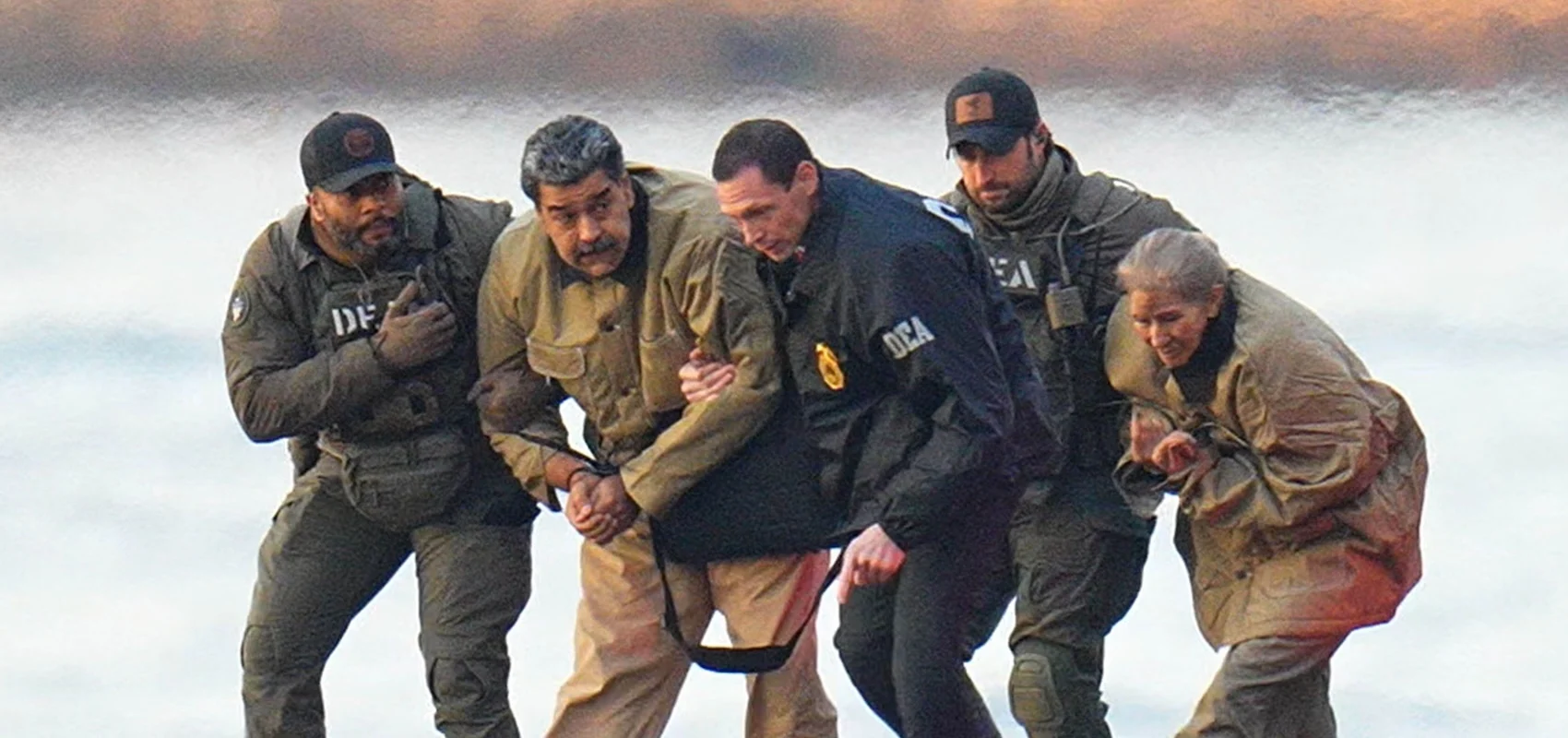
Göran Sluiter, a professor of criminal law at the Open Universiteit and professor of international criminal law at the University of Amsterdam, uses a recent opinion piece to take readers through what he sees as the legal wreckage created by the US operation that seized Venezuelan President Nicolás Maduro and his wife and moved them into preventive custody ahead of a criminal case in New York.
The US action is, in his view, plainly unlawful under multiple bodies of international law, and the muted reaction from much of the Western world risks normalizing something that would be condemned instantly if done by almost any other state. He notes that Washington has not seriously tried to justify the kidnapping in international law terms, and he suggests the reason is simple, there is no workable justification.
A breach of the UN Charter, and why the usual exceptions do not fit
Sluiter starts where international lawyers usually start, with the UN Charter’s prohibition on the use of force. He frames the operation as a direct violation of Venezuela’s territorial integrity and sovereignty, pointing to Article 2(4) of the Charter. In his reading, neither of the two widely accepted exceptions is available here, there was no self-defense situation under Article 51, and there was no UN Security Council authorization for force.
That matters because the use-of-force prohibition is one of the core guardrails of the post-1945 order. Sluiter’s warning is that if a powerful state can send troops into another country to seize its sitting head of state and then call it “law enforcement,” the barrier between policing and war gets dangerously thin.
Head-of-state immunity, and the slippery “recognition” escape hatch
From there he moves to immunities, an area where the law is often unpopular but still deeply entrenched. Sluiter argues that customary international law gives a sitting head of state “absolute immunity” from foreign criminal jurisdiction, meaning Maduro cannot lawfully be arrested or prosecuted by another state’s courts while in office. The only clear routes around that, he says, are prosecution before an international criminal court such as the ICC, or a waiver of immunity by Venezuela.
He tackles a comparison that has surfaced repeatedly in commentary, the 1990 US arrest and prosecution of Panama’s Manuel Noriega. In that case, Noriega’s immunity argument was rejected in US court partly because Washington did not recognize him as Panama’s president. Sluiter accepts that similar reasoning might be attempted against Maduro, but he says it is corrosive if recognition becomes the switch that turns immunity on and off. If non-recognition is treated as decisive, he warns, states could sidestep immunity obligations simply by declaring they do not accept a leader’s status.
Sluiter’s escalation, he calls it “aggression”
Sluiter goes further than “illegal.” He argues the kidnapping operation can also be understood as the crime of aggression, the leadership-level offense codified in Article 8bis of the ICC Statute, and also criminalized in Dutch law via Article 8b of the International Crimes Act.
He acknowledges a key threshold point, aggression in the ICC framework requires a “manifest” UN Charter violation judged by nature, seriousness, and scale. In his view, the absence of any credible legal justification makes the “manifest” character easier to see.
He briefly explores a hypothetical that could complicate the seriousness analysis, humanitarian intervention aimed at ending large-scale and serious human rights violations in Venezuela. Even then, he suggests, the action could still violate the prohibition on force, but might be argued as less serious in the “aggression” sense if it were genuinely tied to preventing mass atrocities. He stresses that this is theoretical, because the US has not presented that kind of justification.
Human rights still apply, even to a rights-violating leader
He argues that even a dictator accused of serious abuses retains internationally recognized human rights, including the right not to be deprived of liberty except through lawful procedure under Article 9 of the ICCPR, a treaty he notes the US is party to.
He stresses a basic point that tends to get lost in emotionally charged cases, an American arrest warrant can be executed lawfully on American soil, it does not magically authorize soldiers to seize a suspect abroad. For a lawful arrest in Venezuela, the US would have had to pursue lawful means such as extradition, and the expectation that Venezuela would refuse is not, in his view, a lawful reason to bypass the process. He cites human rights case law to underline that “workarounds” to extradition procedures, including less extreme tactics than outright abduction, can violate the right to liberty, pointing to the European Court of Human Rights decision in Bozano v. France.
The “prisoner of war” claim, and why it complicates the picture
At arraignment in New York, Maduro claimed he is a prisoner of war, and Sluiter treats that as more than courtroom theater. He explains that the claim assumes an armed conflict between the US and Venezuela, and that Maduro, as commander in chief of Venezuelan armed forces, could be treated as part of hostile forces and therefore capturable under the laws of war, with Geneva Convention protections attaching to POW status.
He notes the US does not currently accept that framing and is emphasizing “law enforcement,” not war. Still, Sluiter points to the ICTY’s “Tadić criteria,” often summarized as: an international armed conflict exists whenever there is resort to force between states, while intensity and duration thresholds are more central to internal armed conflict analysis and also appear in the ICC Statute’s approach to non-international armed conflicts. On that logic, he says Maduro’s POW claim has some basis, but he also sketches the counterargument, the operation may be too limited, especially if no further hostilities follow, to describe the situation as an actual international armed conflict in practice.
The political reaction problem, and the precedent fear
He argues that condemnatory reactions matter in a system without a central enforcement mechanism, and that silence, or carefully hedged statements, can function like permission. In his view, the lack of clear condemnation creates a precedent risk and a credibility problem, it becomes harder to convincingly condemn other acts of aggression while treating this case as a special exception.
He is not alone in framing it that way, UN experts publicly condemned the operation as a grave violation of foundational international law principles, and they also emphasized that sitting heads of state are immune from foreign criminal jurisdiction while in office, regardless of diplomatic recognition or politics.
A Dutch legal sting, “condoning” international crimes
Sluiter adds a Netherlands-specific wrinkle that is easy to miss if you are only watching Washington and Caracas. He points to the Dutch criminalization, from 2024, of publicly “condoning” international crimes covered by the International Crimes Act, including aggression, under Article 137c(2)(a) of the Dutch Criminal Code. He notes that prosecution for “whitewashing” does not require a prior final court judgment establishing the underlying international crime.
He suggests that cautious political reactions likely do not amount to condoning, but he flags Geert Wilders’ X post, “Bang Boom Maduro gone,” accompanied by a muscle emoji, as the kind of statement that could be read as supportive of aggression. He then underscores the legal hurdle that would still matter, the statement would also need to be insulting to the Venezuelan population, and he lays out both sides of that debate. Support for aggression could be seen as offensive to a population that may suffer from such acts, but others may argue the operation had limited impact on Venezuelans and that removing a rights-violating leader could be beneficial. Sluiter’s practical point is that even if prosecution is unlikely, politicians may not fully appreciate the scope and purpose of the 2024 change when reacting publicly to international crimes.
What he expects in court, and why he doubts Maduro will win early
On the criminal case itself, Sluiter expects the early fight to center on two “pre-trial” issues, the unlawfulness of the arrest and the violation of head-of-state immunity. The defense, he says, will argue that either point should block the case from going forward and require Maduro’s release.
He is pessimistic, largely because of how US courts have handled similar situations. Sluiter points to the US principle commonly described as male captus bene detentus, the idea that even an unlawful capture does not automatically defeat jurisdiction or require dismissal. He cites past US litigation such as United States v. Alvarez-Machain, and he references Christophe Paulussen’s doctoral work on the doctrine, to show how durable the approach has been.
On immunity, he says prosecutors will lean on Noriega as precedent and, more broadly, on the reality that US judges often defer to the executive branch on foreign policy questions. He contrasts that with the Netherlands, where courts are more likely to engage directly with whether domestic criminal jurisdiction runs into “exceptions recognized in international law,” referencing the Dutch framework in that direction.
The charges, “conspiracy” as the engine of the case
If the case reaches the merits, Sluiter notes the US indictment strategy relies heavily on “conspiracy,” a form of liability that allows prosecutors to focus on an alleged agreement to commit crimes rather than proving specific completed acts, in this case, drug trafficking into the United States and the broader branding of “narcoterrorism.” In his description, the practical advantage for prosecutors is that they do not have to prove concrete drug shipments, the agreement and cooperative structure are enough, as long as they can prove them.
He notes examples in the indictment narrative, including allegations about Venezuelan diplomatic passports being used to facilitate trafficking, and he stresses an evidentiary wild card, co-defendants may decide to cooperate, perhaps through plea agreements, and provide incriminating statements that strengthen the case against Maduro.
The missing piece, why not prosecute torture and other international crimes
Sluiter anticipates a European question, why is the US not charging Maduro and associates with international crimes linked to abuses in Venezuela, such as torture of political opponents. He notes the ICC is officially investigating the situation in Venezuela, and he points out that the US could, in principle, use universal jurisdiction to prosecute certain crimes like torture if suspects are present on US territory.
He calls it commendable, as a matter of moral signaling, if the US were to add such charges because it would show attention to the suffering of Venezuelan civilians. Still, his bottom line does not change, he argues the case should not be happening in US court at all because it is built on what he describes as serious violations of international law.
His opinion piece was printed first via nederlandrechtsstaat.