

Caribbean words enter Oxford dictionary, but they were ours long before
.jpg)
A hornerman does not suddenly become a hornerman because the Oxford English Dictionary says so. A jablesse was frightening Caribbean children long before a lexicographer in England wrote down what the word meant. Peanut punch did not need international recognition to become part of Caribbean food culture, and anyone who grew up hearing somebody threaten to “get on” already understood perfectly well what was about to happen.
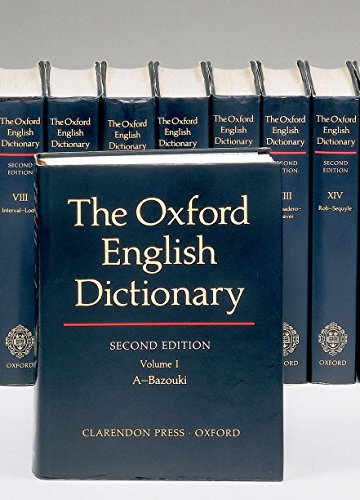
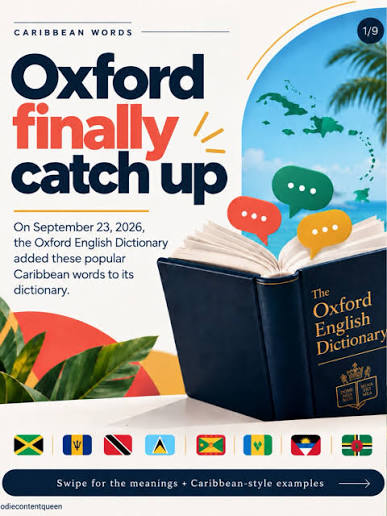
Still, there is something significant about seeing words shaped by Caribbean history, humour, folklore and everyday life added to one of the world’s most influential records of the English language. More than a dozen words from the Caribbean and Bermuda were included in the Oxford English Dictionary’s September update, placing expressions that have circulated for generations alongside hundreds of thousands of words gathered during more than a century of documenting English.
Among the new entries are hornerman, the Trinidad and Tobago term for an unfaithful man or a man involved with someone else’s partner; vex money, money kept by a woman for an emergency or unexpected situation; jablesse, the shape-shifting female spirit of Caribbean folklore; and douen, the mysterious child spirit associated particularly with Trinidad and Tobago folklore.
Also included are peanut punch, sugar cake, Trinbagonian and canboulay, the latter connected to the Carnival traditions and history of Trinidad. Bermuda contributed words including bimpert, used for a foolish person, shadeesh, a term for chorizo, and hamma, meaning a friend.
For Caribbean people, however, the interesting part of the story is not simply that Oxford has discovered some colourful new words. It is what their inclusion says about who gets to define English, how language travels and why words that were once dismissed as dialect, slang or “bad English” increasingly form part of the documented history of the language itself.
English was never only England’s language
The Caribbean relationship with English has always been complicated. English arrived in much of the region through colonialism, but Caribbean societies did not simply receive the language and leave it untouched. English mixed with African languages, French, Spanish, Dutch, Indigenous languages and languages brought by indentured labourers from India and elsewhere. Pronunciation changed, meanings shifted, new words developed and old words were adapted to describe experiences that standard British English could not fully capture.
That history is visible in the latest Oxford additions.
Jablesse, for example, developed from the French diablesse, meaning a female demon. Douen is connected to the Spanish word duende. Nana and nani, also recognized in Caribbean usage, have South Asian roots and are used for maternal grandparents.
Even a word such as canboulay carries history within it. The term is connected to the French expression cannes brûlées, or burnt cane, and became associated with Trinidad’s pre-Carnival celebrations after emancipation. Canboulay is tied to resistance, street processions, drumming and the conflicts that helped shape what eventually became modern Trinidad Carnival. The words are therefore doing more than naming things. They carry pieces of Caribbean migration, colonization, slavery, emancipation, folklore and cultural survival.
What happens when everyday speech becomes dictionary English?
There is a natural temptation to say that these words have now become “official.” That is not quite how dictionaries work.
The Oxford English Dictionary does not create a word or grant permission for people to use it. Its job is to document language that already exists and to trace how that language has been used over time. Oxford itself says that its dictionaries include regional vocabulary and slang because a descriptive dictionary is supposed to record real-life language in all its forms.
A grandmother in Trinidad did not need Oxford to confirm the existence of a douen. People did not wait for a dictionary entry before telling a friend to keep some vex money. A Trinidadian accusing somebody of being a hornerman was not using an incomplete version of English waiting for approval from Britain.
The dictionary is catching up with the speakers, not the other way around.
And perhaps that is what makes these additions culturally important. They acknowledge that English is not owned exclusively by London, Oxford, New York or any other traditional centre of the language. English has been reshaped wherever people have made it their own, including throughout the Caribbean.
Our words tell our stories
Some of the entries are humorous. Others are rooted in fear, history or survival. Vex money may sound amusing when explained to someone unfamiliar with the expression, but embedded in it is a concept of independence and preparedness. It is money put aside so that a woman has options if a situation goes wrong.
Jablesse and douen preserve stories that generations heard from parents and grandparents. Whether anyone believes in the creatures is almost beside the point. Folklore is part of how communities teach children, explain danger, entertain themselves and pass cultural memory from one generation to another.
Peanut punch and sugar cake show another side of language. Food words often survive because food itself survives. Recipes move through families and communities, carrying their names with them.
And then there is hornerman, a word requiring very little explanation anywhere in the Caribbean once the meaning of “horn” is understood.
These are not academic creations. They came from ordinary people speaking to one another.
What about St. Maarten?
The Oxford announcement should also provoke an interesting question closer to home: which St. Maarten words and expressions would belong in such a collection? St. Maarten’s language is particularly difficult to place neatly into one category because the island has always been multilingual. English dominates everyday communication on the Dutch side, but Dutch, Spanish, French, Creole and other languages constantly mix into the way people speak.
There are expressions understood immediately by people who grew up here that could confuse someone encountering them for the first time. Some came from elsewhere in the Caribbean and became part of local speech. Others developed through St. Maarten’s own history and mixture of nationalities.
Documenting those expressions is not merely an exercise in nostalgia. Language can disappear surprisingly quickly. Younger generations adopt new vocabulary through social media, television and migration, while expressions once heard daily can slowly become unfamiliar. When older speakers disappear without their words being recorded, part of the cultural record disappears with them.
That is why Oxford’s latest additions matter beyond the novelty of discovering Caribbean words in a famous dictionary. They are reminders that language is also history.
We never needed permission
There is something slightly amusing about a word used in Caribbean villages, kitchens, rum shops and schoolyards for generations eventually arriving at Oxford and being formally catalogued. But perhaps the real significance is not that Caribbean English has finally been accepted.
It is that institutions that once concentrated overwhelmingly on British and American English are increasingly recognizing what Caribbean people have always known: our version of English is not an error that needs correcting. It is part of the language’s continuing development.
A dictionary can record that history. It cannot create it. The hornerman was already in trouble. The jablesse was already waiting in the darkness. The peanut punch was already cold.
Oxford simply wrote them down.