

Caribbean tourism battle Is shifting from visitors, to who captures their spending
.jpg)
Royal Caribbean Group’s planned US$3 billion investment for a 50 percent stake in Sandals and Beaches Resorts is much more than a deal between a cruise company and a hotel operator. It could signal a broader change in how Caribbean tourism is packaged, marketed and sold, with one company increasingly able to keep a traveler within its vacation network from the moment a trip is considered until long after the guest returns home.
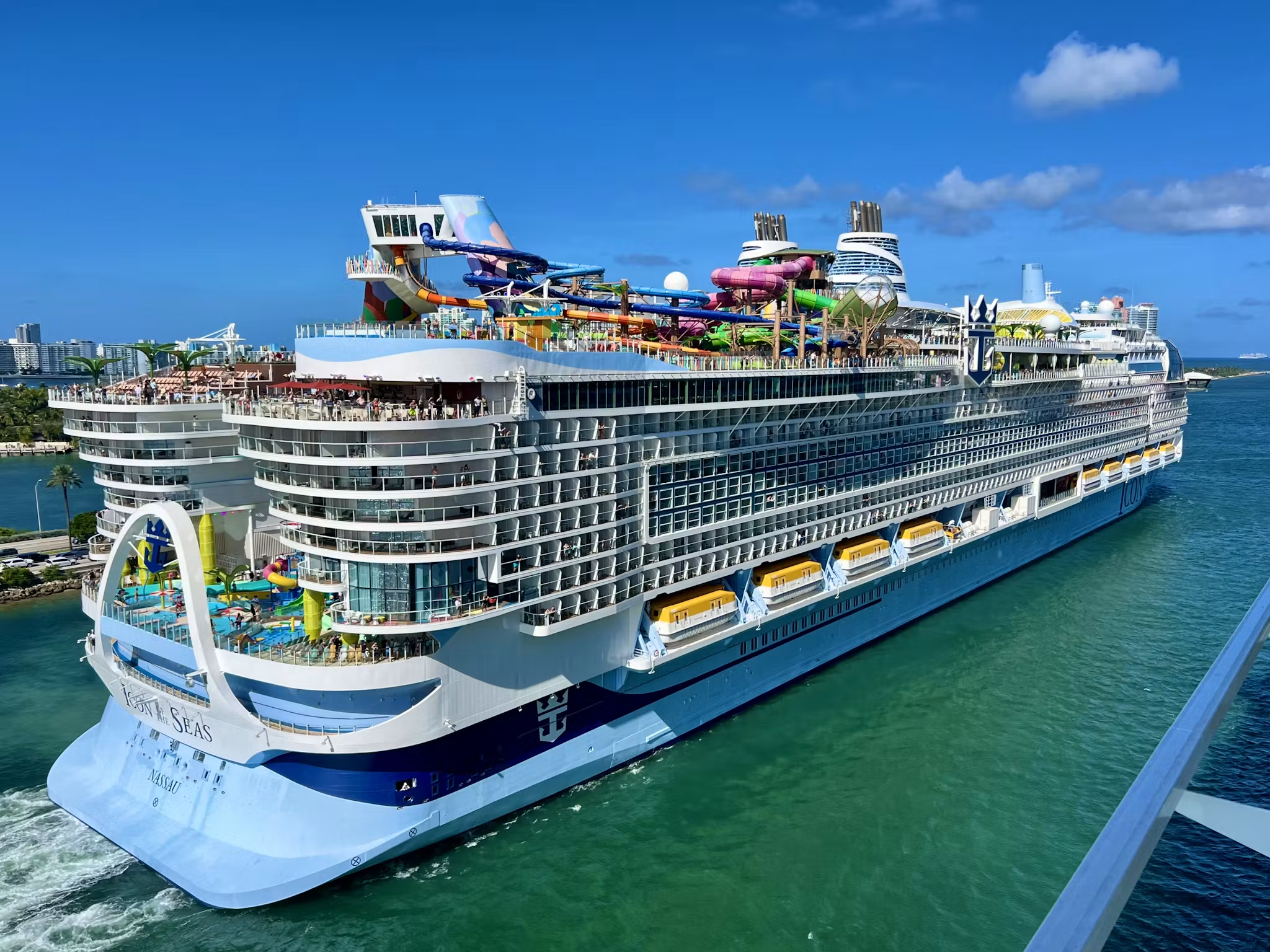
The agreement brings together Royal Caribbean Group, whose brands include Royal Caribbean International, Celebrity Cruises and Silversea, with one of the Caribbean’s best-known all-inclusive resort companies. Sandals and Beaches will continue operating as distinct brands, but the companies have already indicated that they intend to explore stronger distribution, customer engagement and connections between their vacation products. For the Caribbean, the important question is what happens when cruise and land-based tourism, traditionally treated as separate segments, begin functioning as parts of the same tourism system.
From choosing a cruise or resort to choosing both
For decades, destinations have often discussed cruise tourism and stay-over tourism as separate markets. Cruise passengers arrive for several hours and return to their ships, while stay-over visitors occupy hotel rooms, eat in local restaurants and generally spend several days on an island. The Royal Caribbean-Sandals partnership challenges that separation by creating obvious possibilities for vacations that combine both.
A traveler could eventually book several nights at an all-inclusive resort before or after a cruise, while loyalty benefits, marketing and booking systems make movement between the two products easier. Travel advisors interviewed since the announcement have already pointed to combinations such as a shorter cruise followed by several nights at a Beaches or Sandals resort. Royal Caribbean and Sandals have not announced such packages, but the structure of the partnership makes that type of development easier to imagine.
A cruise visitor who previously spent six or eight hours on an island could eventually be encouraged to return for a longer stay. Likewise, someone who normally chooses an all-inclusive resort could be introduced to cruising through the same vacation network. Instead of fighting over the same traveler, cruise and resort operators could seek to increase the number of Caribbean vacations that traveler takes over a lifetime.
article continues below...

The Caribbean becomes the product, not simply the destination
Royal Caribbean has been steadily expanding beyond the traditional cruise ship model. It has invested heavily in private destinations and beach clubs and is preparing to enter river cruising. Sandals, meanwhile, has spent more than four decades building an all-inclusive brand closely associated with Caribbean vacations.
Combining those networks gives Royal Caribbean something increasingly valuable: more ways to sell the Caribbean without depending on one type of vacation.
That's significant for the region because large tourism companies are increasingly competing for the entire customer relationship. Flights, hotels, cruises, excursions, beach experiences, loyalty benefits and repeat vacations can all become interconnected. Royal Caribbean and Sandals have already discussed linking loyalty programs so that customers are recognized across both businesses.
The potential advantage for the Caribbean is greater repeat visitation and a wider range of vacation experiences. The risk is that more of the visitor’s spending could be captured before the traveler ever reaches a local business.
Local businesses should pay attention
This is where the deal becomes especially important for tourism-dependent economies. If a visitor books the cruise, resort stay, transportation, excursions and other experiences through one connected vacation platform, independent operators may have to work harder to secure a place in that spending chain. Local restaurants, tour companies, transportation providers, attractions and smaller hotels could benefit enormously if they are incorporated into a growing network. They could also lose opportunities if visitors increasingly purchase their activities directly through large operators.
The Florida-Caribbean Cruise Association has emphasized the potential for partnerships of this kind to create opportunities across the tourism value chain. That outcome, however, is not automatic. Caribbean governments and tourism authorities will have to pay attention to how future developments connect with local suppliers, workers and businesses.
The size of the investment also strengthens the argument that Caribbean destinations need to think beyond arrival numbers. Two million visitors mean less economically if an increasing share of their vacation spending never enters the wider local economy. The more integrated the global tourism companies become, the more important it will be for destinations to measure not only how many people arrive, but how much visitor expenditure remains locally.
More Sandals and Beaches could mean more investment
The clearest immediate objective of the deal is expansion. Sandals Executive Chairman Adam Stewart has said there is still considerable room for growth in the Caribbean, while Royal Caribbean CEO Jason Liberty has made clear that expanding the resort portfolio is the initial priority. That could mean additional rooms, new resorts and greater investment in existing Sandals and Beaches destinations. It could also intensify competition among Caribbean islands seeking resort investment.
Attracting a major resort is about more than construction jobs. New properties can support airlift, increase destination marketing and create demand for food, transportation, entertainment and services. The bigger question will be how much of those opportunities can be supplied locally rather than imported.
Royal Caribbean and Sandals also acknowledged that purchasing and supply-chain opportunities could emerge from the partnership. That should be closely watched. A company with enormous purchasing power could create opportunities for Caribbean farmers, manufacturers and service providers if regional sourcing is expanded. The opposite is also possible if increased scale leads to more centralized purchasing from outside the region.
Competitors are unlikely to ignore this
The deal could also trigger a response from other cruise lines, hotel groups and tourism companies. Travel industry observers have already raised the possibility that competitors will look for their own hotel partnerships, resort acquisitions or stronger land-based products.
If that happens, the Caribbean could see a period in which the lines separating cruise companies, resorts and destination experiences become increasingly difficult to see.
For islands heavily dependent on tourism, this would change the competitive environment. Destinations would not simply be negotiating with a cruise line about calls or a hotel developer about rooms. They could increasingly be dealing with companies that control multiple parts of the visitor journey.
That gives large tourism companies more influence, but it could also give destinations new opportunities to negotiate partnerships that encourage longer stays, repeat visits and stronger connections with local businesses.
A Caribbean company attracting global capital
There is another part of the story that should not be overlooked. Sandals was created in the Caribbean and built its international reputation around the Caribbean. A transaction valuing the business at roughly US$6 billion is also a statement about the value that has been created within the region’s tourism industry.
Sandals intends to expand beyond its traditional Caribbean footprint, but its leadership has also stressed that further Caribbean growth remains part of the plan.
That makes the Royal Caribbean deal both an opportunity and a challenge for the region. It could bring additional investment, new visitors, stronger marketing and new combinations of cruise and stay-over tourism. It could also accelerate the concentration of tourism spending within a smaller number of very large companies.
The Caribbean should therefore watch more than where the next Sandals resort is built.
The bigger development may be the emergence of a tourism model in which the cruise, the hotel, the beach experience, the loyalty program and the next vacation are all connected. For a region that depends heavily on tourism, the task will be making sure the Caribbean is not merely where that vacation takes place, but where a meaningful share of its economic value remains.