Caribbean Cannabis and Agriculture: Can one help revive the other?
.jpg)
For decades, agriculture across much of the Caribbean has been under pressure. Small farmers face high production costs, limited access to land and financing, competition from imported food, aging farming populations and weak local markets. Many islands import the majority of what they eat, while agriculture contributes far less to national economies than tourism and services.
Against that backdrop, cannabis is increasingly entering the agricultural conversation, not simply as a recreational or medical product, but as a crop that could help restore farming as a viable livelihood. The real question is whether cannabis can strengthen agriculture without displacing food production.
A new crop, but an old farming tradition
Cannabis is not new to Caribbean agriculture. Traditional growers in countries such as Jamaica and St. Vincent and the Grenadines have cultivated the crop for generations, often outside the legal economy. What is changing is the effort to move cannabis into regulated agricultural systems.
St. Vincent and the Grenadines has become one of the clearest examples. After legal reforms beginning in 2018, the country created a medical cannabis framework that sought to include traditional farmers rather than replace them with large investors. Licensed companies are required to source a portion of their cannabis from traditional cultivators, while farmers have been offered subsidized licenses and other forms of support.
That approach matters because legalization alone does not guarantee that small farmers benefit. The Transnational Institute has repeatedly warned that Caribbean reform should deliberately protect traditional growers from being pushed aside by companies with greater access to capital, technology and export markets.
Jamaica has faced the same challenge. Its government developed an Alternative Development approach aimed at helping small and traditional ganja farmers transition into the legal medicinal cannabis industry. The Cannabis Licensing Authority has also worked on special arrangements intended to make entry easier for smaller cultivators who struggle with the cost of full licensing.
These experiences suggest that cannabis can become an agricultural opportunity, but only if policy is designed around farmers rather than simply around investors.
Where St. Maarten fits
St. Maarten is now exploring its own version of that model, and agriculture has become an important part of the discussion.
Government’s 2024-2028 governing program identifies cannabis regulation and industry development as a potential new economic sector, with legislation intended to govern cultivation, processing, distribution and consumption while creating opportunities for local entrepreneurs and employment.
The formal cannabis workgroup established by government is specifically tasked with developing rules covering cultivation, manufacturing, testing, distribution and use. But the agricultural significance goes further.
St. Maarten already has an approved agriculture policy that identifies food security, economic diversification and local production as national goals. The policy aims to reduce reliance on imported fresh produce and explicitly includes cannabis under agricultural diversification.
More recently, Native Nations SXM, government’s project partner in the cannabis development process, has been working with local farmers on a model that attempts to connect cannabis production directly to food farming.
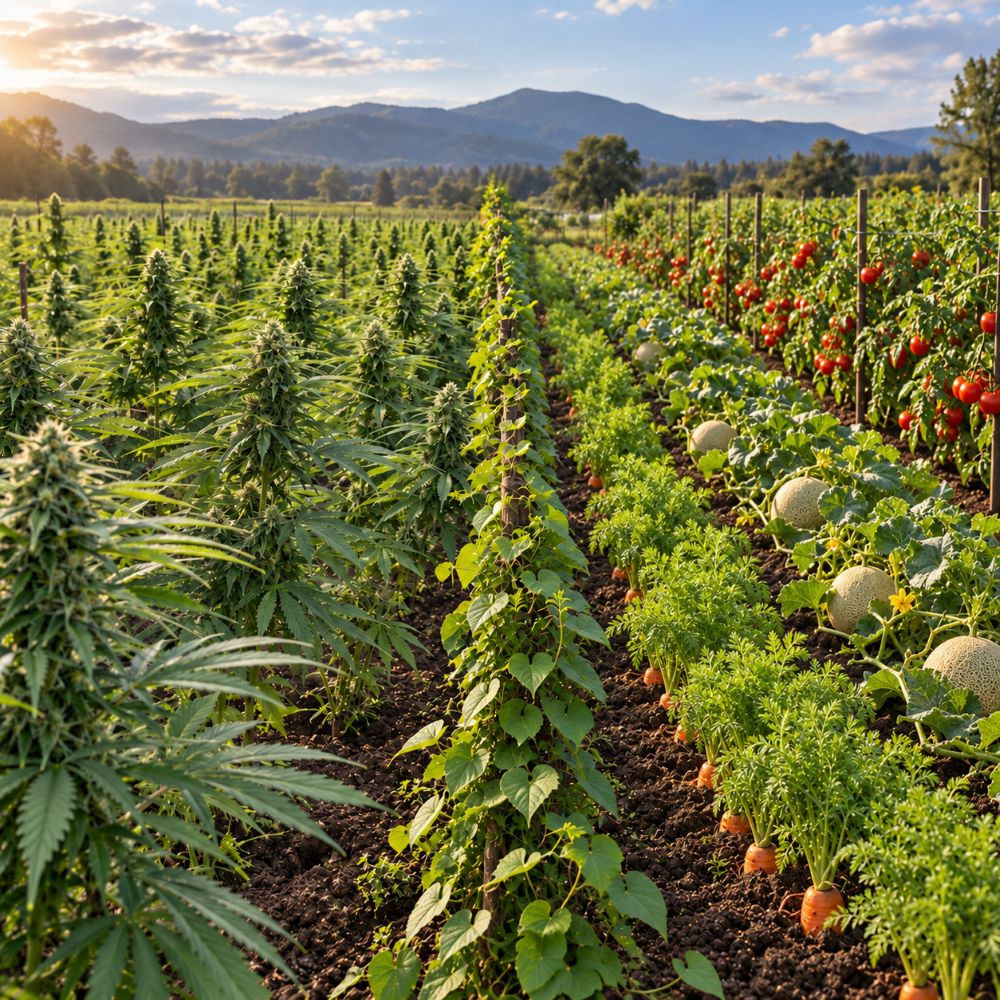
According to information released during 2025 and 2026, letters of intent have been signed with local farmers for a system in which farmers could grow cannabis while also producing food crops. The proposed model includes crop rotation, with cannabis cultivated on one plot and crops such as cucumber, watermelon and herbs grown on another, before the plots are rotated.
The concept also includes training, access to plant genetics, testing and processing support, purchase agreements for harvested cannabis and potential startup financing for qualifying farmers. Importantly, the plan has also included discussion of a farmers market focused on locally produced food.
That creates a very different agricultural proposition from simply licensing a few large cannabis farms. If implemented as described, cannabis income could help make farming financially attractive enough for growers to remain on the land while continuing to produce food.
Cannabis as the crop that helps pay for food farming
This may be where the strongest agricultural case for cannabis lies.
Food farming on a small island is difficult. Imported vegetables can arrive at prices local farmers struggle to match. Water and electricity are expensive. Land is limited. Equipment costs are high. Farmers also face inconsistent markets and the risk of losing crops to drought, heavy rainfall, pests or hurricanes.
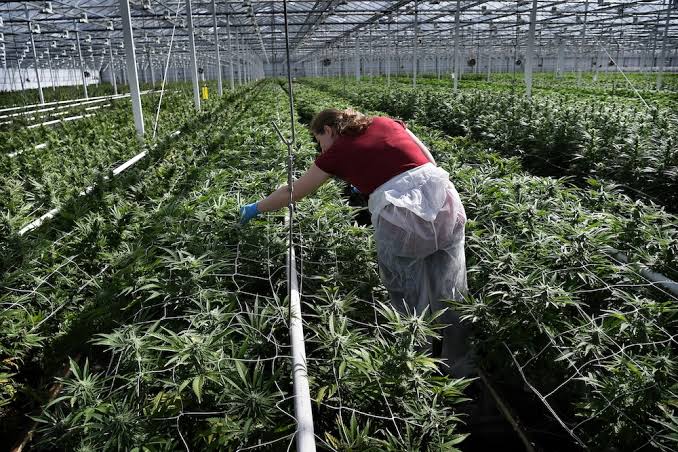
A higher-value crop can change that equation. If a farmer earns stronger returns from regulated cannabis, part of that income can support irrigation, equipment, workers, greenhouses and the cultivation of less profitable food crops. In that sense, cannabis does not necessarily have to compete with food. It could help finance it.
For St. Maarten, that is particularly relevant because the country has been trying for years to increase local food production while remaining heavily dependent on imports. The Agriculture Policy sets ambitious goals around food security and economic diversification, but those goals require farming to become commercially worthwhile. Cannabis could potentially provide that commercial engine.
The danger of getting it wrong
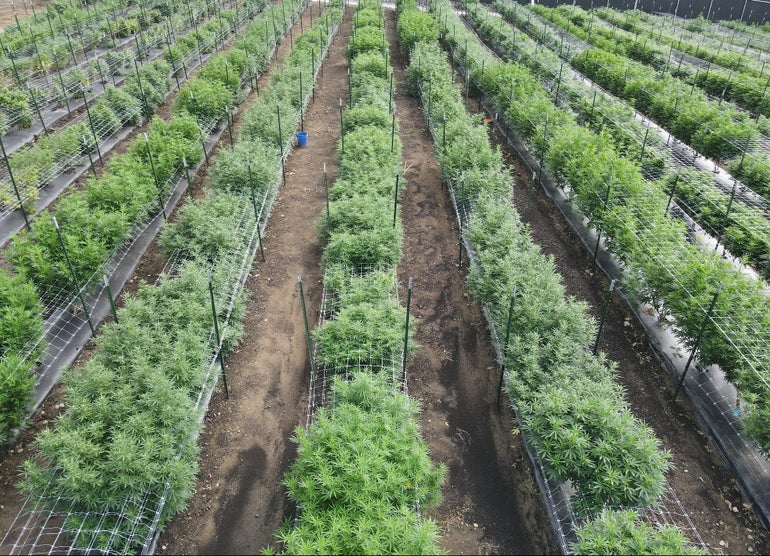
There is also a clear risk. If cannabis becomes significantly more profitable than vegetables, fruits and other crops, farmers may simply stop producing food and devote available land entirely to cannabis. That would undermine the very food-security goals policymakers say they want to achieve.
This is why the St. Maarten crop-rotation model deserves attention. It attempts to build food production directly into the cannabis farming structure instead of treating it as an optional side activity. Another danger is that small farmers could become spectators in an industry dominated by outside capital.
St. Vincent and Jamaica have already shown how difficult it can be for traditional farmers to meet licensing, security, testing and financing requirements. St. Maarten will therefore have to decide what local participation actually means. Does it mean local farmers owning and operating farms? Does it mean contract growing? Does it mean local processing? And how much of the value generated from the final product remains with the farmer?
Those questions are just as important as legalization itself.
Agriculture first
Cannabis is often discussed through the lenses of health, crime, tourism, taxation and personal use. But the agricultural angle may ultimately be one of the most important for the Caribbean. The region does not simply need another product to sell. It needs stronger farmers, more productive land, better food security and more young people who see agriculture as a viable career.
Cannabis could contribute to that, but only if governments resist the temptation to build the sector purely around licence fees, tourism or large investors. The opportunity, for St. Maarten, is to make cannabis part of a broader agricultural revival. That would mean using the crop to support local farmers, strengthen food production, create agricultural training, improve access to financing and build processing and market infrastructure.
The measure of success should therefore not simply be how much cannabis St. Maarten produces. It should also be whether more land is being farmed, whether local food production increases, whether farmers earn sustainable incomes and whether agriculture becomes more attractive to a new generation.
If those things happen, cannabis may prove useful not simply as a new industry, but as a tool to help rebuild Caribbean agriculture and, more specifically, St. Maarten's agriculture.