

Cannabis plan meets wall of questions in Parliament
.jpg)
GREAT BAY--Members of Parliament on Friday raised a wide range of questions and concerns during Parliament’s meeting on the cannabis framework presented by Native Nations St. Maarten, with several MPs stressing that major issues remain unresolved before any draft legislation can earn informed support in Parliament.
Across the discussion, MPs repeatedly called for greater clarity on the projected revenue figures, the legal and regulatory path forward, the expected public health burden, the role of financial institutions, the protection of local stakeholders, and the separation between those drafting the framework and those who may ultimately benefit from or help implement it. The overall message from the floor was that the cannabis debate must be approached with caution, transparency, and a full accounting of both the opportunities and the risks.
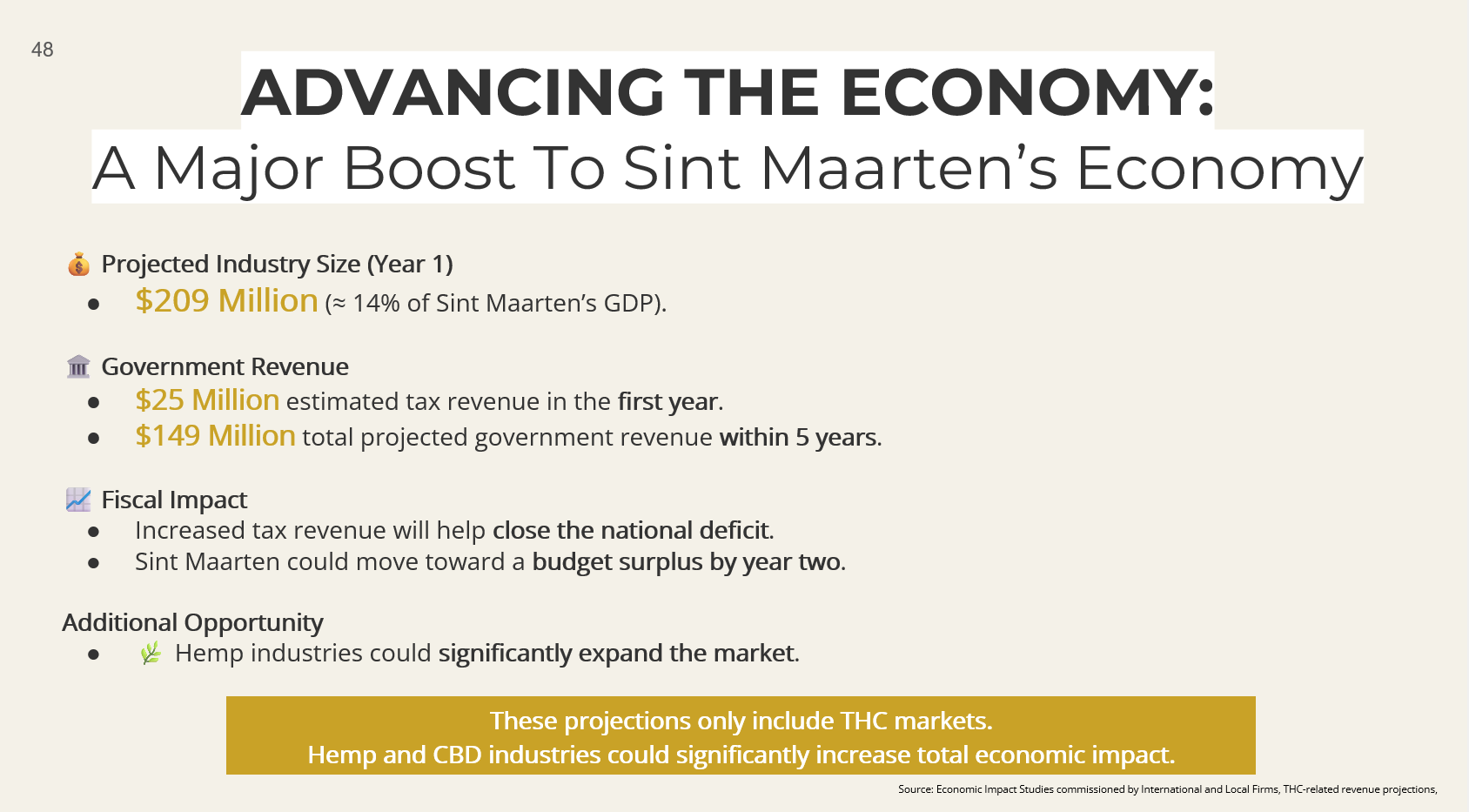
MP Viren Kotai was among the first to question the numerical projections presented. Referring to the projected $500 million over five years, he asked how those figures were calculated in relation to St. Maarten’s relatively small population and whether the assumptions were grounded in local consumption data or drawn from larger foreign jurisdictions.
Kotai noted that while St. Maarten benefits from strong visitor arrivals, with roughly 1.5 million cruise passengers and around 700,000 airport visitors annually, the numbers presented still required more explanation. He also asked what share of projected revenue would be expected to come from local consumption if the tourism component accounts for only part of the total. In addition, he sought clarification on the proposed land allocation for 19 farmers, whether that land has already been secured or would require government allocation, whether local farmers would be able to access export markets, and how the projected 47 licenses would be distributed.
MP Ardwell Irion, while making clear that he supports examining a regulated market in principle, cautioned that Parliament must not speak as though legalization is already settled before the underlying studies have been fully assessed. He reminded Parliament that the original RFP was meant to examine the economic, social, and health impacts of cannabis legalization, as well as medicinal, scientific, religious, and recreational dimensions of the issue.
Irion said those foundations matter because if the data ultimately show negative social, health, or economic consequences, then legislation should not move forward. He also stressed that the public deserves a full and honest discussion of the risks, including the possible burden on institutions dealing with substance abuse and mental health challenges.
He raised particular concern about the absence of detail on how government would support entities such as the Mental Health Foundation and Turning Point if cannabis-related harm increases. Referring to figures presented about possible adverse mental health outcomes, Irion said it is not enough to cite a percentage of the population that could be affected without also showing what that means in actual numbers, what those cases could cost, and how the country intends to support the institutions that would be expected to respond.
Irion also questioned whether St. Maarten is realistically positioned to succeed in areas such as export, pointing to Canada’s experience after legalization, where rapid expansion and overproduction drove prices down and export ambitions did not unfold as expected. He said those examples should be openly presented to the public so that expectations are grounded in reality rather than optimism alone.
Another major point raised by Irion was banking. He warned that if financial institutions remain reluctant to serve cannabis-related businesses, the island could end up with a legal framework that still operates largely in cash, creating the very type of blurred line between regulated and unregulated systems that lawmakers are supposed to avoid.

MP Darryl York also zeroed in on the financial assumptions behind the proposal, questioning the basis for projections that suggested $150 million in tax revenue over five years and an industry valued at more than $200 million annually. He asked whether those estimates were based on real local market data or extrapolated from foreign jurisdictions that may not be comparable to St. Maarten’s scale and profile.
York also sought clarification on claims that legalization could drive a 30 percent increase in tourism spending, asking which jurisdictions with a similar population size and tourism model had actually experienced that kind of result after regulating cannabis. He further pressed for answers on compliance risk, warning that Caribbean banks are already extremely sensitive to anti-money laundering and safety issues and that the presentation did not clearly establish what guarantees exist to shield the island from reputational or financial fallout.
He also questioned the proposed regulatory authority, asking who would appoint its members, what safeguards would exist against political interference, and how independent such a body would truly be from government.
On public health, York warned that if legalization leads to increased demand for addiction treatment or mental health services, Parliament must know which institutions will bear that burden and whether a long-term health cost analysis has already been done. Referring to the health-related projections presented, he said the country’s support institutions are already under strain, making it essential to understand what preparatory steps would be taken if demand rises.
York also asked whether the Mental Health Foundation and Turning Point had merely been consulted as stakeholders or were directly involved in the working groups shaping the proposal. He requested clarity on what feedback those institutions gave and how that feedback was incorporated into the framework. He further warned against market concentration, asking how the proposed model would prevent large investors from dominating the industry and leaving local farmers and entrepreneurs dependent rather than empowered, especially in cases where a guaranteed purchase arrangement appears to be envisioned.
MP Sjamira Roseburg said the meeting was important precisely because there is still so much that remains unclear. She said Parliament must be fully informed before any vote is taken and raised concern about the way the issue is being described publicly, particularly the distinction between fully legalizing cannabis and merely tolerating it under a controlled system.
Roseburg noted that the Netherlands is often described as tolerating cannabis rather than fully legalizing it, and said those terms must be used correctly so that the public understands what is actually being proposed for St. Maarten. She also questioned what exactly is now being legislated, what law is being amended, and how the process moved from stakeholder consultation and review into what appears to be an advanced legislative stage.
She also sought clarity on the composition and activity of the relevant committee or work group, including whether ministries such as VSA and Justice are actively involved and whether the prosecutor’s office has been consulted on the implications for enforcement. Roseburg further asked about exclusivity, importation, oversight, and whether any rights or advantages have already been granted to specific entities.
She stressed that the issue goes well beyond generating revenue for government and must be approached with particular sensitivity toward vulnerable groups, especially given that mental health and treatment institutions are already under pressure.
MP Sarah Wescot-Williams focused heavily on the process itself, saying her understanding of the 2022 RFP was that it was intended to create a legislative and regulatory trajectory for government, not necessarily to merge the drafting, proposing, and execution of the framework under one umbrella.
She said that in her view, the government first needed help to formulate a vision and chart a path, after which any approved framework should be implemented through a separate process. Wescot-Williams warned that combining those roles risks complicating the legislative trajectory and blurring lines that should remain distinct.
She pointed to the disclaimer in the original RFP, which stated that submitting a proposal did not guarantee work, consulting assignments, concessions, or any other benefit from government. Against that backdrop, she asked where Native Nations sees itself in the process today, what specific deliverables have been completed, whether the government apparatus is already substantively aligned with the proposal now before Legal Affairs, and whether the organization considers itself still in a proposal stage or effectively further along in implementation.

Wescot-Williams also requested more detail on the social and economic impact studies, including the identification of potential risks and pitfalls, saying Parliament needs a clearer understanding of where exactly the matter stands before draft legislation arrives.
MP Egbert Doran raised questions of a different kind, including how cannabis revenues would support sports and social causes, what results came from the survey mentioned publicly, and what role the Ministry of VSA played in the inter-ministerial process. He also asked what the island should expect after legalization in terms of crime, youth consumption, and quality control.
Doran noted that St. Maarten’s open border makes coordination with the French side especially relevant and asked whether France’s position on cannabis had been factored into the drafting process and whether discussions with French counterparts are planned. He also requested more information on the proposed land allocation for farmers and what expectations exist for production.
While Doran said he believes in regulation as a way of bringing order to an existing reality, he stressed that if stores eventually open under a legal system, the controls must be strict enough to protect the public from unsafe products and poor-quality doses.
MP Ludmila DeWeever said many of the questions raised during the meeting showed just how little information had been publicly available about the RFP and the broader process up to now. While acknowledging the work that had gone into the presentation, De Weever said she found it too heavily weighted toward economic benefits and not comprehensive enough on public health consequences.
She warned that St. Maarten’s healthcare system is already under pressure and that any serious cannabis framework must fully account for the burden that legalization could place on emergency departments, treatment services, and broader medical infrastructure. In her view, the presentation read more like a business plan for why the island should move toward legalization than a full regulatory framework grounded equally in health, finance, and enforcement realities.
De Weever also echoed concerns about overlap in roles, saying it was difficult to reconcile a process in which the same umbrella appears to be involved in helping shape legislation, presenting the business rationale, and engaging in community work. She said that kind of overlap raises questions about separation of powers and governance.
By the close of the meeting, one point had become unmistakably clear: while Parliament is now hearing much more about the cannabis proposal than it had in the past, many MPs remain unconvinced that the public has yet been given a complete picture. MPs repeatedly signaled that before any legislation reaches the floor, they expect clearer answers on economics, health, banking, regulatory independence, stakeholder involvement, and the exact legal path being proposed.
The meeting was ultimately adjourned to allow Native Nations and its representatives time to prepare answers to the questions raised, with additional written questions also expected to be submitted.