

Beyond the Check-In Counter: PJIA talks operations, moving 830,040 bags and its next stage of growth
.jpg)
GREAT BAY--Much of the public attention surrounding Princess Juliana International Airport is usually placed on passenger numbers, new routes and the familiar sight of a crowded terminal during the winter tourism season.
Less attention is given to the machinery behind those movements: baggage systems running continuously, ground handlers racing against departure times, airport teams coordinating aircraft turns, security personnel adjusting to heavier traffic and service providers responding to passengers who need additional assistance.
Between January and June 2026, Princess Juliana International Airport processed 830,040 pieces of checked baggage through its baggage-handling system.
That figure offers a different view of the scale of the airport’s operation. Every checked suitcase has to be accepted, screened, sorted, moved through the terminal, assigned to the correct flight and delivered within a limited window. On arrival, the entire process moves in reverse.
For an airport serving St. Maarten, neighbouring islands and a large tourism market, baggage is not a minor part of the passenger journey. It is one of the airport’s most demanding daily operations and one of the areas where delays or errors are immediately felt by travellers.
PJIA described the November 2025 to April 2026 high season as a successful period marked by strong passenger traffic and general operational stability. Final passenger-arrival figures requested by The People’s Tribune are still being compiled, but the airport’s operational account provides an early look at how it managed the season and where management intends to invest next.

What 830,040 bags represent
The baggage total covers the first six months of 2026, extending two months beyond the official high-season period reviewed by the airport. Even so, it captures the peak winter months and gives some indication of the pressure placed on the system.
Baggage handling is one of the less visible measurements of airport performance. A terminal may appear calm while thousands of individual items are moving behind walls, below counters and across the airside operation.
Each item passes through several hands and systems. Airlines and handling agents receive the luggage. Screening equipment checks it. The baggage system sorts and directs it. Ground crews move it to the aircraft. On arrival, teams unload it and send it to the correct reclaim belt.
The process becomes more complicated when flights are delayed, connections are short, baggage tags are damaged or passengers are transferring between airlines.
PJIA said its self-service check-in kiosks, automated bag-drop systems and enhanced passenger-processing facilities contributed to a smoother operation during the season. The airport also credited regular coordination among airlines, ground handlers, government authorities and operational teams for supporting baggage delivery, terminal flow and aircraft turnaround times.
It did not provide specific figures for baggage-delivery times, mishandled luggage or average aircraft turns. Those measurements would offer a deeper picture of performance, but the volume handled alone illustrates the scale of activity taking place beyond the public areas of the terminal.
High season required daily coordination
The airport said the heavier passenger volumes created increased operational demand, but those pressures were managed through advance planning, daily operational meetings and close communication among stakeholders.
Airport operations during a high season are rarely controlled by a single company. PJIA manages the facility, but the passenger experience also depends on airlines, immigration, customs, security, ground handlers, concessionaires, government ministries and companies providing specialised services.
A delay or shortage in one area can quickly affect the rest of the system.
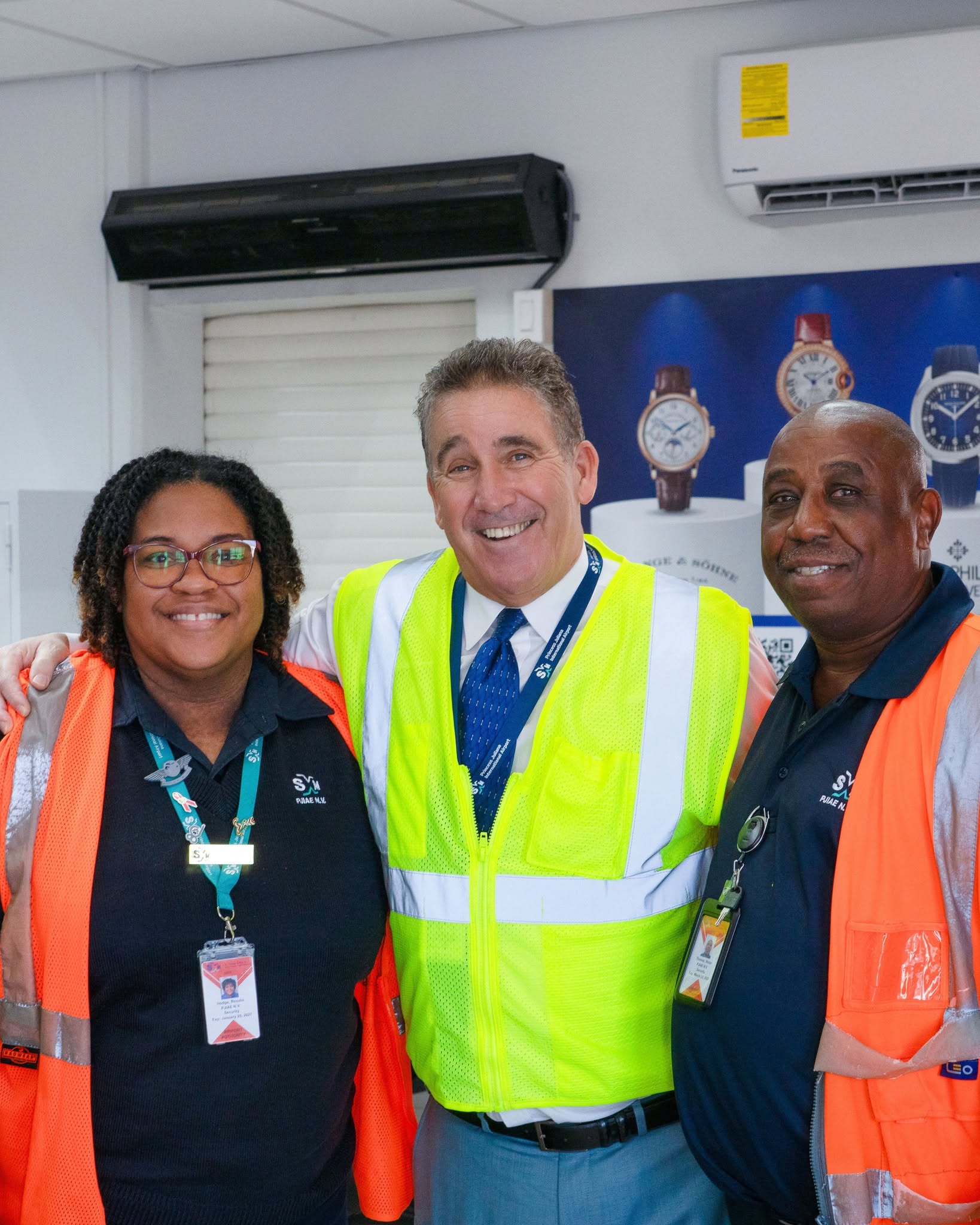
PJIA said its leadership maintained a visible presence inside the terminal throughout the season, engaging passengers and monitoring operations. This gave management an opportunity to identify problems while they were occurring rather than relying only on reports after the fact.
One area where demand noticeably increased was wheelchair assistance.
The airport said Connor’s Wheelchair Service and Accessible Ventures responded to the higher need for assistance during the season. This is another part of airport activity that can easily be overlooked but becomes increasingly important as passenger numbers grow and more travellers require mobility support.
The performance of those services can directly affect boarding times, connections and the overall dignity of the passenger experience.
PJIA also said it continued working closely with its airline partners, including home-based carrier Winair, to support reliable operations.
Expansion planning has already started
While the airport has only recently returned to full terminal operations following years of reconstruction and phased reopening, management is already looking at the next stage of development.
PJIA said it is working with architects and designers on expansion plans aimed at increasing capacity and preparing the airport for the future needs of St. Maarten and the wider region.
The airport did not disclose the size, design, cost or intended construction timeline of the expansion. It also did not specify whether the plans would involve new terminal space, additional gates, baggage facilities, passenger-processing areas or commercial development.
However, the fact that planning has started is significant. Airports cannot usually expand quickly in response to sudden demand. Design, financing, permits, procurement and construction can take years. Planning has to begin before the existing facility reaches its limit.
For PJIA, the challenge will be to expand without repeating a cycle in which infrastructure falls behind the growth of passenger traffic and airline activity.
Expansion also has to be considered in a regional context. PJIA is not only St. Maarten’s main international gateway. It also serves travellers connecting to several smaller islands, making its terminal capacity and transfer systems important beyond the country’s own borders.
Direct baggage transfers under consideration
One of the more practical improvements being explored is a direct baggage-transfer system.
At present, connecting through St. Maarten can require passengers on certain itineraries to collect their checked luggage and complete additional processing before continuing to another destination.
PJIA said it is examining direct baggage-transfer solutions that could simplify the journey and improve connectivity for travellers.
Such a system could be particularly important for passengers travelling onward to nearby islands. It could reduce the need to retrieve and recheck luggage, shorten transfer times and make St. Maarten a more attractive connecting point.
However, implementing direct transfers involves more than moving bags between aircraft.
It requires coordination among airlines, customs, immigration, security authorities, ground handlers and baggage-system operators. Different carriers may also use separate ticketing and handling arrangements, creating additional technical and legal requirements.
The airport did not indicate when a direct-transfer system might be introduced, but its inclusion in PJIA’s planning shows that management is looking at the passenger journey beyond arrival and departure from St. Maarten itself.
Airside infrastructure also needs attention
Passenger-facing improvements often receive the most public attention, but PJIA said it is also investing in the less visible infrastructure required to support aircraft operations.
This includes airside support systems, hardstands and continued asphalt maintenance.
Hardstands are areas where aircraft can park away from the terminal. They are particularly important when gate space is limited or several flights arrive within a short period.
Maintaining airside pavement is equally critical. Aircraft place enormous weight and repeated stress on runways, taxiways and parking areas. Deterioration cannot be handled in the same way as an ordinary road because loose material or surface failures can create serious safety risks.
These investments may not change the appearance of the terminal, but they directly affect how many aircraft the airport can accommodate and how reliably those movements can be managed.

Building the workforce before the next peak
Preparation for the next high season is already underway.
PJIA said it has recruited new employees across several departments over the past few months, including additional Airport Security personnel.
The expansion of the security workforce is particularly relevant during peak travel periods, when additional passenger screening and terminal activity can quickly create congestion.
The airport is also continuing staff training, operational planning and customer-service initiatives.
PJIA said its preparations involve ongoing coordination with the Ministry of Tourism, Economic Affairs, Transport and Telecommunication, the Ministry of Justice and the Department of Civil Aviation.
This coordination is essential because many of the services passengers associate with “the airport” are handled by different organisations operating within the same building.
Immigration processing, customs, security, airline check-in and baggage handling all have separate responsibilities. The airport’s ability to move people efficiently depends on whether those organisations are prepared for the same traffic levels at the same time.
More use of technology
PJIA also plans to continue building on the technologies already operating in the terminal. These include self-service check-in, automated bag drop and electronic border-control gates. The airport said it intends to continue optimising passenger processing in cooperation with its operational partners.
Technology can reduce some pressure on check-in counters and immigration lines, but only when passengers understand how to use it and when enough staff remain available to assist travellers who cannot complete the process independently.
The systems also have to be reliable during the busiest periods. A technology failure during a peak departure window can create a larger disruption than the slower manual process it was intended to replace.
The airport’s next challenge will therefore be not only to install technology but to integrate it into daily operations in a way that genuinely shortens the passenger journey.
The FBO market is growing
PJIA also reported increasing activity at its new Fixed Base Operator facility, operated by Signature Aviation and Atlantic Aviation.
An FBO serves private and business aircraft, offering services that can include aircraft handling, passenger reception, fueling coordination, crew support and ground transportation.
Growth in this area strengthens PJIA’s position in the private-aviation market, particularly during the Caribbean’s peak tourism and yachting seasons.
Private aviation can generate significant value for the airport and wider economy, although its operational needs differ considerably from those of commercial carriers.
As the FBO business expands, PJIA will have to balance private aircraft activity with gate, apron and airspace demands from scheduled airlines.
South America is part of the growth strategy
The airport is also examining opportunities to expand connectivity with South America.
PJIA did not identify specific countries, cities or airlines under consideration, but said potential services would complement the existing route network and support sustainable growth.
New South American routes could diversify the airport’s passenger base and reduce some dependence on its traditional North American and European markets.
They could also strengthen St. Maarten’s position as a connection point between the Caribbean and the South American mainland.
However, route development depends on more than available terminal space. Airlines will consider demand, operating costs, aircraft availability, bilateral air-service arrangements and the ability to sustain traffic beyond an initial launch period.
The airport said any new services would be aligned with established peak travel patterns.
For now, the airport’s response shows that its focus is moving beyond rebuilding. The next phase is about preparing for growth, improving transfers, strengthening the workforce and expanding the systems that operate behind the terminal’s public face.
As PJIA prepares for another high season and begins planning its future expansion, those behind-the-scenes systems may be just as important as the size of the terminal itself.