

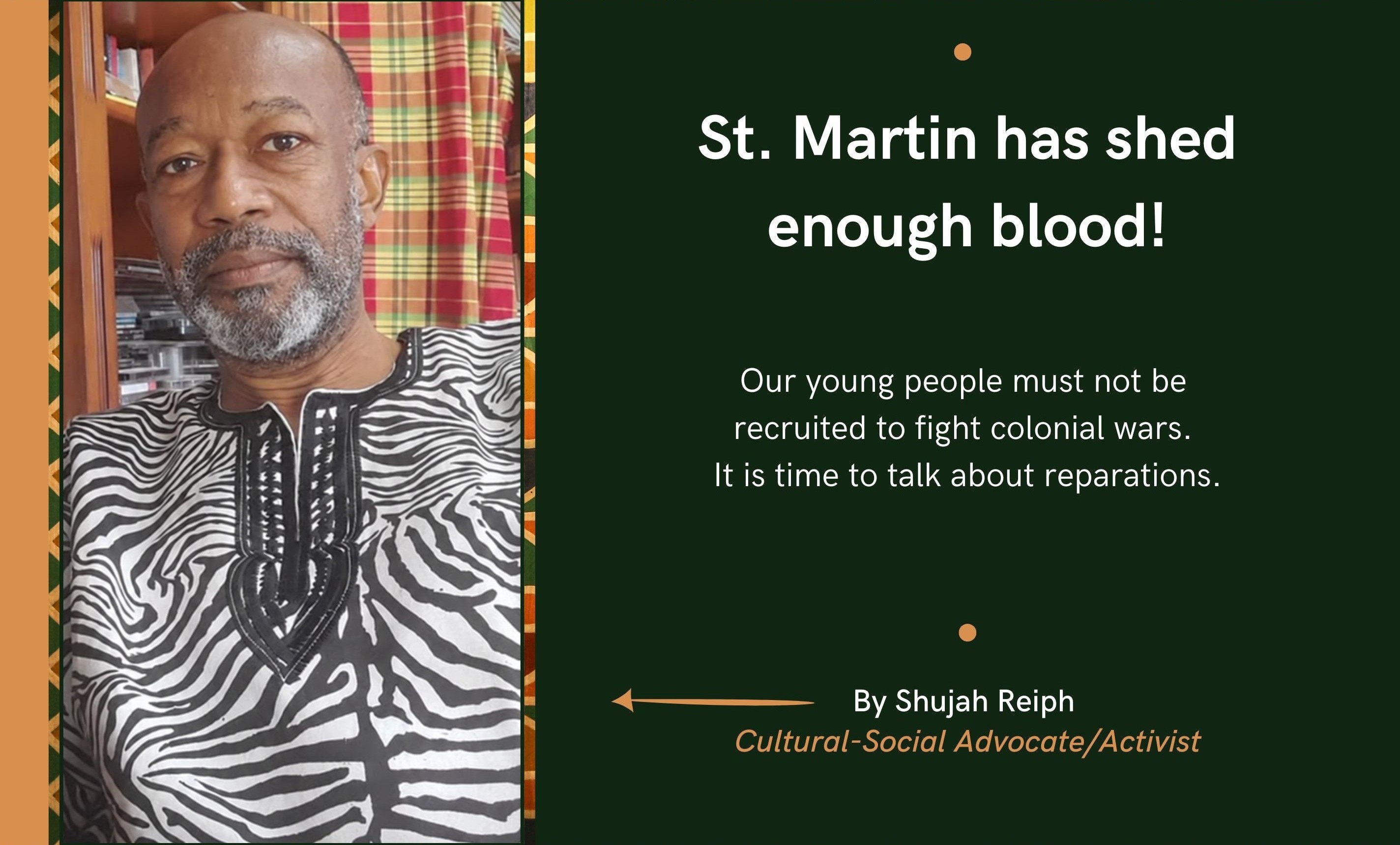
St. Martin has shed enough blood!
For nearly 400 years, the people of St. Martin and their ancestors have lived with the consequences of European colonization. Our history is marked by slavery, forced labor, exploitation, resistance, and the struggle for freedom and human dignity. Generations of our ancestors suffered under colonial systems that denied them basic human rights, while the wealth created through their labor contributed to the prosperity of colonial powers. Today, as discussions emerge about new Dutch military service proposals and the possibility of compulsory military call-ups, we must ask a fundamental question: After everything our ancestors endured, is it now the responsibility of our young people to prepare themselves to fight in wars determined by the same colonial system that shaped our past?
My answer is clear: our young people deserve the freedom to determine their own future. We have shed enough blood. We have endured enough suffering. We have inherited enough historical injustice. It is time to stop talking about preparing our young people for war and start talking about repairing the damage caused by centuries of colonialism.
Our ancestors fought for freedom, not for another generation of war
When we speak about the history of St. Martin, we must remember the countless African men, women, and children who were brought to this island under the evil system of transatlantic slavery. They were denied their freedom, separated from their families, forced to work, and subjected to violence under colonial rule. Their labor sustained plantations and generated wealth for others, while they were deprived of the rights and opportunities that should have belonged to every human being. Our ancestors resisted this oppression in different ways. Some rebelled, some escaped, some fought against the system, and others struggled to preserve their families, traditions, and humanity under unbearable conditions.
We must also remember that the history of our island did not end with emancipation. The abolition of slavery did not automatically eliminate economic inequality, colonial dependency, or the structural disadvantages inherited by subsequent generations. These consequences remain important subjects for historical investigation, public discussion, and reparatory justice. And now, in the twenty-first century, we are confronted with discussions about military service and the possibility that young people could eventually face compulsory military obligations. We must ask ourselves whether this is the future we want for St. Martin. Must our young people continue to inherit the burdens of colonial history, or can we finally begin building a future based on freedom, dignity, peace, and self-determination?
The Dutch military service proposal: our young people deserve better than to dumped on the battlefield
The Netherlands is developing a new military service model intended to expand its armed forces. The proposed approach begins with voluntary participation but includes progressively more compulsory measures, with selective compulsory call-up being considered as a possible last resort under certain circumstances. The Dutch government has indicated that legislation would be needed before compulsory elements could be introduced. Whether and how these proposals could affect young people in St. Martin remains a matter requiring clear legal and political clarification. This uncertainty makes public discussion essential, and we must not wait until decisions have been made before asking questions about the future of our young people.
What legal authority would be required to impose military obligations on residents of St. Martin? What role would our elected representatives play? Would our people be consulted? Would the views of our youth be taken seriously? And who would decide whether our young people should be placed in situations involving armed conflict? These are legitimate questions that deserve clear answers. Our position must be that no military obligation should be imposed on the people of St. Martin without proper democratic debate, meaningful consultation, and respect for our constitutional position and fundamental rights.
Our young people have ambitions beyond the battlefield. They want access to higher education, professional training, meaningful employment, affordable housing, economic opportunities, and the freedom to build families and communities in which they can prosper. They want to become teachers, doctors, engineers, entrepreneurs, artists, historians, scientists, and leaders. They should not have to fear that their future will be determined by military policies over which they have little or no meaningful influence. We should be investing in their potential, not preparing them to become casualties of wars they did not choose.
We are not interested in fighting another generation of colonial wars
For centuries, European powers pursued their interests through colonial expansion, competition for territory, control of trade, and military force. Caribbean people lived with the consequences of these struggles, even when they had little control over the decisions being made. Today, our circumstances are different, but the questions of power, responsibility, and democratic consent remain relevant. Why should our young people be expected to place their lives at risk for military objectives determined elsewhere, while the historical consequences of colonialism still demand attention? Why should military recruitment become a priority when we must continue addressing educational inequalities, economic vulnerability, the preservation of our heritage, and the long-term development of our people?
Why should we be discussing the possibility of sending our youth into military service before having a serious public conversation about the historical injustices that continue to shape our society? St. Martin must have the right to discuss peace, neutrality, security, self-determination, and reparatory justice, not the Dutch colonial military policy. Our young people are not simply manpower for somebody else's military strategy. They are human beings with rights, aspirations, responsibilities, and futures of their own. If governments can develop plans for military recruitment, they can also participate in serious discussions about historical accountability and reparatory justice.
These to us are more serious matters, and reparations must be pursued on their own historical, legal, moral, and political merits. Nevertheless, our priorities deserve examination. For St. Martin, the conversation about reparations should include both France and the Netherlands, taking into account their respective histories and responsibilities on the island. It should examine the consequences of slavery, the economic benefits derived from enslaved labor, the loss of land and opportunities, and the social and economic inequalities that developed under colonial rule. It should also consider what concrete measures could help repair the harm.
Our young people deserve better opportunities, not an inheritance of war
Imagine what St. Martin could achieve if the energy currently being directed towards military readiness were matched by a comparable commitment to the education and development of our youth. Imagine a comprehensive scholarship program that allowed every qualified young person to pursue higher education without being held back by a failing outdated educational system. Imagine greater investment in technical education, digital innovation, agriculture, renewable energy, cultural industries, and local entrepreneurship. Imagine our young people being equipped with the skills and resources to build businesses, conduct historical research, create jobs, and develop solutions to the challenges facing our island.
If we restructure and develop our university with a vision for the 21st century, this could be achieved with the young brilliant minds we have on this island. Imagine a generation that knows its history, understands its rights, and has the confidence to participate in determining its own future. That is the kind of future we should be discussing. Our young people should not be made to feel that military service is the highest expression of citizenship. Citizenship can also mean serving your community as a teacher, creative artist, caring for the sick, protecting the environment, preserving cultural heritage, developing new technologies, or helping to build a stronger economy. There are many ways to serve humanity without preparing to kill or die in a war.
Conclusion: enough blood has been shed
For nearly four centuries, the history of St. Martin has been shaped by colonial power and its consequences. Our ancestors endured slavery, exploitation, and the denial of their freedom. Their lives, labor, resistance, and sacrifices helped shape the island we call home today. Their suffering must never be forgotten. But remembrance alone is not enough. We owe it to those who came before us to preserve their history, tell the truth about what happened, and work towards a future in which the descendants of the enslaved enjoy the freedom, dignity, and opportunities that were denied to earlier generations.
We cannot bring back the lives that were lost. We cannot erase the suffering of those who endured slavery. But we can demand recognition, accountability, and meaningful action to address the consequences of that history. And we can insist that the future of our young people must not be dictated without their voices being heard. To the Dutch government, our message should be clear: before discussing how the young people of St. Martin might be called upon to serve in your armed forces, let us have a serious conversation about the historical injustices that remain unaddressed.
No more colonial wars. No more treating our young people as instruments of military policy. Let us talk about reparations. Let us talk about justice. Let us talk about repairing the damage and mess you created for centuries. St. Martin has shed enough blood. It is time for reparatory justice!
By Shujah Reiph