

Human Rights, Colonialism, and Self-Determination in St. Maarten
.jpg)
𝘛𝘩𝘦 𝘧𝘰𝘭𝘭𝘰𝘸𝘪𝘯𝘨 𝘢𝘥𝘥𝘳𝘦𝘴𝘴 𝘸𝘢𝘴 𝘱𝘳𝘦𝘴𝘦𝘯𝘵𝘦𝘥 𝘢𝘵 𝘵𝘩𝘦 𝘉𝘢𝘬𝘶 𝘐𝘯𝘪𝘵𝘪𝘢𝘵𝘪𝘷𝘦 𝘎𝘳𝘰𝘶𝘱 𝘊𝘰𝘯𝘧𝘦𝘳𝘦𝘯𝘤𝘦, “𝘙𝘪𝘨𝘩𝘵 𝘰𝘧 𝘙𝘦𝘵𝘶𝘳𝘯 𝘢𝘯𝘥 𝘚𝘦𝘭𝘧-𝘋𝘦𝘵𝘦𝘳𝘮𝘪𝘯𝘢𝘵𝘪𝘰𝘯: 𝘋𝘰𝘶𝘣𝘭𝘦 𝘚𝘵𝘢𝘯𝘥𝘢𝘳𝘥𝘴 𝘢𝘯𝘥 𝘚𝘦𝘭𝘦𝘤𝘵𝘪𝘷𝘦 𝘈𝘱𝘱𝘳𝘰𝘢𝘤𝘩𝘦𝘴,” 𝘩𝘦𝘭𝘥 𝘰𝘯 𝘑𝘶𝘯𝘦 24, 2026, 𝘢𝘵 𝘵𝘩𝘦 𝘜𝘯𝘪𝘵𝘦𝘥 𝘚𝘵𝘢𝘵𝘦𝘴 𝘊𝘰𝘯𝘨𝘳𝘦𝘴𝘴 𝘰𝘯 𝘊𝘢𝘱𝘪𝘵𝘰𝘭 𝘏𝘪𝘭𝘭, 𝘪𝘯𝘴𝘪𝘥𝘦 𝘵𝘩𝘦 𝘒𝘦𝘯𝘯𝘦𝘥𝘺 𝘊𝘢𝘶𝘤𝘶𝘴 𝘙𝘰𝘰𝘮 𝘰𝘧 𝘵𝘩𝘦 𝘙𝘶𝘴𝘴𝘦𝘭𝘭 𝘚𝘦𝘯𝘢𝘵𝘦 𝘖𝘧𝘧𝘪𝘤𝘦 𝘉𝘶𝘪𝘭𝘥𝘪𝘯𝘨.
Honorable Chair, distinguished delegates, and fellow representatives,
Today, I will address the relationship between human rights, colonialism, and self-determination in St. Maarten.
While colonialism is often regarded as a historical phenomenon, its impacts continue to shape political institutions, economic opportunities, and the enjoyment of human rights in many territories worldwide. St. Maarten provides a relevant example of how colonial legacies remain pertinent to contemporary discussions within the United Nations.
Historical Background
St. Maarten has been influenced by centuries of European colonial administration.
Since the signing of the Treaty of Concordia in 1648, the island has been divided between French and Dutch jurisdiction. During the colonial period, enslaved Africans were brought to the island and subjected to conditions that violated fundamental human rights, including freedom, equality, and human dignity.
The legacy of slavery and colonial governance continues to affect social and economic structures today.
Colonialism and Human Rights
Colonialism is not solely a historical matter; it also has significant human rights dimensions.
The principles enshrined in the Universal Declaration of Human Rights affirm that all peoples are entitled to dignity, equality, and participation in decisions affecting their future.
Under colonial systems, local populations frequently lacked:
• Political representation.
• Control over their resources.
• The ability to determine their own future.
• Equal treatment within systems established by colonial powers.
These issues remain central to contemporary discussions on decolonization.
St. Maarten’s Relationship with the Netherlands
Today, St. Maarten is a constituent country within the Kingdom of the Netherlands.
While St. Maarten maintains its own government and parliament, certain responsibilities remain at the Kingdom level, including defense, nationality, and aspects of governance.
Supporters of the current constitutional arrangement contend that it contributes to economic stability, security, and international support.
Others, however, maintain that the continuing role of the Netherlands raises questions regarding the full realization of self-determination and political autonomy.
The discussion focuses on whether the people of St. Maarten exercise sufficient authority over decisions that directly affect their future.
Hurricane Irma and Questions of External Authority
Following Hurricane Irma in 2017, which devastated much of St. Maarten, the Kingdom of the Netherlands provided significant financial assistance for reconstruction.
However, the assistance was accompanied by conditions that generated debate within St. Maarten regarding autonomy and self-determination.
The Netherlands required the establishment of the Integrity Chamber, an anti-corruption oversight body, as a condition for access to reconstruction funds. Some leaders in St. Maarten argued that these conditions represented an external influence over local governance and decision-making.
Additional concerns were raised regarding:
• The management and oversight of reconstruction funds.
• The role of Dutch institutions in supervising recovery efforts.
• The extent to which local authorities could independently determine reconstruction priorities.
• The balance between financial assistance and political autonomy.
Supporters of the Dutch position argued that oversight mechanisms were necessary to ensure transparency, accountability, and the effective use of public funds.
Critics argued that the conditions demonstrated an unequal power relationship in which St. Maarten had limited ability to negotiate due to its dependence on external aid following a humanitarian disaster.
This debate highlights a broader question often discussed at the United Nations: Can a people fully exercise their right to self-determination when critical economic and political decisions remain subject to approval by another governing authority?
The Role of the CFT in St. Maarten’s Budget Process: Oversight, Accountability, and Autonomy
The Board of Financial Supervision Curaçao and St. Maarten (CFT) occupies a unique position within St. Maarten’s public finance framework. Established under the Kingdom Act on Financial Supervision, Rijkswet Financieel Toezicht, Rft, the CFT reviews draft and adopted budgets, monitors budget execution, advises on borrowing, and reports to the Kingdom Council of Ministers when fiscal standards are not met.
Supporters argue that the CFT has been essential in promoting fiscal discipline, protecting public finances, and ensuring that St. Maarten maintains access to affordable financing. Critics contend that the CFT limits policy flexibility and can be perceived as reducing the country’s fiscal autonomy. This paper examines both perspectives and proposes a future-oriented approach that balances accountability with self-governance.
1. Background
Following the constitutional reforms of 10 October 2010, Curaçao and St. Maarten became autonomous countries within the Kingdom of the Netherlands. Given concerns regarding fiscal sustainability, the Kingdom Act on Financial Supervision established an independent supervisory mechanism: the CFT.
The CFT’s mandate is not to govern St. Maarten’s finances directly. Rather, it assesses whether budgets, amendments, loans, and financial reports comply with the fiscal norms established in the Kingdom Act. It serves primarily as an advisory and monitoring institution.
2. What Does the CFT Actually Do?
The CFT performs five principal functions:
A. Review of Draft Budgets
Before a national budget is submitted to Parliament, the Government must submit it to the CFT for review under Article 11 of the Kingdom Act. The CFT evaluates whether:
• Revenues are realistic.
• Expenditures are properly funded.
• The budget is balanced or sustainable.
• Borrowing complies with legal requirements.
B. Review of Adopted Budgets
After Parliament approves a budget, the adopted budget is returned to the CFT for further assessment. The CFT may issue recommendations or identify concerns regarding compliance with fiscal standards.
C. Monitoring Budget Execution
The CFT reviews quarterly and annual financial reports to determine whether actual spending and revenue collection align with approved budgets.
D. Oversight of Borrowing
St. Maarten cannot simply borrow funds on international markets at will. The CFT evaluates loan requests and advises whether borrowing is consistent with the Kingdom Act. This function is especially important for capital investment projects.
E. Reporting to the Kingdom Council of Ministers
When St. Maarten fails to meet statutory requirements, such as adopting a budget on time, the CFT may report the matter to the Kingdom Council of Ministers.
3. Contributions of the CFT
The strongest argument in favor of the CFT is that it imposes discipline on public finances.
Without an independent reviewer, governments may be tempted to:
• Overestimate revenues.
• Underestimate expenditures.
• Expand borrowing beyond sustainable levels.
• Delay difficult fiscal decisions.
The CFT provides an external check against these risks.
Protection of Future Generations
Persistent deficits create debt burdens that future taxpayer must bear. By requiring fiscal sustainability, the CFT seeks to prevent the accumulation of unsustainable debt.
Access to Financing
Compliance with the Kingdom Act enables St. Maarten to access financing under favorable conditions. In recent years, CFT approval has been necessary for capital investment loans.
Improved Financial Management
The CFT has consistently advocated for:
• Timely budgets.
• Accurate annual accounts.
• Better financial reporting.
• Stronger internal controls.
These are fundamental requirements of good governance.
4. Criticisms of the CFT
Perceived Limitation of Autonomy
Critics argue that an autonomous country should have greater freedom to determine its own fiscal priorities.
From this perspective, external supervision may be viewed as inconsistent with the principle of self-government. Some view the CFT as a mechanism through which Dutch influence is exercised over local policy decisions.
A precise year-by-year debt series for St. Maarten is difficult because government publications have not consistently published historical debt tables in one place. However, using CFT reports, Ministry of Finance statements, and GDP data, the following timeline provides a reasonable picture of how the country’s debt evolved after 10/10/10.
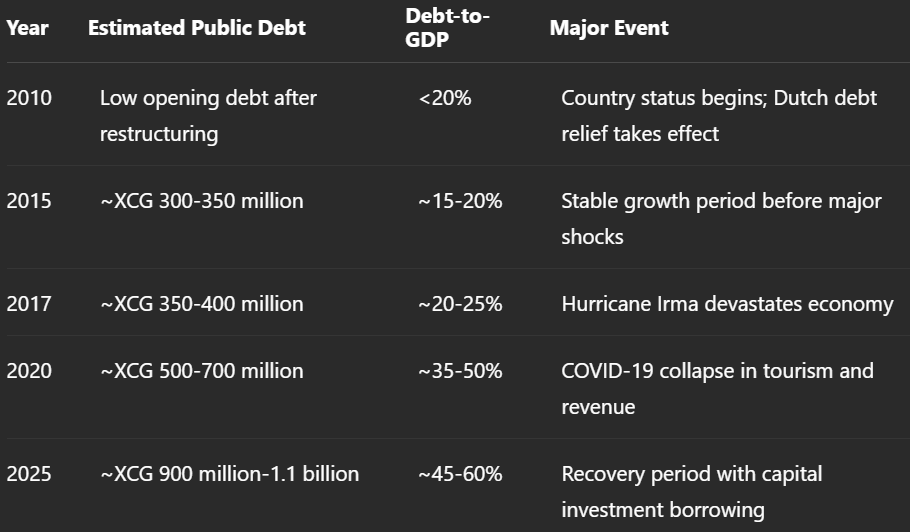
As of the latest figures available from the CFT, St. Maarten’s public debt stood at approximately XCG 1.44 billion, ANG 1.44 billion, at the end of 2025. The CFT reported a debt-to-GDP ratio of about 45%.
Who does St. Maarten owe?
The largest creditor is overwhelmingly the Kingdom of the Netherlands, through various loan arrangements.
1. Government of the Netherlands
Most of St. Maarten’s debt consists of:
• Long-term capital loans obtained through the Kingdom financing mechanism, “lopende inschrijving”.
• Refinanced loans dating back to the 2010 constitutional transition.
• Infrastructure and capital investment loans.
• Liquidity support loans following Hurricane Irma.
An important point
Unlike many Caribbean countries that borrow heavily from:
• the IMF,
• World Bank,
• commercial banks, or
• international bond markets,
St. Maarten’s debt is largely owed to the Dutch State, generally at much more favorable interest rates than would be available on the open market. This has kept debt-service costs relatively manageable despite the increase in total debt since Hurricane Irma and COVID-19.
Self-Determination as a Human Right
The United Nations recognizes self-determination as a fundamental human right.
Self-determination refers to the right of peoples to freely determine their political status and pursue their economic, social, and cultural development.
For some residents of St. Maarten, this gives rise to important questions:
• Should the current constitutional relationship continue?
• Should greater autonomy be granted?
• What role should the people play in determining the island’s future?
• Why a meaningful discussion on independence have yet to be proposed?
These are not solely political questions; they also concern the realization of human rights. We must ask the question: What is the significant of maintaining colonies in this 21st century, year 2026, then just to maintain your control of a different race of people.
The Role of the United Nations
The United Nations has long supported decolonization processes worldwide.
The United Nations promotes:
• Respect for self-determination.
• Protection of human rights.
• Democratic participation.
• Equality among peoples and nations.
The case of St. Maarten underscores the importance of continued dialogue on how historical colonial relationships influence contemporary governance and human rights.
Conclusion
Distinguished delegates,
The history of St. Maarten illustrates that colonialism and human rights remain closely interconnected.
Although substantial progress has been achieved since the era of slavery and direct colonial rule, questions relating to self-determination, political autonomy, and equality continue to be examined.
The responsibility of the international community is to ensure that all peoples, regardless of size or status, are able to fully exercise their human rights and freely determine their future.
Thank you.