

Captain Pete The Pelican
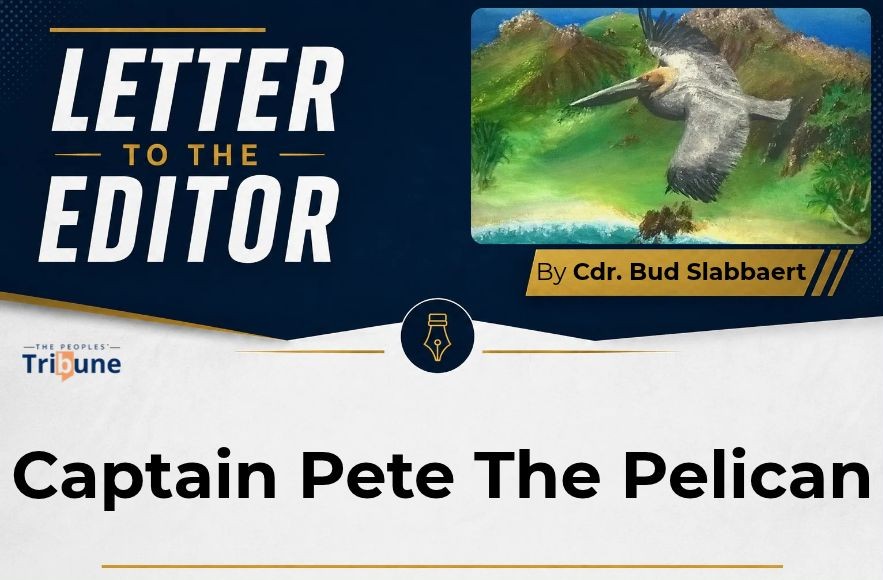
Somewhere between the blue of the sky and the turquoise of the sea, where the trade winds whisper stories and the waves keep secrets, there flies a bird unlike any other. He is a pelican by the name of Pete. When seeing Pete fly, it looks like there goes someone who knows where he is going.
His wings are wide, his beak is enormous. But, don't judge a bird by its beak. Judge it by what it does with it! Among pelicans, the bird with the biggest beak isn't inevitably considered a leader. They follow the bird who knows where the fish are. So far, this system has worked reasonably well. In life, there are leaders who lead a flock, and leaders who prefer to fly ahead so that everyone can see them. If a pelican behaved like one of those, the flock of fellow pelicans might soon discover that he had been eating all the fish himself.
Pelican Pete knows the islands, the reefs, the fishing grounds and the hidden corners of the Caribbean better than most islanders know their own backyards. He has spent many years flying over Caribbean islands, observing the curious activities of the creatures who call themselves human beings. His opinion of human behavior is occasionally rather outspoken.
Among those who know him, he is called Captain Pete, Commander of the Pelican Coast Guard and Guardian of the Caribbean Waters; unofficial observer of everything that happens on the island. After all, somebody ought to keep an eye on things. From his elevated position, he witnesses human ambition, generosity, vanity, ingenuity, foolishness, courage and an extraordinary capacity for making simple things complicated.
Pelican Pete is a bird who has made the sky his observation post. What fascinates him is what he sees below. Sometimes people doing things that make absolutely no sense to a sensible pelican. If you listen carefully when the wind is right, you might just hear him say: "Ahoy down there! Captain Pete here, reporting. I've been watching you humans. And believe me, there's never a dull moment! Up here, I can see the whole island. Down there, everybody seems to see only their own little corner."
Pete challenges the peculiar habits and assumptions of humans. He has discovered that wisdom is not necessarily about flying higher, but about seeing things from a different perspective. He always keeps in mind something his pelican mother once told him: “You don't have to be the biggest bird to make the biggest difference."
And Pete’s point of view: “I've been fishing these waters for years. I may not understand everything humans do, but I know one thing: you shouldn't destroy the pond you depend on for fish. By the feathers of my ancestors, I don't need a pelican committee to tell me the water is dirty."
Pete does like people, although he sometimes finds them difficult to understand. A pelican has no interest in becoming famous, rich or powerful. Pete already has the Caribbean sky. Perhaps his greatest advantage is that he can observe humanity without having to participate in its peculiar competition for importance. He finds humans strange. They spend half their lives climbing ladders, and the other half arguing about who is standing on the highest rung. Pete has never seen a pelican do that. They simply find a good wind updraft.
When people see a pelican flying past, they often experience something rather different from seeing an ordinary bird. There is something almost theatrical about a pelican in flight. Freedom. A pelican soaring effortlessly over the sea is a picture of independence, open horizons and freedom from earthly concerns. They wonder what the island looks like from a Pelican’s view. He probably knows a few things the rest of us haven't figured out yet.
He looks like he owns the sky! Yet, the sky belongs to nobody. You don't have to agree with another bird to share the same sky. You are free to fly wherever the wind takes you, provided there is somewhere to land and something to eat.
Captain Pete patrols the Caribbean waters. He feels responsible. "I am a seasoned observer of the Caribbean. These waters have given us life. The least we can do is look after them. The sea doesn't belong to those who take the most from it, but to those who take care of it. Nature doesn't send invoices. It simply sends consequences. Humans call the sea a resource. A pelican like me calls it home.”
Pete is not a cynic. He rather likes humans. He admires their ability to accomplish remarkable things. The world below is endlessly fascinating. He has witnessed acts that made even a pelican pause in mid-flight. Humans are remarkably clever at inventing solutions to problems they were equally clever at creating. Perhaps the world isn't quite as complicated as humans have made it. Perhaps they have simply forgotten how to see it.
So, if you happen to see a large pelican gliding effortlessly above the sea, don't assume he is merely looking for fish. He may be watching you. And if you ever wonder what he is thinking, remember that he has spent years observing humanity from a perspective most humans never experience. He might just have noticed something you haven't. After all, a different point of view can make the whole world look rather different.
The Pelican in the Caribbean is often used as historical symbol or even a National Bird as part of its national identity. One should learn something from it as it could represent a philosophy. The most useful purpose of a national symbol is not merely to represent a country, but occasionally to remind its people of what they ought to stand for.