

26 stone steps to eternity: The Colombier Heritage Village Experience
.jpg)
The conchshell welcomes you like the deep resonant sound of the foghorn of a ship about to leave port. It is blown by a young beautiful lady in a colorful period costume that could have been a festive wear froma turn of the century Colombier.
The drive from Betty’s Estate on a Thursday morning was quite uneventful. The usual school hour traffic along the L.B. Scot Road no longer severely tested my nerves as it used to, partly because I had resigned myself to the snail-like crawl interspersed with sudden gasps of OMG at a near miss by a scooter rider meandering in between cars without a helmet.
I do not remember exactly how many cruise ships were in port that morning - four, probably five - but it didn’t matter because cruise ship or no cruise ship, traffic had become a nightmare which nobody could escape from, except those with sirens. And there were a few of them that morning, none looking like First Responder vehicles.
I glanced at my watch. There’s no way I would make it to Colombier on time. But miraculously, I found myself half an hour after Colebay on the narrow entrance to this region of the island famous for its ram goat festival and arrow root traditions. Reputed to be the “greenest” part of St. Martin, it sits at a basin that collects the largest amount of rainfall on the island.
Quaint, even cute, the drive along the only road in and out of the village was picturesque with rock walls reminding one that the sweat, blood and tears of our ancestors must have been mixed with the rain water which cascaded in rivulets from the ring of hills that encircled the village.
At the end of the road was Clara Reyes - bare-footed, full of energy and excitement and smiles. The artistic brain behind this beautiful project, she met us with apologies for a short delay before our tour got off to the conch-shell start.
Kyara, our guide, prepared us for the climb. We were approaching haloed grounds and should show some reverence for the ancestral spirits that inspired this project.
There were twenty-six stone steps leading to the Colombier Heritage Village. Each stone was carefully selected to represent each of the 26 enslaved ancestors who fled the Diamond Estate in Colebay to freedom in the French-controlled northern half of the island where Slavery had been abolished since 1848. That made each ostep one took a solemn reconnection with the past. They were 26 stone steps to eternity.
At the landing, a mini-village awaited us minus the livestock, of course. No cocks chasing fowls around. No ram goats eyeing a doe munching on some grass behind the outhouse. No dogs barking at strangers. No pigs rolling in the mud. No horse waiting to be saddled. No donkey groaning under the weight of the farm produce about to be taken to the market.
The Colombier Heritage Village is a calm, beautiful replica of the one that was at the foot of the hill many rains ago. It felt almost like a movie set, with the actors waiting in their hidden trailers, waiting for the director to call them to action.
We were given a refreshing taste of coconut water before being divided into two groups and handed over to two new guides: Naomi and Lorenzo. We would see them again, starring in a play written and directed by Clara Reyes.
The versatility of the team is quite impressive as each member slips from one role into another effortlessly. They are the definition of professional. The good news is that they are paid (including insurance) to do what they obviously love doing.
I was in Naomi’s group.
Listening to her and seeing the replica of Yaya’s “humble” home transported me back to a time when humanity was still very much in tune with Nature. I lingered in that time capsule for a while, taking in the furniture and other items like the old sewing machine, all of which highlighted the resourcefulness of those who lived in there.
The sound of the conch shell brought me back from that brief reverie. It was time to switch guides.
Next up was the outdoor rock oven chez Joshua. Joshua was a real man who lived in Colombier. Like Yaya and Edith and all the others who had stations named after them. He may be long gone but the smell of the bread and Johnny cakes baked in that oven still filled the air. We got a demonstration of how the oven was used, with Lorenzo filling us in with the details.
I think I missed the next sound of the conch shell. However, I was glued to
“Edith’s cassava bread” live tutorial. All through the demonstration, I was amazed at how elegantly Rene (the guide) and Helene (the cook) were dressed. I later understood why: they would appear in the same costumes for the play.
As soon as the cassava bread was cooked, along came some village women in a revival of a Jollification scene straight out of Colombier folklore. The songs they sang, the arrow root they pounded, the dancing, the attitude and the contagious joie de vivre they exhibited made me want to apply for residency in that village.
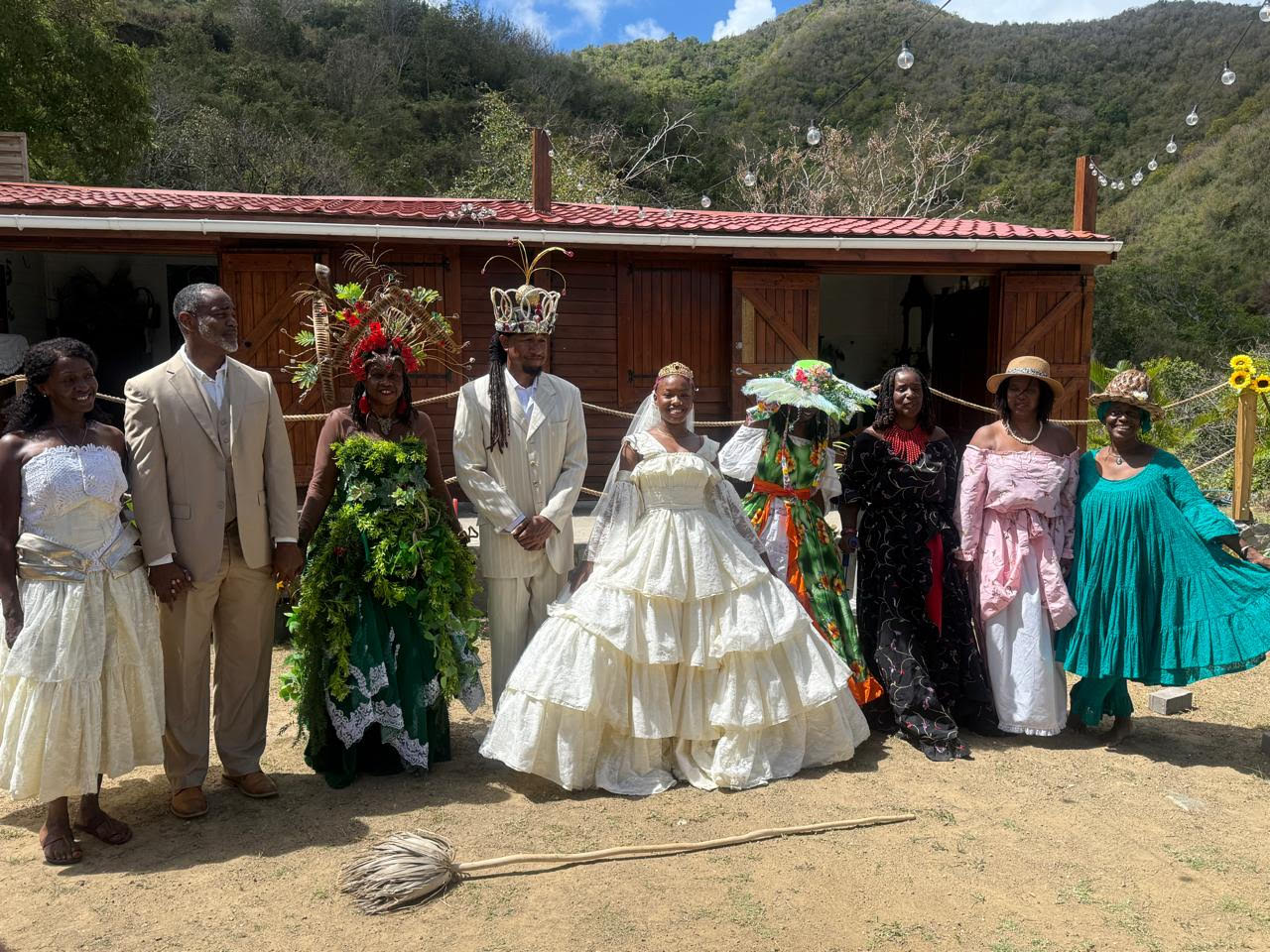
All of this was leading to the climax: a short play: “Love in Spring Garden,” written and directed by Clara Reyes. A young, beautiful village girl (Naomi) has to make a life-changing decision in choosing who to marry between two suitors - one rich, impeccably dressed but lazy with a huge sense of entitlement (Rene) and the other “raggedy” but very hardworking and helpful (Lorenzo) who, in order to win the love of his heartthrob, enlists the “spiritual” (herbal) powers of a “deus ex machina” (“Queen of the hill,” played elegantly by Pauline Gumbs).
The love potion works. The “traditional” wedding unfolds before our very eyes - the bride and bridegroom jump the broom, the marriage is consummated and the couple live happily ever after.
The story was narrated by Kiara, whose voice outmatched the wind that was wrestling for the mic. The performance was well received by the audience despite the technical glitches that forced the cast to improvise and allowed Clara to show her impressive drumming skills.
What can I say about the food? The menu included a sampling of everything from the Johnny cake to the cassava bread made on site. The utensils were wooden and not plastic, thank Goodness!! I don’t know if they tasted better because of that, but the food hit a good spot. I looked around and realized I wasn’t the only one with a healthy appetite.
History. Tradition. Culture. From culinary arts to theatre arts. The Colombier Heritage Village is not a return to nostalgia; it is a vivid experience in living color that should be shared with everyone- resident and visitor alike.
To all the cast members - Karim Toulen
Rene Violenes, Pauline Gumbs, Lo Sigma Gomez, Naomi Warsop, Kyro Kiara Vanterpool, Ghyslaine Richardson, Helene Richardson, Brandon Joseph and
Clara Reyes and everyone else involved in this wonderful project, I say:
Take a well-deserved bow.