.jpg)


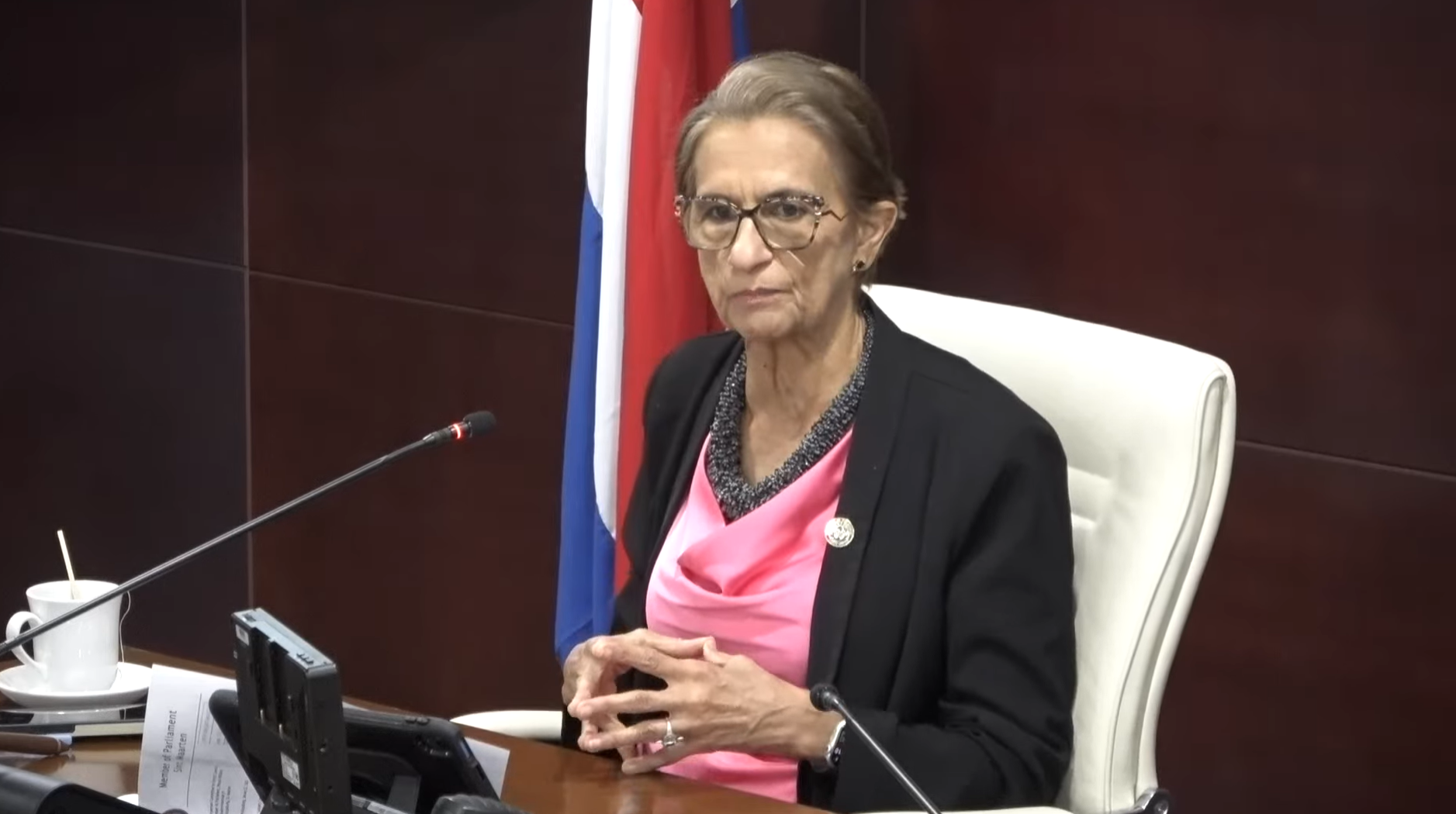
GREAT BAY--President of Parliament and Member of Parliament Sarah Wescot-Williams on Tuesday formally proposed that Parliament explore and pilot a Community-Driven District Development Fund for St. Maarten, an initiative aimed at giving communities a more direct role in identifying, shaping, and helping to finance small-scale projects that improve the quality of life in their districts.
Presenting the proposal during a Committee for District Councils (CDC) meeting of Parliament, Wescot-Williams asked the committee to endorse the exploration of a pilot fund concept that would support practical district-level improvements through a structured, transparent, and community-centered mechanism. She proposed that the fund be administered through the St. Maarten Development Fund, SMDF, or another suitable public instrument capable of handling fiduciary oversight, administration, and reporting.
In her presentation, Wescot-Williams made clear that the proposal is rooted in a broader belief in decentralization and in the importance of empowering communities to play a more active role in shaping their own environments. She told the committee that, by nature, she is “a decentralist,” explaining that she believes organizations below the level of central government should be empowered to take responsibility for their communities, but only within clear structures and guidelines.
The President of Parliament said district residents and district councils should be the ones identifying feasible projects that matter directly to their neighborhoods. She pointed to examples such as beautification, street lighting, small public amenities, playground rehabilitation, and other modest but visible initiatives that can have a real and immediate effect on people’s daily lives.
According to Wescot-Williams, the proposal is intended to address a longstanding gap in district-level improvement efforts, where many good ideas exist in communities but often fail to take root or move beyond discussion because there is no clear structure through which those ideas can be organized, supported, managed, and funded. She argued that such frustration is widely felt in the districts and that Parliament now has an opportunity to help create a mechanism through which civic energy can be translated into tangible results.
A major pillar of the proposal is transparency. Wescot-Williams stressed that projects must be publicly costed, with small-scale funding ranges that allow the public to understand clearly what is being proposed, what it will cost, and how far implementation has progressed. She indicated that micro-project ranges, such as projects valued between hundreds and a few thousand guilders, could provide a practical entry point for a pilot while keeping projects manageable and visible.
The proposal also envisions a co-financing approach in which support would not come only from government. Wescot-Williams said individuals, businesses, community groups, and diaspora supporters should all be able to contribute financially or in kind toward specific projects. In this way, the initiative is intended not only to decentralize action, but also to encourage shared responsibility between citizens, private stakeholders, and public institutions.
She further stressed that any such initiative would require credible fiduciary and administrative oversight. In her proposal, Wescot-Williams suggested that SMDF, or another appropriate mechanism, could act as the fund manager to ensure sound financial administration, compliance, and transparent implementation. She acknowledged that discussions with SMDF might also produce alternative ideas for oversight, but maintained that accountability must be built into the concept from the beginning.
Wescot-Williams also highlighted the importance of public reporting. She said a simple and accessible reporting mechanism, such as an online dashboard or periodic public updates, should be part of the pilot so that residents can see project goals, funding status, progress, and completion outcomes. In her view, transparency is central not only to good administration, but also to rebuilding public trust in how small-scale public spending is handled.
In explaining the institutional basis for the proposal, Wescot-Williams referred back to the establishment of Parliament’s District Council Committee, which was created to engage community councils more directly and to help create a structure through which district representation could function in a more organized way. She recalled that Parliament had previously met with community councils and that those councils had appreciated the effort to formalize and create a legal basis for their role within the country’s governance system.
She made it clear, however, that the objective is not simply to recognize any group that claims to represent a district, but to eventually create a framework within which district or community councils are formed, maintained, and held accountable. Such a framework, she suggested, would need to address issues such as participation, legitimacy, governance, and continuity so that residents, donors, and government all have confidence in the structures they are dealing with.
The stated objectives of the proposal, according to Wescot-Williams, are to foster shared responsibility between citizens, government, and private partners, improve transparency and trust in small-scale public spending, and deliver visible, quick-impact improvements that uplift districts across St. Maarten. She also stressed that the proposal is meant to reinforce the role of district councils as facilitators of participatory governance.
In calling for committee endorsement, Wescot-Williams proposed several next steps. These include a formal invitation to the St. Maarten Development Fund to brief Parliament on any existing or planned initiatives that already support community-driven co-financing or participatory district development, and to advise how those efforts could align with or inform a district-focused pilot framework. She also mentioned NPOwer as another organization Parliament should engage, given its role in bringing NGOs together and strengthening their capacity to administer and manage development-oriented resources on St. Maarten.
Wescot-Williams said efforts by organizations such as SMDF and NPOwer have already helped make the NGO field on St. Maarten more organized and more capable of acting as a social partner, and that Parliament should build on that progress rather than start from scratch. She argued that alignment between parliamentary intent and the existing development and NGO landscape could create a realistic pathway for implementation.
She also proposed that, once Parliament receives input from SMDF and other stakeholders, the committee could move toward developing a practical framework and pilot plan in collaboration with the relevant ministries and community stakeholders. From there, one or two districts could be identified for pilot implementation. Wescot-Williams expressed hope that at least one pilot could still be launched in 2026.
In addition, she suggested that technology should not be left out of the conversation. Referring to an earlier exchange with the Minister of VROMI on the concept of smart cities, she said that as the proposal develops, technology could become a key element of a district-based pilot, particularly in relation to monitoring, communication, project visibility, and community participation.
The committee discussion reflected broad support for the initiative.
MP Dimar Labega welcomed the proposal as a strong and necessary initiative, saying it would give districts a reason to reactivate local structures and provide communities with a channel through which even small concerns can be formally raised and addressed. He agreed that proper structure and policies are essential so that district bodies remain functional, representative, and accessible.
MP Francisco Lacroes also supported the proposal and said he was excited to see it on the agenda. He noted that it aligns closely with district improvement ideas previously raised in Parliament and stressed that proper registration, administration, and accountability would be essential. He also pointed to real examples from his own district, including the unsuccessful effort to restore a playground in St. Peters, as evidence of why organized district-level structures are needed.
MP Veronica Jansen-Webster welcomed the initiative and connected it to wider concerns about isolation and the weakening of neighborhood bonds in St. Maarten. She also referred to earlier efforts related to the social registry and suggested that Parliament should examine what became of that work, since it had already involved gathering detailed information on communities and local needs.
MP Lyndon Lewis also strongly supported the initiative, saying a proper district framework is critical for youth engagement, public safety, and community problem-solving. He described present-day examples of overflowing garbage areas, unsafe streets, and a lack of visible points of contact in some communities, arguing that residents often do not know who to turn to when issues arise. He said a functioning community structure could help address such gaps and create a more proactive rather than reactive approach.
Throughout the discussion, Wescot-Williams repeatedly returned to the same core point: that many communities still have the desire, energy, and pride needed to improve their surroundings, but that they need a structured pathway through which that energy can be organized and supported. She said Parliament now has an opportunity to help create that pathway in a practical, phased manner, beginning with a pilot rather than a large and unwieldy framework.
Join Our Community Today
Subscribe to our mailing list to be the first to receive
breaking news, updates, and more.