.jpg)


THE HAGUE-For years, IPKO has been valuable, but predictable. Delegations from Aruba, Curaçao, St. Maarten and the Netherlands would meet, discuss the familiar issues, exchange positions, reach conclusions and then move on to the next meeting, where many of the same concerns would return.
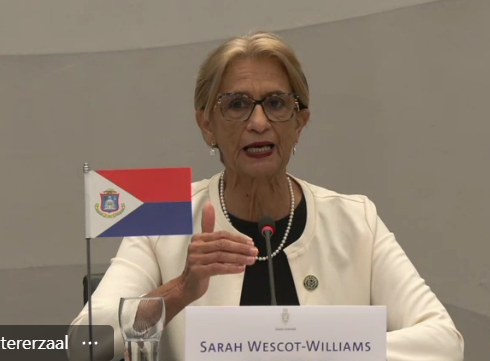
That is why what St. Maarten's Chairlady of Parliament and delegation leader MP Sarah Wescot-Williams managed to accomplish at the recently concluded IPKO in the Netherlands should not be treated as just another procedural adjustment. It represents a serious attempt to change how IPKO functions.
The core of her proposal is simple: IPKO must become more than a talking platform. It must become a mechanism that tracks decisions, assigns responsibility, demands follow-up and preserves institutional memory from one meeting to the next, because the Kingdom has no shortage of discussions. What it has lacked for years is consistent follow-through.
With her seniority and experience looming over the session, Wescot-Williams’ proposal, now accepted by all Kingdom delegations, seeks to move IPKO toward recurring multi-year themes, formal action lists, responsibilities, deadlines, mandatory progress reporting, structured dialogue with the Kingdom Government and an archive that prevents issues from being forgotten when delegations change.
In practical terms, this means that when IPKO discusses a major issue, the agenda must make clear what problem is being addressed, why the matter is being discussed and what the intended outcome should be. That is a shift from broad discussion to structured accountability.
This is why Dutch delegation leader Peter Nicolaï’s remarks were significant. He did not merely compliment Wescot-Williams. He credited her with helping IPKO find a path forward after years of struggling with follow-up and structure. He even referred to her as the “queen of IPKO,” a light moment, but one that recognized the role she played in giving shape to the platform’s next phase.
The progress is also visible in what happened during IPKO itself. The State Secretary for Kingdom Relations attended a session with IPKO members, something described as unique. While the State Secretary does not have a formal constitutional relationship with IPKO, his presence was a first step toward the structured dialogue with the Kingdom Government that Wescot-Williams’ proposal envisions.
If IPKO is to be taken seriously, it cannot only produce conversations among parliamentarians. It must also create pressure points toward governments. Parliaments can debate, question and agree, but governments execute. A stronger bridge between IPKO and the Kingdom Government is therefore necessary if conclusions are to become action.
IPKO also showed why the new approach is needed. The delegations addressed the slavery past, the recent United Nations vote, democratic deficit, the Kingdom Dispute Regulation, data protection, public participation, climate adaptation, aging and the way countries within the Kingdom view one another.
Many of these matters are not small, but many of them are old, sensitive and unresolved. Some go directly to the heart of whether the Kingdom can function as a modern partnership built on trust and respect.
Wescot-Williams made that point clearly at the closing. She said IPKO has made conclusions before. The difference now must be that those conclusions are not allowed to “die a natural death.” That line captures the entire purpose of her reform effort.
The next IPKO, scheduled for St. Maarten in January 2027, will therefore not be just another meeting. It will be the first real test of whether the new IPKO format can work.
By then, delegations are expected to have developed main themes using the newly accepted format. Committees are expected to have continued discussions on difficult topics, including prejudices, perceptions and the legacy of the colonial past. The expert group on the democratic deficit is expected to have advanced its work. The letter on data protection and data-sharing should have moved forward. The discussions on public participation, climate adaptation and aging should not simply disappear.
That places pressure on every delegation, but especially on St. Maarten as the next host.
St. Maarten will not only be organizing the next meeting. It will be hosting the first follow-up test of a format largely shaped by its own Chairlady of Parliament. That gives St. Maarten a leadership opportunity, but also a responsibility.
The country will have to show that it can host an IPKO that is not just ceremonial, but substantive. It will have to help prove that the new method can produce continuity, reporting and sharper outcomes. It will also have to show that the public participation Wescot-Williams repeatedly called for is more than a phrase.
That public involvement is critical. One of her strongest points throughout IPKO was that these discussions cannot remain trapped among politicians and technical experts. The people of St. Maarten must understand what is being discussed, especially when the issues touch the country’s governance model, climate vulnerability, Kingdom cooperation, autonomy, capacity and future constitutional direction.
During the closing, Wescot-Williams acknowledged that St. Maarten heard critical comments about its own structure since 10-10-10. She referred to remarks about the country having taken over structures from other parts of the Kingdom, including the Netherlands, and said St. Maarten should review its own organization and governance model.
She was careful not to present this as something that can be fixed overnight. But she also made clear that it is a discussion St. Maarten must have again.
That is progress in itself. For years, many conversations about autonomy and country status have been emotional, defensive or symbolic. But the country is now being pushed toward a more practical question: does the structure we have match the country we are?
That question cannot be answered only in Parliament. It has to be understood by the public. If people do not understand the burden of the current governance model, the limits of local capacity and the cost of maintaining institutions that the country struggles to properly staff and operate, then any discussion about reform will remain shallow.
Wescot-Williams appears to understand that. Her repeated emphasis on public participation is not decoration. It is necessary if the next phase of Kingdom dialogue is to have legitimacy.
The same applies to the democratic deficit and the Kingdom Dispute Regulation. These matters have been discussed for years, even before and certainly since 10-10-10. Wescot-Williams’ point is that if the Kingdom does not first decide what kind of cooperation it wants going forward, then the technical debates around dispute settlement and democratic legitimacy will continue to circle without resolution.
Wescot-Williams managed to get all delegations to accept a new direction for IPKO. In January 2027, IPKO comes to St. Maarten. By then, the question will no longer be whether the platform has a new format. The question will be whether the Kingdom delegations, including St. Maarten, are prepared to prove that the new format can deliver.
Join Our Community Today
Subscribe to our mailing list to be the first to receive
breaking news, updates, and more.