


GREAT BAY/MARIGOT, St. Martin--The literary work of St. Martin poet and author Lasana M. Sekou continues to attract international academic attention, with three scholarly publications in 2026 examining or drawing on his writings to explore Caribbean identity, history, environmental issues, colonialism, and the relationship between island communities and their natural surroundings.
The publications, appearing in peer-reviewed journals from SAGE, Brill, and Routledge, reflect the continued relevance of Sekou's work in discussions about Caribbean literature and the region's historical, cultural, and environmental experiences.
One of the latest studies comes from German author and researcher Tobias Schank of Saarland University. His paper, Blue Bordertexturing: (Un)knowing Caribbean Wet Borderlands, was published in October 2026 in Environment and Planning E: Nature and Space, a journal published by SAGE.
Schank examines the poetry of Sekou alongside the prose of Virgin Islands author Tiphanie Yanique, exploring how the Caribbean Sea connects island societies and shapes their cultural identities and relationships with the environment.
Central to his analysis is Sekou's Book of the Dead, published by House of Nehesi Publishers in 2016. Schank draws on several poems from the collection, including daylight come, oui, Poem for the dead, and sweet lil' s'maatin, while also examining Yanique's 2014 novel Land of Love and Drowning.
House of Nehesi Publishers President Jacqueline Sample welcomed the attention being given to Sekou's work, particularly its relevance to emerging discussions about Caribbean geography, environmental relationships, and decolonial thought.
"What I find fascinating is how Dr. Schank also draws from Lasana's work when discussing aspects of fresh or emerging critical takes on decolonial thought, though Book of the Dead was published in 2016," Sample said.
article continues below...
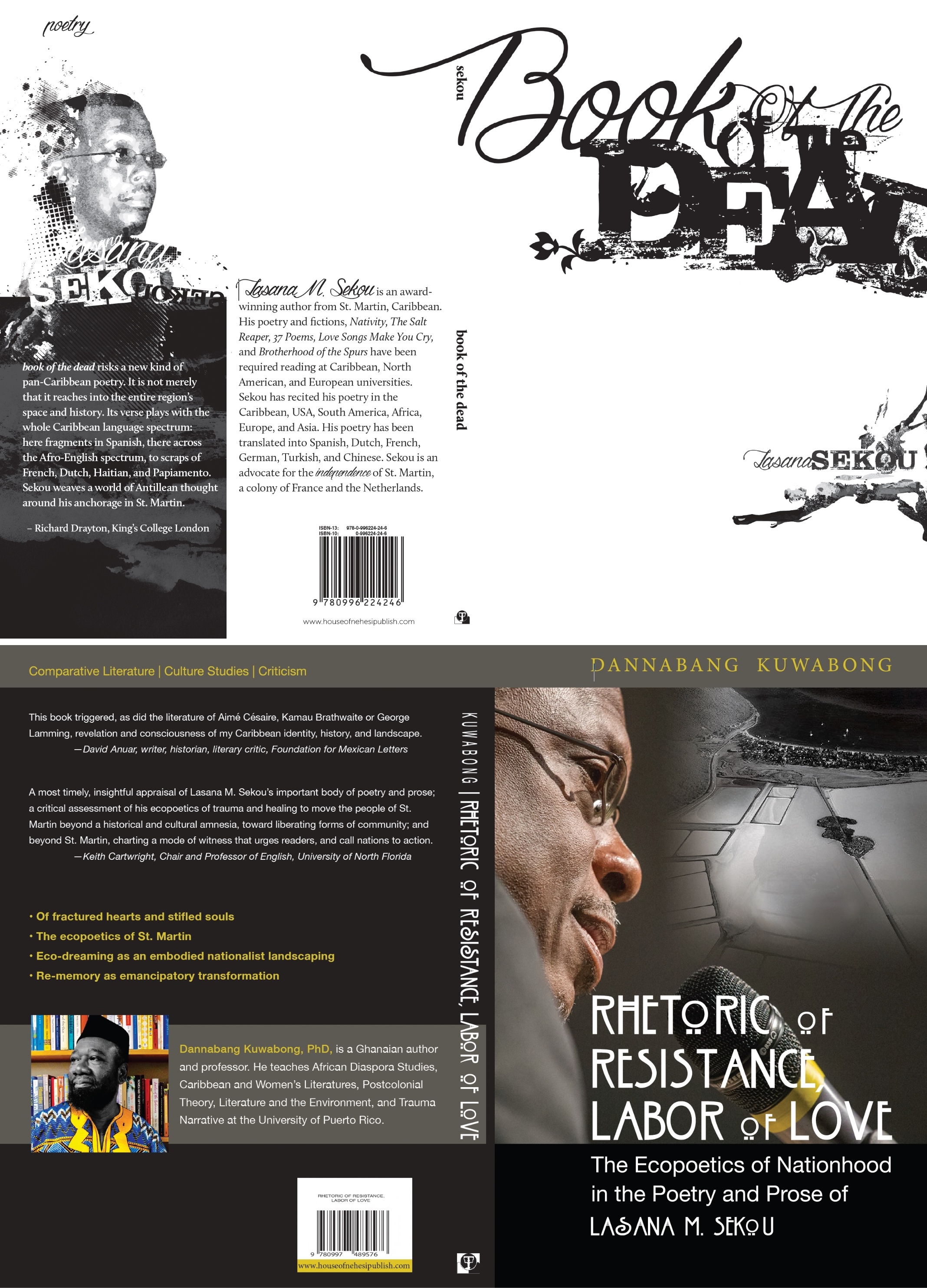
Sekou's work also received attention through a scholarly review of Rhetoric of Resistance, Labor of Love: The Ecopoetics of Nationhood in the Poetry and Prose of Lasana M. Sekou, written by Dannabang Kuwabong.
The five-chapter book examines Sekou's treatment of St. Martin's history, culture, people, and environment, including the Great Salt Pond, which features prominently in his literary exploration of the island's identity.
Sekou has consistently raised concerns about the pond's deterioration and pollution while emphasizing its historical and cultural significance, describing it as the island's "cradle of the nation."
The book was reviewed earlier this year by Dr. Yvette M. Alex-Assensoh, a political science professor and adjunct law professor at the University of Oregon. Her review appeared in African and Asian Studies, a peer-reviewed journal published by Brill.
Alex-Assensoh described Kuwabong's publication as a "very useful and sophisticated study" and concluded that it was suitable for classroom use at colleges and universities.
A third international publication featuring Sekou's contribution appeared in August 2026 in Textual Practice, a peer-reviewed journal published by Routledge.
The article, Listening and Responding to Hurricanes: Ana Portnoy Brimmer and Caribbean Immersive Poetics, was written by Christina Kullberg, whose research includes Caribbean literature, translation, travel writing, and world literature.
Kullberg drew on a conversation with Sekou while examining how Caribbean writers have responded to hurricanes and their consequences, particularly following Hurricanes Irma and Maria.
Her research explores the ways Caribbean literature addresses natural disasters, their lasting impact on communities, and the experiences that remain long after the storms have passed.
The article also references several Caribbean writers and scholars, including Édouard Glissant, Kamau Brathwaite, Frankétienne, Celia Sorhaindo, and Richard Georges, along with disaster-related publications by House of Nehesi Publishers authors Fabian Adekunle Badejo, Yvonne Weekes, and Wendy McMahon.
The three academic publications demonstrate how literary works rooted in St. Martin's experiences continue to contribute to international discussions about Caribbean history, environmental preservation, cultural identity, and the lasting consequences of colonialism and natural disasters.
For St. Martin, the scholarly attention also highlights the importance of locally produced literature in documenting the island's experiences and ensuring that Caribbean perspectives remain part of international academic research.
Join Our Community Today
Subscribe to our mailing list to be the first to receive
breaking news, updates, and more.