.jpg)


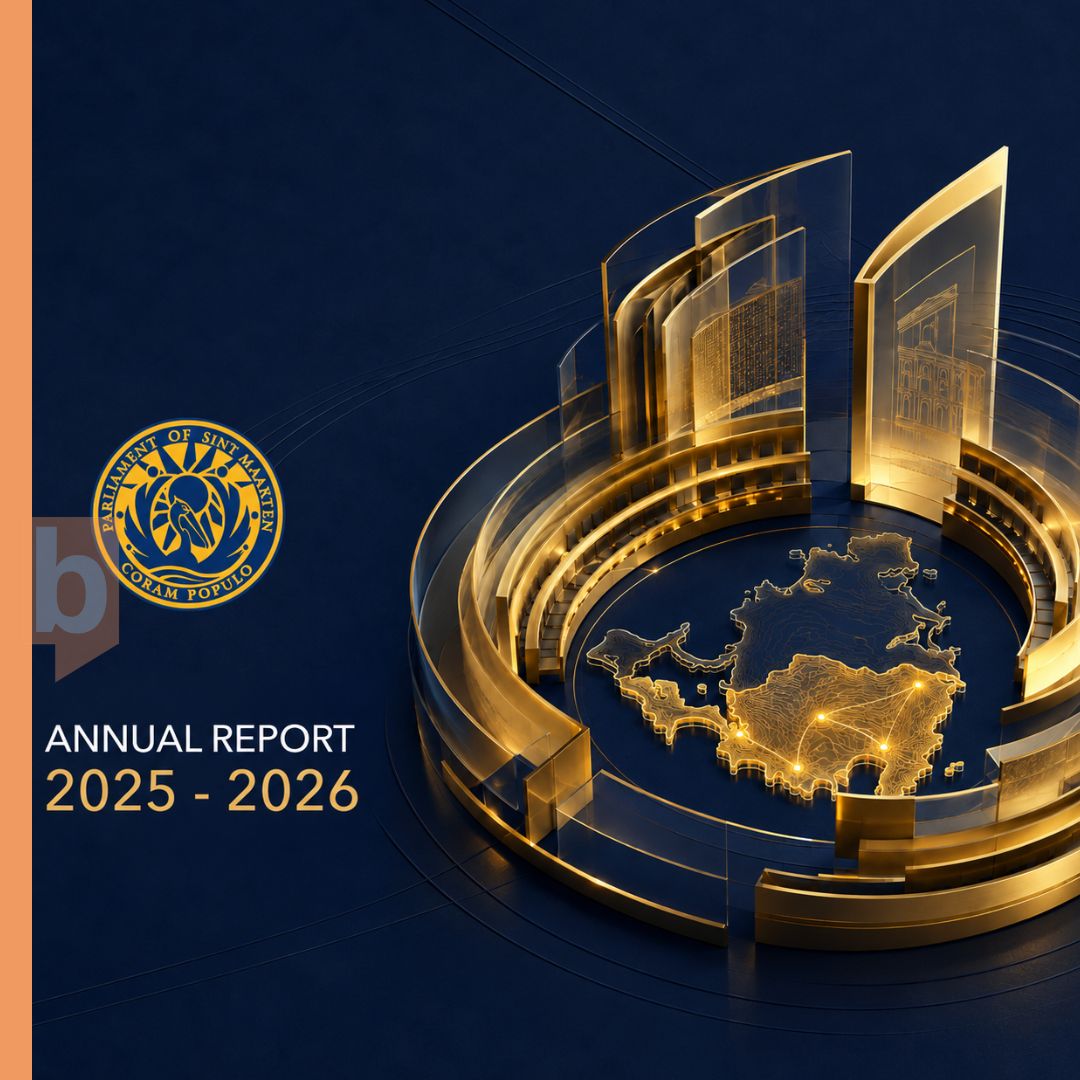
GREAT BAY--Parliament held 93 meetings, significantly increased the use of written questions to government, processed seven new draft national ordinances but passed only one, while expanding its regional and international engagement during the 2025-2026 parliamentary year, according to its newly released Annual Report.
The report provides a broad account of Parliament's legislative, oversight, institutional and public-engagement activities during a year carried out under the theme “Building Digital Trust: Exploring a National AI Strategy and Further Development of an Open Parliament.” Parliament established an AI and Digital Transformation Workgroup as part of efforts to modernize the institution, while identifying continued digital transformation and bringing Parliament closer to the public as priorities going forward.
The annual figures show Parliament recorded 21 public meetings, 23 Central Committee meetings, 42 permanent and other committee meetings, five Presidium meetings and two Faction Leaders meetings, for a total of 93 meetings across the five categories. The overall number was down from the previous year, when the corresponding categories totalled 124 meetings, largely because committee meetings declined from 65 to 42.
Oversight activity, however, increased significantly through written questions. Parliament recorded 114 letters containing written questions to ministers, compared with 77 in 2024-2025 and 71 in 2023-2024, an increase of approximately 48% over the previous year. Parliament cautions that the figure represents letters rather than individual questions, since one letter can contain multiple questions or be addressed to more than one minister.
Justice attracted the most written scrutiny, with 28 letters directed to the Minister of Justice, followed by General Affairs with 24 and Finance with 22. Darryl York led individual MPs with 33 written-question letters attributed to him, followed by Sarah Wescot-Williams with 23, Egbert Doran with 18, Francisco Lacroes with 17 and Sjamira Roseburg with 12.
The report also provides detailed attendance records. Veronica Jansen-Webster and Dimar Labega recorded the highest public-meeting attendance at 95%, followed by Francisco Lacroes at 88%. Omar Ottley recorded the lowest public-meeting attendance at 60%. For Central Committee meetings, Jansen-Webster, Labega and Lacroes each recorded 88%, while Raeyhon Peterson stood at 35%, the lowest figure listed.
Legislative output presents a different picture. Seven new draft national ordinances were submitted during 2025-2026, while one national ordinance was passed. By comparison, five ordinances were submitted and five passed in 2024-2025. The law passed during the latest year was the Basic Payment Account National Ordinance, which was approved with 14 votes in favor and none against on January 9, 2026.
Much of the new legislative agenda involved financial regulation, including draft laws on payment service providers, virtual asset service providers, payment and securities settlement oversight and financial market infrastructure systems. Parliament also received legislation dealing with tax reform, social and health insurance and the 2026 national budget.
MPs submitted three amendments during the year and all three were passed. The amendments, all relating to the Basic Payment Account legislation, addressed discrimination between account holders, digital accessibility, information requirements and reporting for oversight and evaluation.
Six motions were submitted by the August 5 reporting cut-off, with three passed. Among the most consequential was the May 29 no-confidence motion against then Public Health, Social Development and Labor Minister Richinel Brug, which passed by the narrowest possible margin, 8 votes to 7. A no-confidence motion against VROMI Minister Patrice Gumbs was rejected 6 votes to 7.
Parliament's work during the year dealt with several major national issues, including GEBE, fire and ambulance personnel, garbage collection, the new hospital, integrity concerns, the prison and detention system, crime and road safety, banking and financial-sector legislation, public schools and government finances. Committee meetings also dealt with subjects ranging from housing and public transportation to cannabis regulation, early-grade reading and mathematics assessments, justice workers and the cost of electricity.
Beyond the legislative chamber, Parliament reported continued emphasis on civic education. It hosted 17 educational visits involving more than 300 students and young people, giving participants opportunities to learn about Parliament, the legislative process and democratic participation.
The institution also broadened its regional presence. Parliament became an Associate Member of ParlAmericas, strengthened its involvement in Parlatino, continued participation in Kingdom-level consultations and maintained cooperation with neighboring islands. Admission to ParlAmericas was unanimously ratified by all 15 MPs present during the May 29 meeting.
Financially, Parliament had a 2025 budget of Cg 13.72 million and recorded actual expenditure of approximately Cg 13.30 million. Salaries and related costs for MPs and faction staff accounted for 47.55% of expenditure, while Secretariat salaries accounted for 22.20%. Travel by MPs represented 6.54%. Parliament's approved 2026 budget rose to Cg 16.57 million, which also includes pension obligations for former political office holders.
The report also acknowledges internal strain. Parliament's Secretariat operated with staff shortages caused by turnover, retirement and maternity leave, even as the institution continued work on its Function Book, faction support arrangements, staff development and further institutional independence.
Join Our Community Today
Subscribe to our mailing list to be the first to receive
breaking news, updates, and more.