.jpg)


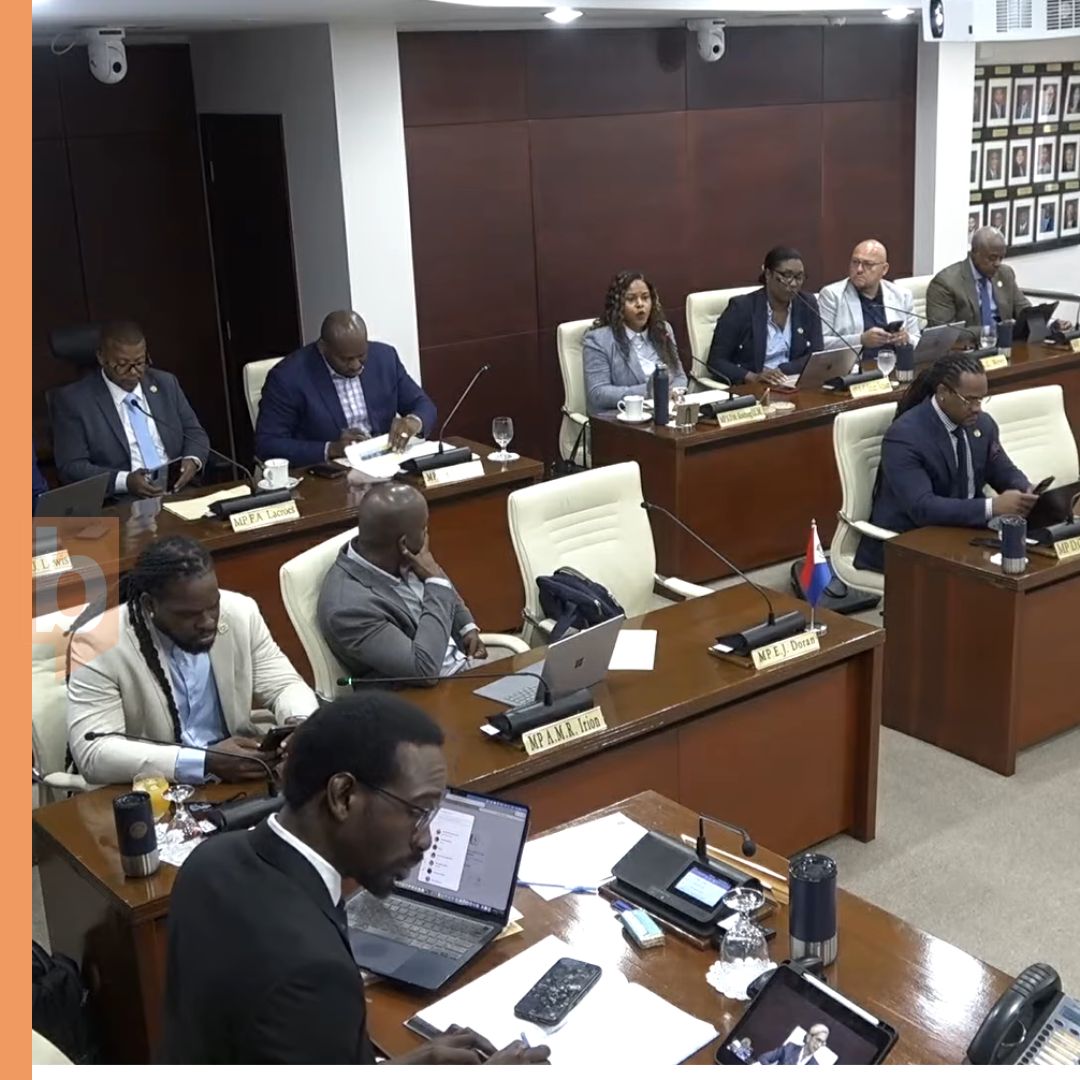
GREAT BAY--Members of Parliament used Tuesday’s continuation of the Central Committee meeting on the draft 2027 national budget to question Government across virtually every ministry, with much of the discussion centered on whether the figures presented will translate into tangible relief, completed projects and improved public services.
While Government’s timely submission of the budget received recognition from several MPs, members repeatedly returned to concerns over execution, the cost of living, tax collection, justice spending, education, healthcare, infrastructure and whether enough measurable targets have been attached to the money Government intends to spend.
MP Ardwell Irion questioned whether the budget sufficiently responds to the immediate pressures facing households. He argued that residents are dealing with high electricity costs, rising fuel prices and general cost-of-living pressure while Government continues to say it is exploring possible relief measures.
Irion asked the Minister of Finance whether Government would consider increasing the amount available for tax refunds and accelerating their payment as a direct way of putting money back into the hands of residents. He recalled that additional resources had previously been made available for this purpose and questioned whether the same approach could be used again.
He also pressed Government on fuel relief, asking why measures used in previous years could not be reconsidered. Irion requested clarity on when Government’s current examination of fuel-relief options began, how far that work has progressed and when residents can expect a decision.
The MP also questioned Government’s revenue collection, seeking updates on land-tax collection, lottery and casino fees and other measures that were previously identified as potential sources of additional income. His concern was whether Government is maximizing existing revenue before placing additional burdens on residents.
Irion also raised the minimum wage, arguing that stronger intervention is necessary if working households are expected to meet rising living costs. He questioned what it would take to substantially increase the minimum wage and called for a clearer Government response to the pressure being experienced by families.
Questions also went to General Affairs regarding outstanding jubilee payments for civil servants and teachers, Government vacancies and the possibility of using solar lighting in Government parking areas as a cost-saving and practical measure.
On Justice, Irion sought clarity on the legal framework governing traffic cameras and whether such technology could also be used to identify licence plates and support enforcement of vehicle inspection requirements. He additionally questioned what it would cost to maintain a Government presence at the borders.
He requested that all ministries provide Parliament with updates on motions and amendments adopted in recent years so MPs can determine what has actually been implemented.
Wever Focuses on Special Education, Career Development and Public Health Funding
MP Christopher Wever concentrated heavily on education and questioned whether the 2027 budget contains enough resources to implement the special education policy roadmap.
He asked Government for a specific implementation timetable and whether sufficient funding has been provided, particularly in light of what he identified as a decrease within parts of the education subsidy structure.
Wever also proposed consideration of an annual career fair that would go beyond connecting job seekers with employers. He said businesses could engage students before they leave school, expose them to different professions and help them better understand the subjects, qualifications and skills required for future careers.
He questioned whether companies could be invited into schools or other settings to provide students with more direct exposure to career opportunities before they make decisions about further education.
Another education issue involved a budget provision related to the possible purchase of land for a sports facility. Wever asked Government to explain what type of facility is being considered, whether land has already been identified and why a sports facility is being prioritized over a performing arts center.
On public health, Wever questioned a significant increase in the relevant budget allocation which he understood to be linked to projects no longer financed through external reform funding. He asked Government to identify which projects St. Maarten will now have to finance directly.
Meyers Questions Spending Growth, Justice Capacity and Ministry Deliverables
MP Franklin Meyers commended the Minister of Finance and the Council of Ministers for submitting the budget on time, describing timely budget presentation as an important fiscal achievement after years in which St. Maarten struggled to meet that requirement.
He nevertheless questioned a number of spending increases and asked Government to clearly distinguish expenses being financed externally from those that must be paid directly by the country.
Meyers sought additional information on tax collection and compliance and asked what measurable improvements Government expects in 2027.
For General Affairs, he questioned increases in expenditure and asked what specific activities account for them and what measurable results residents should expect. He also requested details on planned expansion of the Fire Department and ICT operations and questioned the sharp increase in facilities expenditure.
Meyers asked Government to identify which vacancies are essential to delivering the ministry’s priorities and when those positions are expected to be filled.
On Justice, he questioned whether the Ministry can realistically deliver improvements in policing, detention and border control while its overall allocation remains largely unchanged.
He requested an updated timetable for the new prison, including expected staffing and operational costs for 2027 and 2028, and asked which vacancies present the greatest risk if left unfilled.
Meyers also wanted Government to explain how it intends to measure the results of crime-prevention and protection programs rather than simply reporting expenditure.
Within education, he questioned changes in subsidies and project spending and asked what external financing has been secured. He also sought evidence that spending on student support, school transportation and study financing is reaching the students who need it.
On healthcare and social development, Meyers questioned what reforms will begin in 2027 to address continuing health-fund deficits and what financial effects Government expects from those reforms.
He also asked how many residents are expected to benefit from increased financial assistance and whether the full cost has already been incorporated into the budget.
The social registry was another area of focus, with Meyers asking when it will become operational and how Government will determine whether it is improving the targeting of social assistance.
Turning to VROMI, Meyers asked which projects explain the ministry’s increased spending, which of its vacancies need to be filled first and how much funding is actually available for new housing and infrastructure after existing obligations are met.
Road maintenance also featured in his intervention. He requested the funded 2027 road-maintenance schedule and clarification on how it relates to the future use of motor vehicle tax revenue.
Meyers concluded by asking every minister to identify their three most important deliverables for 2027 so Parliament and the public can track whether those commitments are achieved.
Wescot-Williams Expands Questions Across Ministries
President of Parliament Sarah Wescot-Williams raised a broad series of questions touching on Government accountability, financing, healthcare, regional cooperation, infrastructure and social policy.
She questioned Government’s current vision for the St. Maarten Development Fund, noting that it was originally established with a strong focus on youth and the elderly but has increasingly been used for other government-related responsibilities.
Wescot-Williams also questioned whether St. Maarten’s healthcare system can continue operating under its present structure or whether Government should examine opportunities to align parts of the system with larger healthcare structures.
Cross-border cooperation with the French side also featured prominently in her remarks. She asked Government to clearly identify its priorities and highlighted taxation, crime and financial systems as areas where she believes greater cooperation should be explored.
She questioned why residents on the Dutch side face limitations in accessing certain European banking and financial platforms and asked whether St. Maarten can make greater use of its position within the Kingdom to improve financial connectivity.
On Finance, Wescot-Williams requested updates on several proposed revenue measures, including gambling-related taxation and other legislation Government previously indicated could take effect in 2027.
She also questioned why Parliament no longer receives the type of regular budget-execution information it received in earlier years and asked what systems or additional capacity would be required to restore more detailed reporting.
The Disaster Reserve Fund, Government’s outstanding payables, tax assessments versus actual collections, civil servant salary indexation, short-term rental taxation and gaming-sector revenue were among the additional Finance matters she raised.
Wescot-Williams also asked when Government’s updated digital government and artificial intelligence strategy will come to Parliament and whether the 2027 digitalization plans adequately address the opportunities and risks associated with AI.
She sought updates on Government-owned companies, including whether instructions concerning audited financial statements and annual reports have been followed and when the participation policy will be finalized.
Within TEATT, she asked about the proposed meteorological and civil aviation building, the Simpson Bay Bridge upgrade, Philipsburg beautification and the proposed multi-storey parking facility.
She also raised questions about management of the Simpson Bay Lagoon, including safety, regulation and cooperation with authorities on the French side.
The long-awaited carrying-capacity study also returned to the floor, with Wescot-Williams asking whether Government should already be taking precautionary steps based on pressures that are evident before the study is completed.
On Justice, she requested updates on vacancies, recidivism and violence targets, the digital traffic-fine system and modernization of the Road Traffic Ordinance.
Education questions included the future of structured school programs, the continuation of the Healthier Habits initiative, development of a multi-year study-financing priority list and the possible use of a gasoline and diesel levy to finance sports.
She also called for clearer attention to poverty reduction, asking when the household expenditure and social minimum study will be completed and whether social assistance will eventually be revised and indexed based on its findings.
Wescot-Williams additionally requested an update on General Health Insurance legislation, the island-wide zoning plan, beach policy, the Mullet Bay master plan and the long-standing subsidy level for the St. Maarten Housing Development Foundation.
She returned to the issue of nation building by questioning the legal position of the English language, reminding Government that Parliament has previously adopted motions calling for action on the matter and asking what steps are being taken beyond education policy.
Join Our Community Today
Subscribe to our mailing list to be the first to receive
breaking news, updates, and more.