


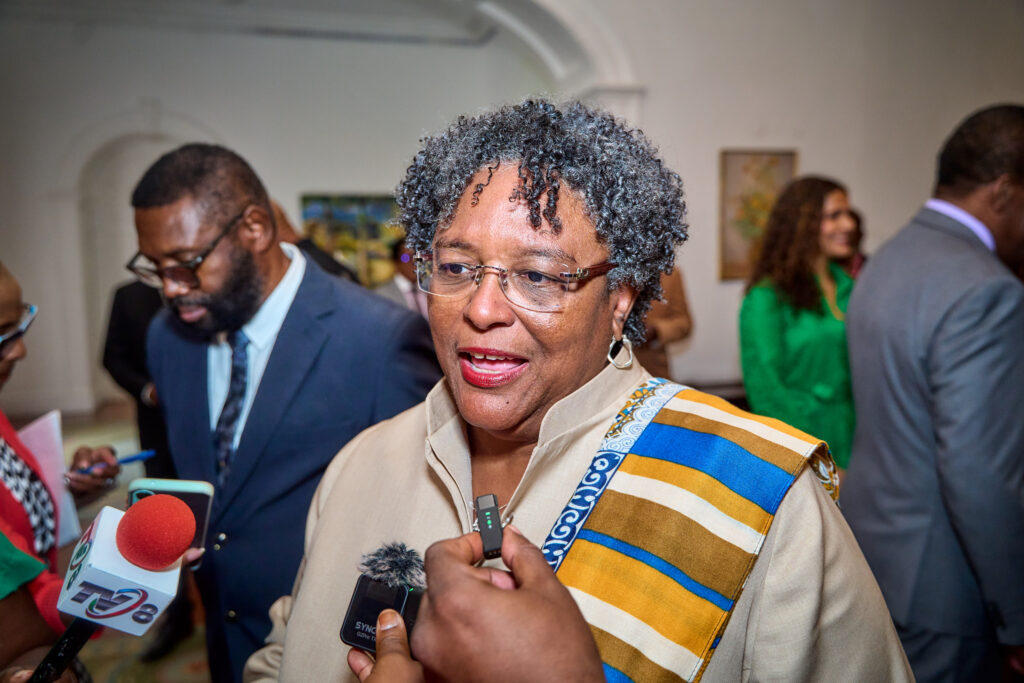
KINGSTON, Jamaica--Barbados Prime Minister Mia Mottley has called for the appointment of a permanent political head of the Caribbean Community (CARICOM), declaring that the regional organization cannot achieve its ambitions under its current rotating leadership structure. Her call, delivered during the launch of a new book examining the Patterson Doctrine, has renewed debate about whether Caribbean governments are prepared to strengthen regional institutions and share political authority to secure a more united and influential Caribbean.
Speaking at the November 15 launch of Caribbean Integration: The Patterson Doctrine at the University of the West Indies, Mona Campus, Mottley argued that CARICOM's six-month rotating chairmanship has failed to provide the continuity and leadership needed to advance regional integration.
“Without a political head, CARICOM will not go any further,” Mottley declared, according to the Jamaica Gleaner.
Her proposal would establish a political leader capable of representing the region internationally, coordinating common policies and ensuring that decisions taken by Caribbean governments are implemented rather than repeatedly discussed without meaningful progress.
The intervention came during the launch of Caribbean Integration: The Patterson Doctrine, Governance, Transformation and the Future of the Caribbean Community, written by former Jamaican Governor-General Professor Sir Kenneth Hall and regional integration specialist Myrtle Chuck-A-Sang.
The book examines the political philosophy and regional contributions of former Jamaican Prime Minister P.J. Patterson, whose approach to Caribbean integration emphasized collective sovereignty, stronger regional institutions and economic transformation.
Patterson Doctrine calls for action beyond political declarations
The Patterson Doctrine, as examined by the authors, is based on the principle that Caribbean countries can exercise greater influence, achieve stronger economic development and protect their sovereignty more effectively by acting together rather than individually.
Patterson, who served as Jamaica's Prime Minister from 1992 to 2006, was instrumental in advancing the Caribbean Single Market and Economy and advocating institutional reforms intended to make regional cooperation more effective.
A central element of his legacy was the 2003 Rose Hall Declaration on Regional Governance and Integrated Development, which called for stronger mechanisms to implement decisions agreed upon by Caribbean leaders.
More than two decades later, the continuing difficulties surrounding implementation of regional agreements have reinforced questions about CARICOM's effectiveness.
Mottley's proposal for a political head reflects one of the central arguments associated with the Patterson Doctrine: regional integration cannot succeed through declarations and agreements alone without institutions possessing the authority, resources and continuity to deliver results.
Caribbean needs a stronger voice internationally
Mottley warned that the region faces growing challenges as international relations become increasingly influenced by powerful countries rather than established international rules.
She questioned who would speak collectively for the Caribbean as geopolitical competition intensifies and smaller states face mounting economic, security and environmental pressures.
The Barbados leader pointed to the European Union as an example of countries maintaining their national sovereignty while developing institutions capable of advancing shared international interests.
She argued that CARICOM should pursue stronger collective representation without requiring member states to surrender their independence.
The Prime Minister identified energy, healthcare and education as areas where deeper regional cooperation could produce benefits.
The wider discussion also addressed climate change, artificial intelligence and the need for Caribbean countries to strengthen their ability to respond collectively to emerging global challenges.
Mottley proposes new taxes to finance CARICOM
Beyond political leadership, Mottley proposed reforms to how CARICOM finances its operations.
The organization currently relies heavily on contributions from member governments, an arrangement she considers increasingly unsustainable.
Among her proposals is a 0.3 percent levy on imports, along with a US$1 charge on cruise passengers and a US$2 levy on longer-staying visitors.
Estimates presented during the discussion suggest that the import levy could generate tens of millions of dollars annually, while the proposed visitor charges could provide approximately US$30 million.
Mottley also advocated mechanisms to ensure that money collected for CARICOM is transferred to regional institutions, including penalties for governments that fail to remit required contributions.
The proposals have not been adopted and would require agreement among member states, including consideration of their potential effects on consumers, tourism and national revenues.
A renewed test of Caribbean integration
The launch of the Patterson Doctrine comes as CARICOM confronts longstanding concerns about the pace of regional integration, the implementation of the Single Market and Economy, and its ability to negotiate effectively with major international powers.
Hall and Chuck-A-Sang argue that integration must ultimately be measured by improvements in employment, education, healthcare, mobility and economic opportunities for Caribbean citizens.
Their examination of Patterson's political philosophy emphasizes that regional unity should strengthen the practical sovereignty of Caribbean states rather than diminish it.
Mottley's intervention brings that argument into the present, placing renewed attention on whether CARICOM's existing leadership and financing arrangements are capable of meeting the region's changing needs.
While the appointment of a permanent political head would require considerable political agreement and institutional reform, her proposal presents Caribbean governments with a question that has remained unresolved for decades: whether they are prepared to move beyond the principle of regional unity and establish the political machinery necessary to make it work.
The Patterson Doctrine provides a historical framework for that debate, while Mottley's call challenges today's leaders to determine what the next stage of Caribbean integration should look like.
Join Our Community Today
Subscribe to our mailing list to be the first to receive
breaking news, updates, and more.