.jpg)


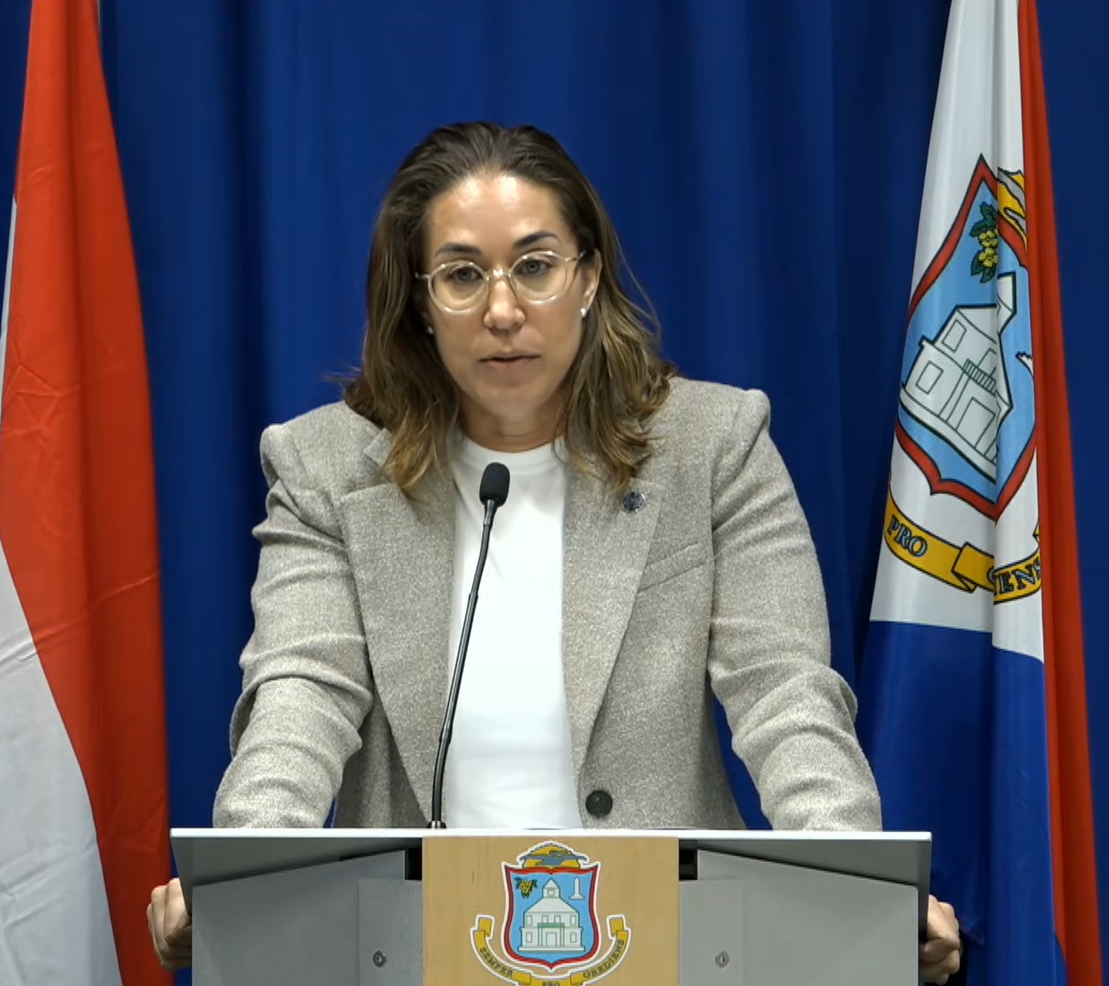
GREAT BAY--Minister of Justice Nathalie Tackling on Wednesday delved a little deeper into the government’s decision to formalize a one-year agreement with Suriname to provide temporary operational support at the Point Blanche Prison, describing the measure as a carefully structured response to ongoing staffing and operational pressure at the facility.
Minister Tackling made it clear that this support is not intended to replace local workers, but to stabilize operations while St. Maarten strengthens its own capacity. She said the Ministry remains committed to recruiting locally and expects to begin that process in the coming months.
Minister Tackling also emphasized that the financial arrangement tied to the Suriname assistance does not create long-term financial obligations for St. Maarten. She explained that the government currently pays the Netherlands approximately €1.2 million per year for the housing of St. Maarten inmates in the Netherlands.
The Minister further clarified that the Surinamese officers remain employed by Suriname and continue to receive their salaries through Suriname, not through the Government of St. Maarten. St. Maarten’s financial responsibility under the arrangement covers deployment-related support, including housing, insurance, and a limited allowance.
According to the Minister, the agreement followed months of discussions and negotiations and was developed as part of a phased and deliberate strategy to stabilize prison operations while the Ministry continues broader reforms and prepares for long-term local staffing.
Minister Tackling explained that efforts to secure external support for Point Blanche began around the summer of 2025, meaning the process has been underway for some time. She said the Ministry explored several options before reaching the agreement with Suriname, including discussions with Aruba, Curaçao, and the Netherlands. However, each of those jurisdictions faced their own operational limitations and were not in a position to provide assistance.
The Ministry also examined the possibility of using private security companies as a temporary solution, but that option was deemed financially unfeasible. In addition to the high cost, the Minister noted that private security personnel do not have the specialized training required to work in a prison environment and manage inmates safely and effectively.
Minister Tackling said the Ministry also had to contend with longstanding internal staffing complications at Point Blanche. She explained that while some prison-related personnel remain on the payroll, formal placement issues within the justice chain meant certain employees could not simply be reassigned to the prison until the proper administrative processes were completed. That placement process, she said, had to progress first in order to create vacancies and make room for new staffing decisions.
She further noted that budget constraints added another layer of complexity. Even where funds may exist within one area of the justice budget, those funds cannot automatically be redirected to fill vacancies elsewhere. For that reason, the Ministry had to pursue a multi-layered approach to address the prison’s urgent operational needs.
The Minister said the decision to seek temporary outside assistance also came in response to repeated concerns raised by prison staff themselves. With limited personnel carrying increasingly heavy workloads, pressure on existing officers has intensified, leading to compounded sick leave and further strain on those still reporting for duty.
The temporary deployment from Suriname, she said, is intended to provide breathing room within the system. It will allow existing staff to receive some relief, while also creating the space needed for training, knowledge-sharing, and a more orderly transition toward local recruitment. A key condition for the Ministry, she emphasized, was that any incoming personnel had to be experienced and immediately capable of functioning in a prison setting.
As part of Budget 2026, the Ministry has secured room for 15 prison guard vacancies to be filled this year. The Minister said this is a critical component of the wider plan, as the ultimate goal is to build a prison system that can be staffed and managed locally, particularly once the new facility becomes operational.
She stressed that the Ministry does not want to remain dependent on external assistance. Instead, the long-term objective is to create a sustainable, locally run detention system that fits St. Maarten’s own legal and institutional context. In that regard, she said the temporary assistance from Suriname is part of a transitional stabilization effort, not a substitute for reform.
Minister Tackling also pointed out that cooperation with Suriname made practical sense because Suriname operates within a legal and institutional framework that aligns closely with St. Maarten’s own system. She added that prior discussions with Suriname had already taken place under previous justice ministers, and that her role was to revive and advance those existing lines of cooperation in a more concrete and structured way.
Under the agreement, the temporary deployment will begin on March 1, with one group of officers arriving first, followed by a second group of 13 officers for an additional six-month period. The arrangement is structured in two six-month phases, allowing the Ministry to assess the first phase and make adjustments if necessary before moving forward.
The Minister also addressed concerns surrounding immigration and residency implications, stating that the officers deployed from Suriname will not build any immigration rights in St. Maarten as a result of this arrangement. She said the government took care to ensure the terms of the agreement prevent any misuse of the system and do not open a pathway to local residency or Dutch nationality through this temporary assignment.
She said the phased arrangement is also important from an operational standpoint because it gives the Ministry time to evaluate what is working, identify areas for improvement, and strengthen the structure around local recruitment, vetting, training, and onboarding.
Minister Tackling noted that responsible recruitment requires more than simply filling vacancies. New prison staff must be properly identified, vetted, trained, and integrated into the system. That process becomes far more difficult when the prison is operating under severe staff shortages. The temporary support from Suriname, she said, creates the operational space needed to prepare and train a new local class of recruits in a more stable setting.
In the immediate term, the Minister said her responsibility is to maintain safe and stable prison operations, particularly as construction of the new facility continues and the country moves through what she described as a critical transition period. Bringing in experienced and operationally ready officers, she said, is essential to maintaining continuity while structural human resources and reform efforts continue.
Important to note: With the consent of the Netherlands, St. Maarten has been granted permission to temporarily pause those payments in order to redirect that funding toward stabilization measures at Point Blanche, specifically the temporary Suriname support. The Minister said this arrangement allows the country to address urgent prison needs without undermining its ability to pursue structural local recruitment.
She noted that the Netherlands has made clear it will not fund personnel costs for St. Maarten’s prison system, meaning that salaries for locally recruited prison staff must still come from the country’s own budget. To avoid sacrificing that goal, the Ministry negotiated a separate path: temporarily earmarking the funds otherwise paid to the Netherlands in order to support stabilization, while preserving budgetary room for local hires.
In addition to supporting operations, Minister Tackling said part of the funding flexibility will also help the Ministry address unresolved human resources matters within Point Blanche, including function-related issues, long-term sick leave cases, and the better placement of employees whose circumstances have gone unaddressed for too long.
She reiterated that while stabilization is not the same as reform, it is a necessary step to protect staff, inmates, and the wider public while structural improvements continue. Through the broader justice reform process, the Ministry is working on two fronts at once: reinforcing operations now, while building local capacity for the future.
Minister Tackling said that stabilizing the prison today is essential to ensuring a responsible transition into a sustainable, locally staffed detention system aligned with the new facility and the long-term reform goals of the justice sector.
Join Our Community Today
Subscribe to our mailing list to be the first to receive
breaking news, updates, and more.