





(𝘌𝘥𝘪𝘵𝘰𝘳𝘪𝘢𝘭 𝘤𝘭𝘢𝘳𝘪𝘧𝘪𝘤𝘢𝘵𝘪𝘰𝘯 𝘯𝘰𝘵𝘦: 𝘕𝘰 𝘥𝘦𝘤𝘪𝘴𝘪𝘰𝘯 𝘩𝘢𝘴 𝘣𝘦𝘦𝘯 𝘵𝘢𝘬𝘦𝘯 𝘸𝘪𝘵𝘩 𝘳𝘦𝘨𝘢𝘳𝘥𝘴 𝘵𝘰 𝘢 𝘍𝘪𝘯𝘢𝘯𝘤𝘪𝘢𝘭 𝘛𝘳𝘢𝘯𝘴𝘢𝘤𝘵𝘪𝘰𝘯 𝘛𝘢𝘹. 𝘛𝘩𝘦 𝘪𝘯𝘪𝘵𝘪𝘢𝘵𝘪𝘷𝘦 𝘪𝘴 𝘴𝘵𝘪𝘭𝘭 𝘪𝘯 𝘢𝘯 𝘦𝘹𝘱𝘭𝘰𝘳𝘢𝘵𝘰𝘳𝘺 𝘱𝘩𝘢𝘴𝘦.)
GREAT BAY-- Minister of Tourism, Economic Affairs, Transport and Telecommunication (TEATT) Grisha Heyliger-Marten respectfully asked Members of Parliament on Wednesday not to question her work ethic, emphasizing that she consistently makes herself available to Parliament, proposes solutions to national challenges and does not shy away from difficult discussions. She said her approach would be no different in pursuing the exploration of a Financial Transaction Tax (FTT) for St. Maarten.
In her closing remarks following an extensive exchange with parliamentarians, and triggered by comments about Ministers not being available for Parliament meetings, Heyliger-Marten reminded MPs that during her tenure as Chairlady in Parliament, she was among those who repeatedly called on ministers to make themselves available to the legislature. She said she did not enter politics to waste people's time and remains prepared to return to Parliament to address the questions and concerns surrounding the proposed tax.
“I don't shy away from anything,” the Minister stated, respectfully asking parliamentarians not to question her work ethic.
Heyliger-Marten referenced the recent traffic congestion crisis, explaining that she took the initiative to engage her coalition partners and the Ministry of Justice, resulting in the presentation of a proposed solution. She said the same approach applies to economic and fiscal challenges affecting businesses and consumers.
The Minister stressed that the Ministry of TEATT maintains direct contact with the business community, monitors economic developments and carries responsibility for consumer protection. When businesses and residents are experiencing difficulties, she said, her ministry has a responsibility to explore solutions.
“I come with solutions,” she stated.
Heyliger-Marten also reiterated that the exploration of the FTT is included in the governing program as a TEATT initiative, continuing work that began under a previous administration. She emphasized that the Ministers of Finance and TEATT serve in the same government, represent the same political party and have endorsed the same governing program.
TEATT is currently leading the research and gathering information that will subsequently be examined with the Ministry of Finance once the joint task force is formally established. The Minister indicated that she would address the questions submitted by MPs and make herself available for the continuation of the meeting.
Testing the proposed tax
MP Dimar Labega proposed conducting a simulation involving between 50 and 100 businesses to obtain data on spending patterns, consumer behaviour and the potential consequences of introducing an FTT. He suggested that such an exercise could identify obstacles before decisions are made.
Heyliger-Marten explained that the existing one percent foreign exchange license fee provides a reference point for exploring how an FTT could operate. The concept being examined would allow financial institutions to transfer tax revenue directly into government accounts as transactions occur.
TEATT Secretary General Miguel de Weever explained that behavioural changes among consumers and businesses remain among the factors requiring further examination. The intention is to create conditions through reductions in existing taxes that discourage businesses from circumventing the new system, supported by penalties for violations.
Cash transactions and access to banking
Several MPs questioned how an FTT would function within an economy where cash remains widely used, particularly among small businesses, independent service providers and individuals experiencing difficulties obtaining bank accounts.
MP Veronica Jansen-Webster expressed support for exploring a system that distributes the tax burden among residents and visitors. However, she questioned how cash transactions involving hairdressers, barbers and other small businesses would be captured, particularly given concerns about banking and electronic payment costs.
She also questioned how government would prevent retailers from maintaining different prices for cash and electronic payments and whether administering the tax would result in additional costs payable to the Central Bank of Curaçao and St. Maarten (CBCS).
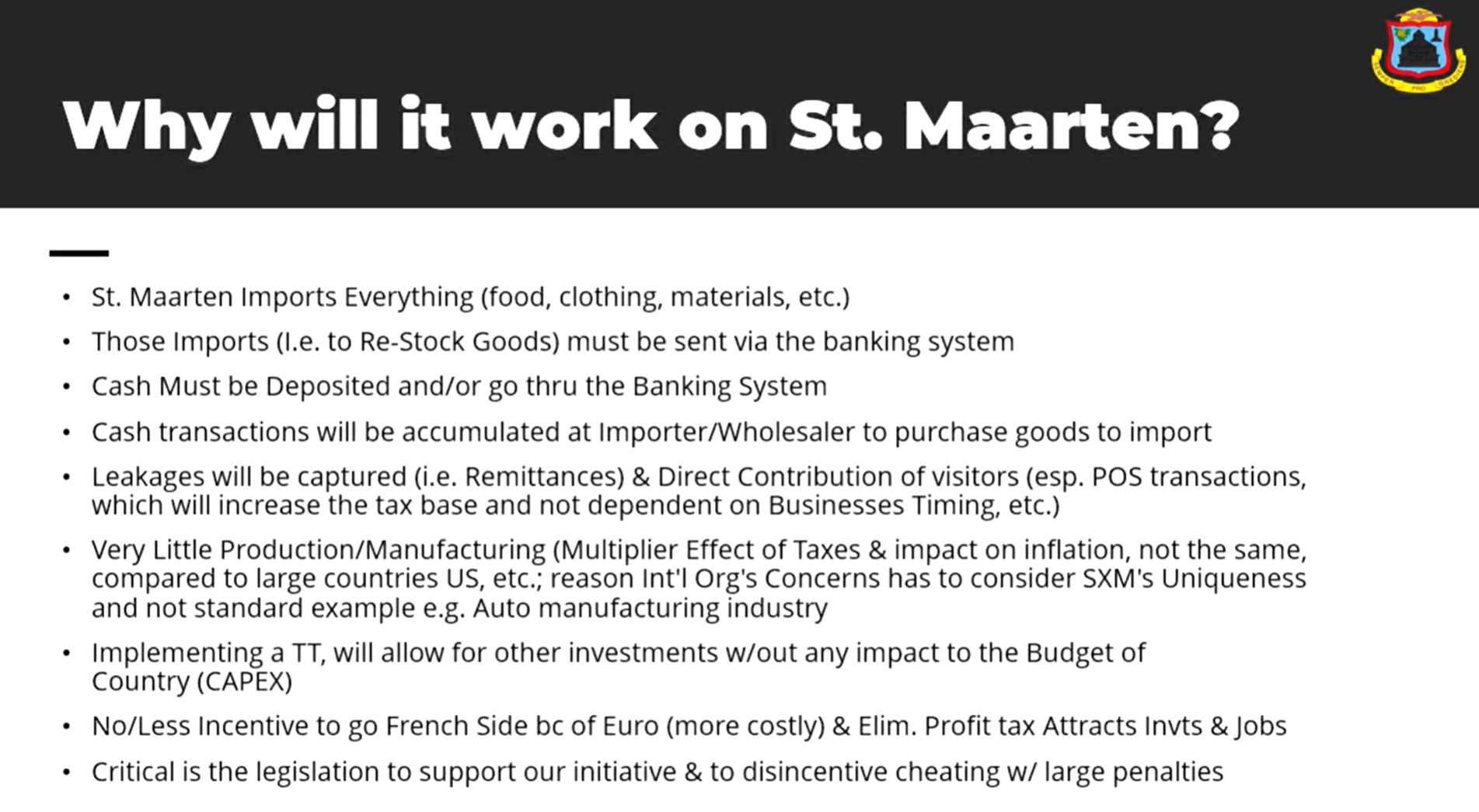
De Weever explained that the intention would be to capture substantial financial flows through the banking system without necessarily pursuing every individual cash transaction. Money circulating through cash-based businesses could eventually enter the banking system through purchases from suppliers, deposits or payments for imported goods.
The Secretary General reiterated that applying an illustrative five percent rate to the nearly 12 billion in transactions examined would generate approximately 590 million in theoretical revenue. Further research would be required to determine the composition of those transactions, possible exemptions and the amount government could collect.
Rolando Brison, who has been assisting with the research, said Central Bank statistics cited during the meeting showed ATM cash withdrawals valued at 357 million, cash deposits at 340 million and point-of-sale payment transactions at 935 million. He argued that electronic transactions already represent a substantial part of economic activity.
Concerns were also raised about businesses operating foreign point-of-sale terminals. Brison suggested that international banking regulations and reporting arrangements could assist authorities in identifying and addressing unauthorized terminals operating outside their licensed jurisdictions.
Continuity beyond the Minister's tenure
Jansen-Webster also questioned the timeline for introducing the FTT and how continuity would be guaranteed, particularly given Heyliger-Marten's announced intention to discontinue her political career.
The MP expressed concern that a future administration could introduce the transaction tax without carrying through the corresponding reductions in other taxes, leaving residents and businesses with an additional financial burden.
Heyliger-Marten responded that the Secretary General is leading the project and that the task force being established would remain in place irrespective of her political future. She said she would continue advocating for the initiative even after leaving office.
The Minister declined to provide a definitive timeline, explaining that research and consultation remain underway. Introduction could extend into the next governing term, depending on the findings and completion of the preparatory work.

Preventing higher consumer prices
MP Francisco Lacroes, who described himself as a supporter of the transaction tax concept, questioned how government would prevent businesses from retaining existing price increases associated with Turnover Tax (TOT) while passing additional transaction costs on to consumers.
Using transactions between suppliers, wholesalers and retailers as examples, Lacroes questioned whether repeated taxation throughout the supply chain could increase the final cost of goods.
De Weever said the proposed ASYCUDA customs system could improve government's access to information about import costs, which could assist with the development of pricing policies and discussions with businesses.
Brison explained that the wider concept under examination also includes eliminating profit tax, reducing wage tax by 50 percent and substantially increasing the minimum wage. These measures, he said, are being considered to offset potential increases in costs and improve purchasing power.
He also argued that eliminating profit tax could make St. Maarten more attractive to larger businesses, potentially increasing competition within the wholesale and retail sectors.
Irion questions costs and cumulative effects
MP Ardwell Irion requested further information regarding the fiscal expertise available to the research team, the cumulative effect of taxing successive transactions and the financial cost of establishing and administering the proposed system.
Irion also requested documentation concerning consultations with the International Monetary Fund (IMF), Organisation for Economic Co-operation and Development (OECD) and other international organizations.
He questioned whether the existing infrastructure used to collect the foreign exchange license fee could accommodate an FTT and requested confirmation of whether the Central Bank had assessed that possibility.
Brison explained that the research team had examined several possible tax rates, including three, four, five and six percent. The five percent example was selected for presentation purposes and does not represent a final decision.
He also indicated that international consultations had examined the conditions under which St. Maarten could potentially eliminate profit tax while maintaining compliance with international requirements.
Wescot-Williams calls for unified tax reform direction
MP Sarah Wescot-Williams questioned what was specifically expected of Parliament at this stage and whether the legislature should await the findings of the proposed task force before advancing discussions.
She recalled that a financial transaction tax had previously been proposed as part of economic recovery efforts following Hurricane Irma. At that time, she said, the suggested rate was 0.25 percent, with one percent regarded as the upper limit because of potential economic consequences.
Wescot-Williams questioned what had changed sufficiently to warrant examining a five percent rate and cautioned against creating expectations based on preliminary calculations.
She also expressed concern that the tax reform process being pursued under the Country Package and the FTT exploration could develop along separate paths, potentially delaying both initiatives.
The MP called for a definitive position from the Council of Ministers regarding whether government intends to fundamentally change its tax reform direction. She acknowledged that St. Maarten cannot adequately address its financial obligations with a budget consistently hovering around 500 million guilders.
Concerns over coordination between ministries
Other parliamentarians questioned the apparent differences in enthusiasm between the Ministries of TEATT and Finance concerning the proposed tax. They requested information about stakeholder consultations, comparable jurisdictions, feasibility study costs and the risks identified by international organizations, including tax avoidance, economic distortions and revenue sustainability.
A former TEATT minister also cautioned against overlooking existing revenue losses, particularly income generated through properties owned by individuals abroad whose financial transactions may never enter St. Maarten's banking system. She argued that existing gaps in tax registration and collection must also be addressed.
MP Egbert Doran questioned why the Minister of Finance was absent when much of the discussion concerned fiscal policy and responsibilities falling under that ministry. He acknowledged that Heyliger-Marten had made herself available to Parliament and announced that his faction would submit an urgent public meeting request involving both ministers to discuss tax reform.
Heyliger-Marten subsequently reiterated in her closing remarks that TEATT's exploration is part of the government's agreed program and that her ministry is carrying out its assigned responsibilities. She committed to returning to Parliament with responses to the outstanding questions.
The committee meeting was adjourned, with arrangements for its continuation to be coordinated with the Minister and her support staff.
Join Our Community Today
Subscribe to our mailing list to be the first to receive
breaking news, updates, and more.