.jpg)


SABA--Jocelyn Roberto Levenstone formally accepted the office of Island Governor of Saba on July 9, pledging to exercise his authority with discipline, humility and respect for the generations that shaped the island.
Levenstone, addressing members of the Island Councils and Executive Councils of Bonaire, St. Eustatius and Saba, the Kingdom Representative, Acting Governor Nicholson, dignitaries, invited guests, relatives, clergy, elders, teachers, fishermen and residents, said his installation represented both a personal homecoming and a moment of historical and constitutional significance.
He also acknowledged Sabans living abroad who followed the ceremony from across the world, describing them as part of the island community regardless of where they were born or presently reside.
“I, Jocelyn Roberto Levenstone, standing before this island and under the authority of the Kingdom, do accept the leadership conferred upon me as Gezaghebber of Saba, and I pledge to carry it with the discipline, humility, and honor owed to those who came before me and those who will come after,” Levenstone said. The installation was held on the birthday of his family’s matriarch, Rebecca Levenstone, a date he said carried deep personal meaning.
Levenstone was appointed to the office by Kingdom decree on July 1, Emancipation Day. His inauguration eight days later coincided with Rebecca Levenstone’s birthday and the entry into force on Saba of reforms to the Public Entities Act and Public Entities Finance Act, commonly referred to as WolBES and FinBES. Following the decision in the First Chamber, the rewritten laws introduced changes to the constitutional relationship, financial responsibilities and reporting arrangements governing the Caribbean public entities.
Levenstone described the period as the meeting of three important developments: the remembrance of emancipation, changes to the constitutional order within the Kingdom and the installation of a son of Saba as Island Governor. “Three currents meet in this single period: the memory of chains broken, the law of a Kingdom renewed, and the installation of a son of this island as its Gezaghebber,” he said.
Levenstone spoke openly about his ancestry and the history of slavery on Saba, identifying himself as a descendant of people who were enslaved on the island. He said this was not merely symbolic language, but a matter of family history and recorded fact. For many Saban families, he said, their history did not begin in positions of authority or privilege, but in bondage, unpaid labour and circumstances in which enslaved people were given names by those who claimed ownership over them. “That is where my line starts. That is the ground on which I stand,” Levenstone said.
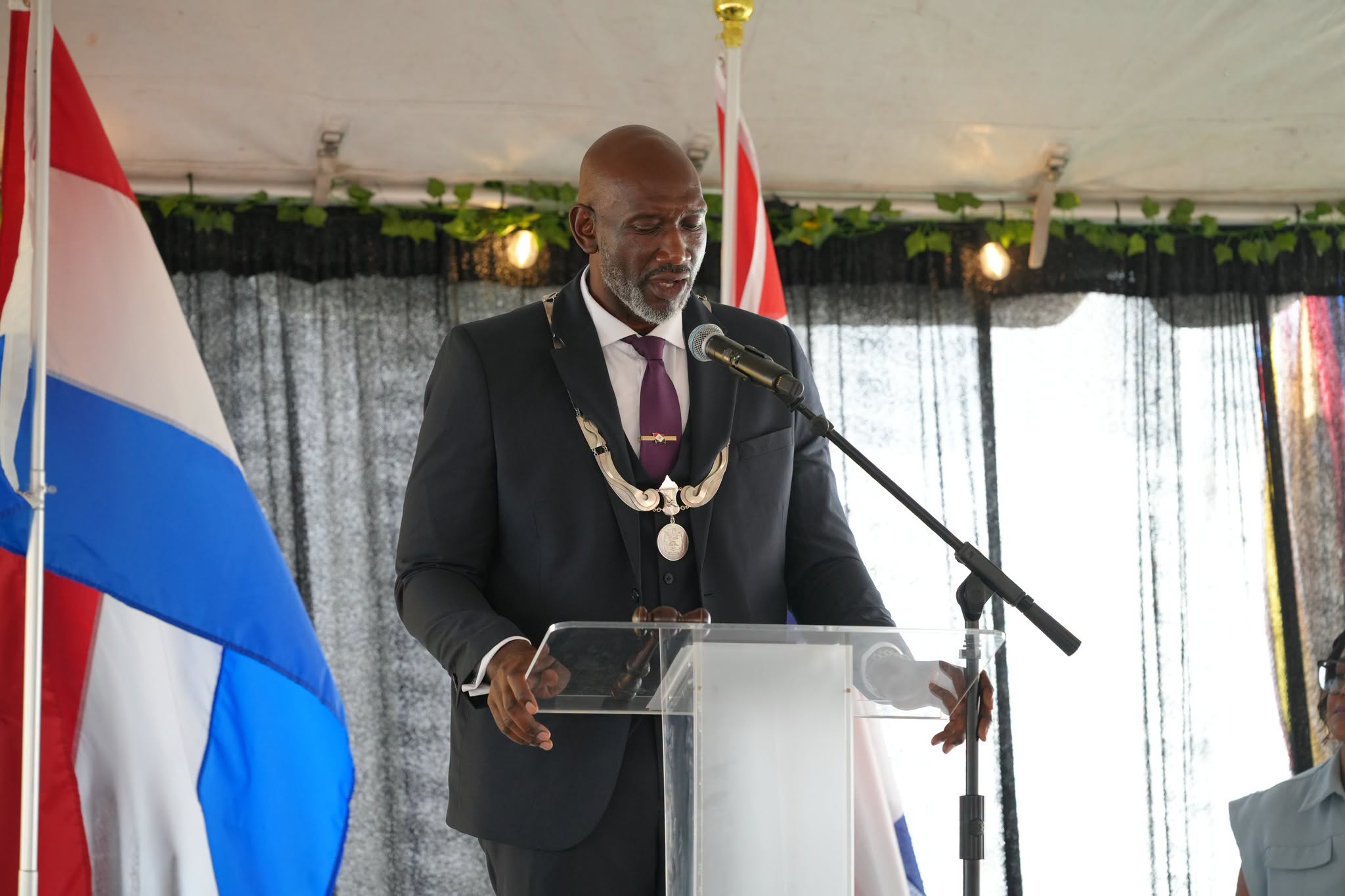
His first official responsibility after assuming office was to lead Saba in remembering the island’s history of slavery and emancipation. Levenstone said the commemoration was not intended to be treated simply as a ceremony, but as a lesson that should influence future decisions. The island paused to name and honour those who suffered under slavery so that the work carried out afterward would be done with that history clearly in view.
He stressed that he did not reach the office alone, acknowledging the relatives, partners, colleagues, teachers, elders and community members who supported him throughout his life and career. Levenstone thanked his life partner Victoria Williams and her family, as well as members of his immediate and extended families. He also paid tribute to relatives and ancestors whose sacrifices contributed to the opportunities available to him.
He said he carried the name and blood of Becca and Bully Levenstone and remembered Mathew Levenstone, whose contributions to the community were not always fully captured in official records. Levenstone described them as Sabans whose lives were defined not by titles, but by labour, endurance and the work of raising families on a Caribbean island with limited material resources.
“Theirs were not lives of title. They were lives of labor, of endurance, of raising children on a rock in the Caribbean Sea with almost nothing but each other and this mountain,” he said. He said Saba’s development was built partly on the sacrifices and contributions of people such as these, even when their names were not widely recorded.
Levenstone also honoured Bernadette Levenstone, Agatha Charles, Alidia Levenstone, Alma Louise Charles and Christina Woodley-Charles. He described them as Saban women who did not seek public recognition and for whom no monuments were erected, but who established enduring standards for family life, faith, dignity, personal responsibility and keeping one’s word.
According to Levenstone, he did not fully understand as a younger man what these women were teaching him. He said he now understood that their example prepared him to carry himself with dignity and responsibility at an important moment in his life.
Levenstone said his journey to the office had not followed a straight path and that he had become convinced it unfolded according to a greater design. “This was God’s divine intervention,” he said, while thanking the many people, both known and unknown to him, who prayed for his success and perseverance. He said those prayers, whether offered regularly or at different moments throughout his journey, strengthened him and contributed to his ability to stand before the people of Saba as their Island Governor.
Levenstone reflected on a career that included service in maritime security, the Dutch Caribbean Coast Guard, immigration and border protection, as well as participation in discussions concerning relations within the Kingdom. He served as a harbour and maritime security officer at the port in St. Maarten and later worked at sea in the uniform of the Dutch Caribbean Coast Guard.
He also worked in immigration and border protection services, describing that field as involving difficult responsibilities that are often carried out outside public view. His work brought him into meeting rooms in both The Hague and Philipsburg, where he participated in discussions concerning what the Kingdom owes its smallest islands and what the islands owe one another. Levenstone said every position taught him the same lesson from a different perspective: authority exercised without discipline can become dangerous, while discipline applied without compassion can become cruel.
He pledged to continue balancing both principles throughout his term. “Authority without discipline is dangerous, and discipline without compassion is cruelty. I have tried to carry both. I will keep trying for as long as I serve,” he said.
Levenstone also acknowledged the teachers who continued working with him during his youth, including at times when he was not always easy company. He thanked commanding officers who corrected him without humiliating him and colleagues throughout Saba, St. Maarten and the wider Kingdom who entrusted him with responsibility before he believed he had fully earned it. He said their confidence taught him to grow into the responsibilities placed before him.
Levenstone also recognized the elders of Saba who spoke honestly to him about the standards expected of anyone entrusted with the office of Island Governor. He said the debt he owes those who guided him can only be repaid through the manner in which he governs. Levenstone further acknowledged his two children and the partners, past and present, who walked alongside him at different stages of his journey. He said the daily responsibilities of raising children taught him more about patience, humility and steady leadership than any professional position or official title.
Turning to the responsibilities of the office, Levenstone stressed that the position of Gezaghebber should not be regarded as a crown. “It is a post,” he said. He described the office as the point where the authority of the Kingdom and the will of Saba are expected to meet without either side overwhelming the other.
Levenstone said the reforms to WolBES and FinBES were redrawing that relationship in real time, establishing new rules for how The Hague engages with Saba, new obligations governing how Saba manages its own affairs and new reporting requirements.
Through his roles on the relevant councils, and in cooperation with their members, Levenstone said he intends to maintain a position that remains open to partnership with the other countries and entities within the Kingdom while firmly defending Saba’s dignity and self-respect. He stressed that this approach was not intended as a slogan, but as a governing method.
For Levenstone, the method requires maintaining standards even when no one is observing, ensuring that the Executive Council conducts itself with the understanding that its decisions will eventually be judged by future generations and building an Island Governor’s Cabinet based on competence, discipline and care rather than convenience.
He noted that Saba’s population of approximately 2,000 people has never allowed the island’s small size to determine its character, ambition or sense of responsibility. Levenstone told residents that he was shaped by Saba as much as by his own personal choices. He said he was formed by ancestors who endured slavery, by relatives who lived with dignity and quiet grace and by living teachers and elders who helped a difficult young man learn how to conduct himself.
He pledged to carry all of them into the office with him, whether their names appear in official archives or remain preserved only in family and personal memory. “Emancipation freed the body. What we do from here must free the future. That is the work,” Levenstone said.
He added that he did not return to the mountain to become comfortable in the office, but to serve Saba. “Long live Saba. Long live the Kingdom we choose to build together on honest terms. And may we never again need reminding of what it cost to bring us to this reality,” Levenstone said.
Join Our Community Today
Subscribe to our mailing list to be the first to receive
breaking news, updates, and more.