

.jpg)


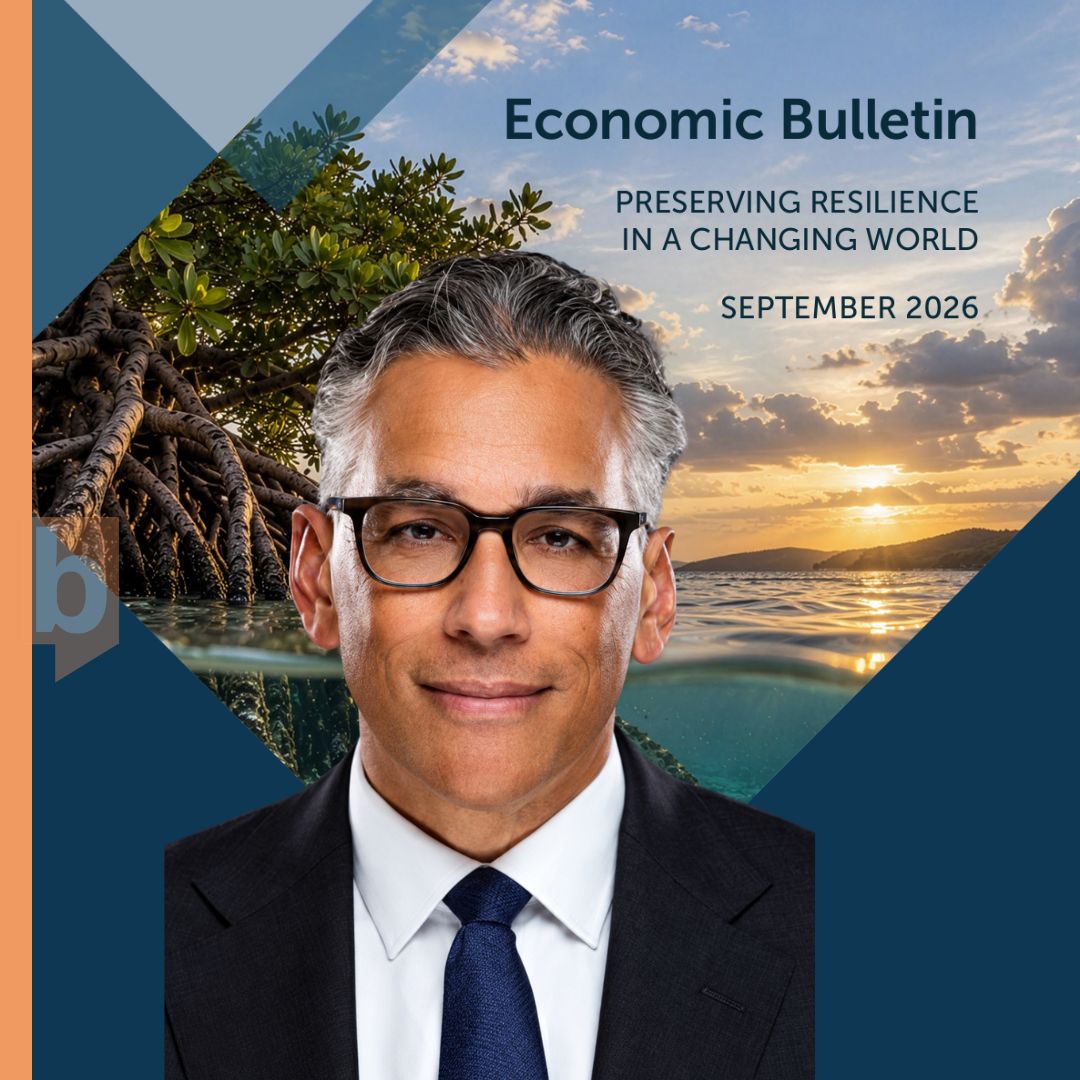
GREAT BAY--St. Maarten has moved beyond the economic recovery phase, but the challenge now facing the country is whether it can protect the gains it has made while preparing for an increasingly uncertain global environment, according to Central Bank President Ference Lamp.
In his report accompanying the CBCS September 2026 Economic Bulletin, Lamp argues that the economies of St. Maarten and Curaçao continue to demonstrate resilience, supported by tourism, private investment and favorable fiscal positions. Growth is expected to continue in 2026 and 2027, although at a slower pace than the strong expansion recorded in recent years.
For St. Maarten, the Central Bank now expects real Gross Domestic Product to grow by 3.1 percent in 2026. That is lower than the 3.5 percent growth recorded in 2025, but considerably stronger than the Bank expected only a few months ago. The new projection is 0.5 percentage points higher than its June forecast.
Private demand is expected to remain the principal driver of the economy, supported by household spending and continued residential and commercial construction. Tourism is also performing better than previously anticipated, strengthening activity in accommodation and food services, transportation, storage and communications, with spillovers into wholesale and retail businesses. Growth is projected to moderate further to 2.5 percent in 2027.
Lamp’s message, however, extends beyond whether St. Maarten records another year of economic growth. The broader question raised by the bulletin is how the country manages that growth and how much of its economic value ultimately remains in St. Maarten.
The Central Bank President stresses that continued tourism development has to be considered alongside infrastructure capacity, available space and environmental concerns. For a small island economy with limited land, growing visitor numbers and continued development cannot be treated separately from roads, utilities, public services and the physical capacity of the country.
The challenge is particularly important for St. Maarten because tourism remains the main engine of the economy. CBCS says tourism will continue to be important for foreign exchange earnings, employment and business activity, but says greater attention should be placed on increasing the amount of value retained locally.
That means strengthening local supply chains, creating stronger connections between tourism and domestic businesses, increasing visitor spending and reducing economic leakages. CBCS also argues for investment in sectors outside tourism so that economic benefits can reach a wider range of businesses and households.
For St. Maarten specifically, Lamp identifies disaster-risk financing, climate resilience and adequate infrastructure and public services as critical priorities as tourism continues to expand.
Those priorities are becoming more important as the external environment becomes less predictable. The bulletin identifies geopolitical tensions, trade fragmentation, international energy prices, shipping costs and weaker global growth among the risks facing the monetary union.
Inflation provides an immediate example. St. Maarten’s inflation rate is projected to rise sharply from 0.9 percent in 2025 to 2.8 percent in 2026, driven largely by international oil prices and transportation costs. Inflation is projected to ease to 2.3 percent in 2027, although CBCS warns that uncertainty surrounding oil and transportation costs remains significant.
St. Maarten’s fiscal indicators, meanwhile, continue to improve. The current budget surplus is projected to increase from 0.7 percent of GDP in 2025 to 1.2 percent this year and 1.5 percent in 2027. The public debt-to-GDP ratio is projected to decline from 40.7 percent in 2025 to 39.2 percent this year and 38.4 percent next year. The reduction in the ratio, however, comes as economic growth offsets additional borrowing for public investment.
Lamp also places stronger tax administration among the priorities for both countries. CBCS points to compliance, digitalization, administration and enforcement as ways of increasing government revenue without necessarily raising statutory tax rates. It also calls for better data to identify possible revenue leakage and improve fiscal planning.
The Bank similarly calls for improvements to the investment climate, including reducing administrative burdens, improving access to financing for small and medium-sized businesses and aligning education and training more closely with the labor market. Public investments, it says, should focus on projects that strengthen infrastructure, transportation, climate resilience, energy security and the country’s ability to generate income from abroad.
Lamp’s central message is therefore not that the St. Maarten economy is in difficulty. The bulletin shows an economy that continues to grow, with tourism exceeding earlier expectations and the fiscal position strengthening.
The warning is that economic resilience should not be treated as permanent. For St. Maarten, the next stage is about converting growth into stronger infrastructure, greater local economic participation, better public services and the financial buffers needed to withstand the next external shock.
Join Our Community Today
Subscribe to our mailing list to be the first to receive
breaking news, updates, and more.
