.jpg)


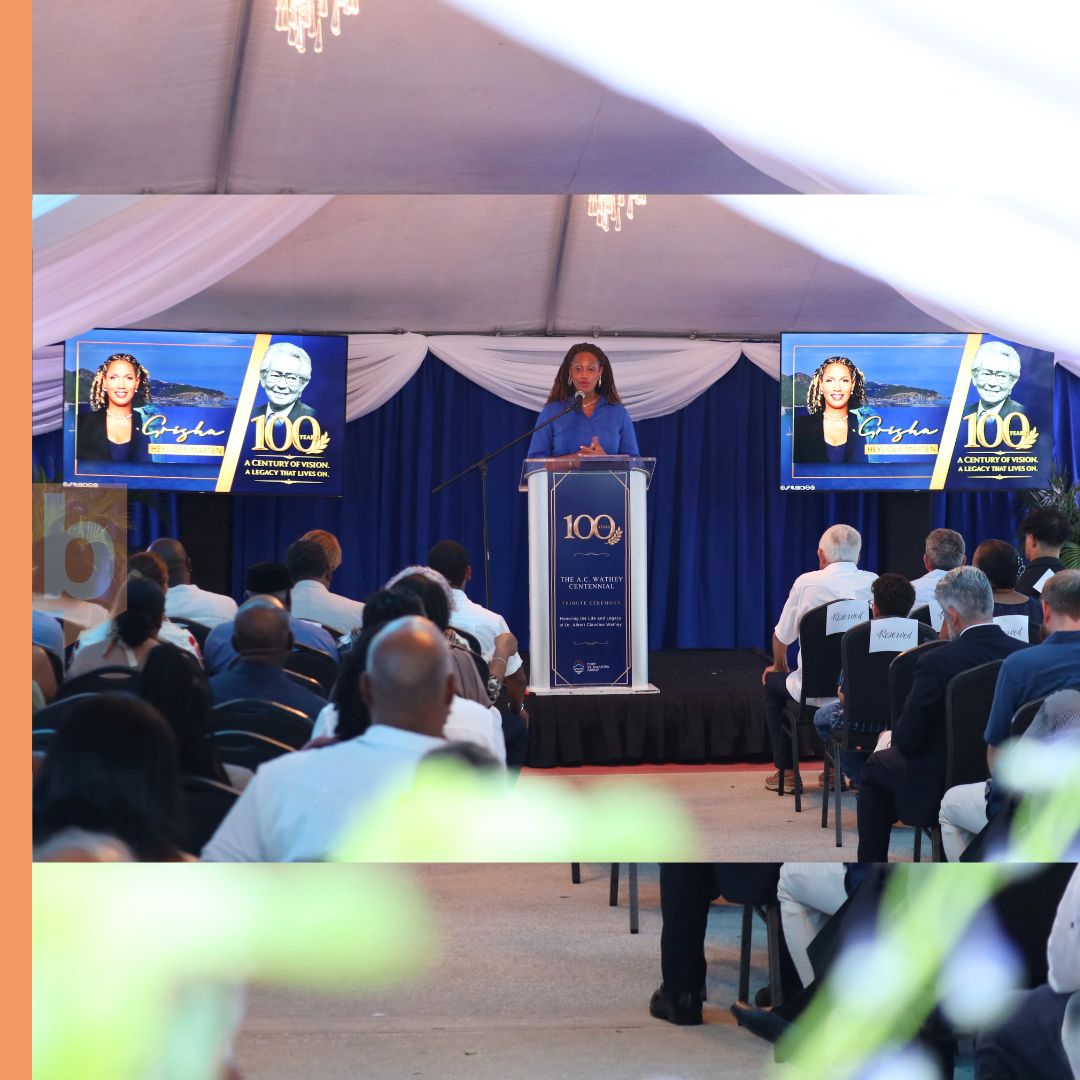
GREAT BAY--Deputy Prime Minister and Minister of Tourism, Economic Affairs, Transport and Telecommunication Grisha Heyliger-Marten marked the centennial of Dr. Albert Claudius “Claude” Wathey with a reflection on his family life, political leadership and role in transforming St. Maarten from an island with limited opportunities into an internationally connected tourism destination.
Speaking during the July 24 celebration commemorating 100 years since Wathey’s birth, Heyliger-Marten said public remembrance of the man widely known as the “Ole Man” often begins with politics, tourism and national development. She chose instead to begin with the grandfather known by his family.
“Before we speak about the man who helped build a country, I want us to meet the man his grandchildren knew, the grandfather whose lessons began long before they were old enough to understand them,” she said.
Heyliger-Marten recalled Wathey’s Sunday drives around the island with his older grandchildren, during which he shared stories, laughter and songs. The outings would end at the family home, where he prepared a separate breakfast for each child based on what that grandchild liked.
“Imagine that: a man carrying the future of an entire island in his mind, yet still taking the time to know what each grandchild liked for breakfast,” she said.
The breakfast routine also included a spoonful of cod liver oil for every child, a requirement Wathey would not allow them to avoid.
“You could complain. You could make a face. You could try to reason with him. But the Ole Man had made up his mind. No negotiation. No postponement. No committee meeting. And definitely no appeal,” Heyliger-Marten said.
She said the story captured the combination of affection, discipline and conviction that Wathey displayed in both his personal and public life.
“He was loving, but firm. He could laugh with you, care for you and still insist on what he believed was best for you,” she said. “Once the Ole Man decided something was necessary for the good of those entrusted to him, he did not take no for an answer.”
Heyliger-Marten said the determination that led him to insist on the cod liver oil was the same determination that helped place St. Maarten before the world.
“With the Ole Man, family and country were never far apart,” she said. “The qualities he showed at home, care, discipline, conviction and an unwillingness to accept that something could not be done, were the same qualities he brought to the leadership of St. Maarten.”
She addressed the gathering not only as Deputy Prime Minister and Minister of TEATT, but also as the wife of one of Wathey’s eldest grandsons and the mother of three of his great-grandsons.
“I stand as a member of a family that continues to carry his lessons, his memories and his deep love for St. Maarten,” she said. “Tonight, one hundred years after his birth, we are living in the St. Maarten others told him was impossible.”
Wathey saw opportunity when others saw limitations
Heyliger-Marten recalled that work was scarce when Wathey entered public life, forcing many St. Maarteners to leave for Aruba, Curaçao and other destinations because they could not see a future at home.
She said Wathey looked at the same small island and imagined cruise ships arriving in Great Bay, passenger aircraft connecting Simpson Bay with the wider world, and an economy built around St. Maarten’s beaches, location and people.
“Most importantly, he saw St. Maarteners leaving and decided that we had to build an island they would want to return to,” she said. “That is vision. Vision is seeing what others cannot yet see, and having the courage to begin building it.”
She highlighted the efforts of Wathey and Clem LaBega, who travelled abroad to promote St. Maarten at a time when government had little money. At times, she said, they could afford only one hotel room and had to share it while seeking support from hotels, cruise lines and investors.
“They travelled with determination and belief in this little rock,” Heyliger-Marten said. “They persuaded hotels, cruise lines and investors to take a chance on a St. Maarten the world had not yet discovered.”
The island gradually changed as hotels, jobs and cruise ships arrived, residents began returning home, and the airport, harbour, roads and communities expanded.
Heyliger-Marten also recalled Wathey putting on a hard hat and helping to move rocks and debris during construction of the former pier that carried his name.
“That was his style,” she said. “Leadership was not pointing from afar. Leadership was putting your hands to the work.”
As Minister of TEATT, Heyliger-Marten said she encounters Wathey’s legacy through every aircraft landing at Princess Juliana International Airport, every cruise ship entering the harbour and every St. Maartener earning a living through tourism.
“He understood that our greatest resource was not beneath the ground,” she said. “Our greatest resource was, and remains, our people. Our friendliness. Our adaptability. Our courage to begin again after every storm.”
Preparing the next generation through responsibility
Heyliger-Marten also reflected on how Wathey prepared his grandson Theo Heyliger for leadership.
She recalled that Theo was only 15 when Wathey sent him and his cousin Roddy to Saba and St. Eustatius to secure political signatures needed to help remove a 10 per cent crisis tax imposed by the Central Government in Curaçao on people in the Windward Islands.
“The instructions were clear: travel to Saba and Statia, meet senators, secure their signatures and bring the document safely home,” she said. “Most young men that age were being sent to the shop. Theo was being sent across the Windward Islands to help lift a financial burden from the people.”
She said Wathey prepared Theo not by giving him a title, but by placing responsibility in his hands.
“He prepared him by trusting him with responsibility,” Heyliger-Marten said. “Long before Theo entered public office, he was learning to build relationships, make decisions and get things done.”
She drew a connection between Wathey’s early tourism vision and projects later advanced by Theo Heyliger, including the expanded port and the Boardwalk.
“The Ole Man imagined the gateway. Theo understood that the gateway had to be widened,” she said. “The Ole Man showed St. Maarten what was possible. Theo took that possibility and built for the next generation.”
Heyliger-Marten stressed that leadership is not automatically inherited through family connections.
“A family name may open a door, but only character, work and the confidence of the people can keep that door open,” she said. “Theo had to establish his own record.”
She urged St. Maarteners not to allow party differences or political rivalry to erase contributions made to the country’s development.
“We do not all have to agree politically to be honest historically,” she said. “We can disagree about personalities. We can disagree about parties. We can disagree about decisions made along the way. But we should never allow political rivalry to erase the work that helped shape our country.”
She pointed to the Boardwalk, expanded port, roads and other public works as a record written into the physical landscape of St. Maarten.
“Leadership is not established by title alone,” she said. “It reveals itself in the person whose vision people recognize and trust, whose work changes their daily lives, whose absence is felt and whose experience remains relevant to the future.”
Heyliger-Marten said the political movement Wathey helped build carries a responsibility not only to protect its history, but also to preserve its founding spirit of courage, development and service.
“A country does not move forward by forgetting its builders,” she said. “It moves forward by recognising when one of them is still ready to build.”
She called for government to work for the people, for young residents to be given reasons to remain in St. Maarten and for those who left to be given reasons to return.
“Let us put aside the divisions that keep us standing still,” she said. “And let us recognise vision, experience and leadership when they stand before us.”
She concluded that Wathey’s political chapter may have ended, but his vision continues through those willing to understand the sacrifice and commitment upon which St. Maarten was built.
“The torch must be passed, because the vision must continue,” she said. “It must be carried forward by those who understand it, value it and are willing to dedicate themselves to preserving and advancing it.”
“Happy 100th birthday, Ole Man. Your family remembers you. Your people still speak your name. And the work you started is not finished,” Heyliger-Marten said. “The vision continues. The road continues. Your hope for your people will continue.”
Join Our Community Today
Subscribe to our mailing list to be the first to receive
breaking news, updates, and more.