





GREAT BAY--Minister of Tourism, Economic Affairs, Traffic and Telecommunication (TEATT) Grisha Heyliger-Marten has introduced the possibility of a financial transaction tax as part of a broader discussion on reforming St. Maarten's revenue system, reducing existing tax burdens and creating a more attractive investment environment. The Minister also disclosed that a proposal for a dedicated investment promotion agency has been presented to her, potentially establishing a new institution to assist investors and support the expansion of local businesses.
Speaking during Tuesday's parliamentary debate on the draft 2027 National Budget, Heyliger-Marten emphasized that the transaction tax concept is an idea requiring research, economic analysis and consultation, rather than an approved government policy or a proposal to introduce an additional tax at a predetermined rate.
The Minister raised the issue within a wider discussion about St. Maarten's ability to generate sufficient revenue to finance national development, improve public services and provide greater financial relief to households and businesses.
With the draft 2027 National Budget projecting approximately Cg 670 million in government revenue, Heyliger-Marten suggested that St. Maarten should begin examining what would be required to eventually support a national budget of Cg 1 billion.
She presented the figure as a longer-term ambition dependent on economic growth, improved revenue collection, investment, fiscal reform and credible financial projections, not as an established revenue target for 2027.
Examining a Different Approach to Taxation
At the center of the Minister's discussion was whether the country's existing tax structure places too much pressure on a relatively small population and established businesses, while other forms of economic activity could contribute more broadly to government revenue.
She pointed to the combined effect of wage and income taxes, turnover tax and profit tax, noting that businesses must meet those obligations while also covering salaries, rent, electricity, insurance, supplies and other operating expenses.
For employees, the amount deducted from their salaries directly affects the money available for household expenses.
Heyliger-Marten suggested that government should examine whether a broader revenue collection system could create opportunities to reduce, restructure or potentially replace certain existing taxes while maintaining the funding needed for public services.
One option identified for study is a financial transaction tax.
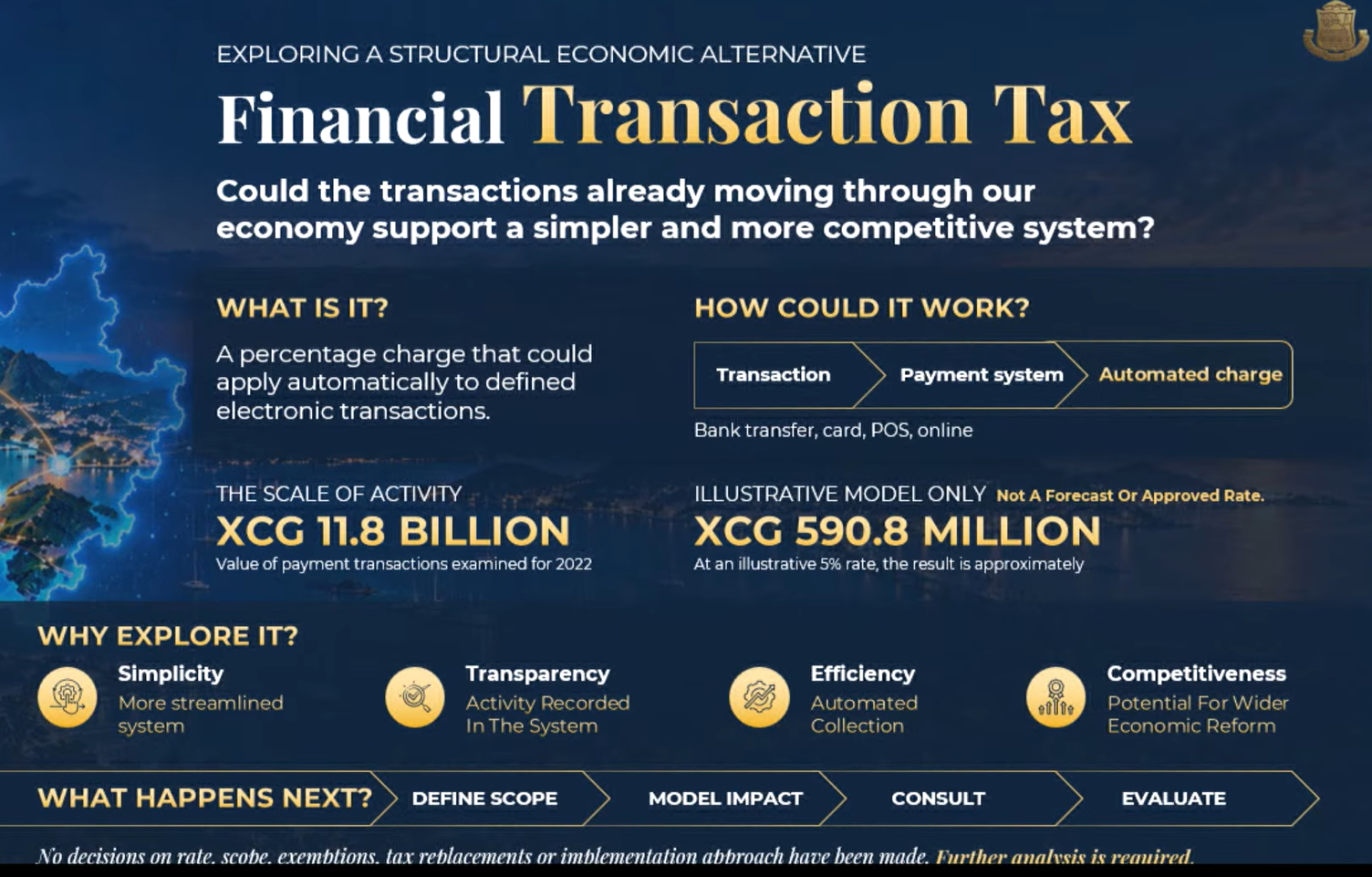
Under the concept described during the presentation, a percentage-based charge could be collected automatically on clearly defined electronic financial transactions.
The potential attraction of such a mechanism is that collections could take place through the payment system, possibly reducing certain administrative requirements associated with traditional taxation.
However, the Minister emphasized that the critical issue is whether such a system could generate sufficient and predictable revenue to allow meaningful reductions in other taxes without increasing the overall financial burden on residents and businesses.
The proposal, as discussed, is not intended simply to introduce another tax on top of the existing system.
Illustrative Calculation Is Not a Proposed Tax Rate
During the presentation, Heyliger-Marten referred to approximately 11.8 billion guilders in payment transactions recorded in 2022, drawing on Central Bank payment system statistics.
Using that volume purely for illustration, she explained that a hypothetical five percent charge would produce an arithmetic figure of approximately 590 million guilders.
The Minister specifically cautioned Parliament against interpreting that example as a proposed tax rate or a reliable estimate of potential revenue.
No five percent financial transaction tax has been formally proposed, and the illustrative Cg 590 million figure should not be treated as a government revenue forecast.
The transaction volume was used to demonstrate the scale of financial activity and the reason the concept might warrant examination.
A major part of any assessment would involve determining which transactions could legitimately form part of a taxable base, which should be exempt and whether repeated transfers of the same money could result in multiple charges.
For example, money may pass between businesses, suppliers, financial institutions and consumers several times before reaching its final destination. A transaction-based charge applied at different stages could accumulate and eventually be passed on through higher prices.
The Minister acknowledged that these effects would have to be studied carefully, particularly in a small economy where most consumer goods are imported.
Other considerations include whether businesses and individuals could shift toward cash payments or alternative financial arrangements to avoid transaction charges, potentially affecting revenue collection and the functioning of the payment system.
The central question, according to the presentation, is whether the overall financial position of workers and businesses would actually improve after accounting for the new mechanism and any reductions in existing taxes.
Without that evidence, a large payment transaction volume cannot be assumed to represent an equally large or reliable source of government revenue.
Could Existing Taxes Be Reduced or Replaced?
Heyliger-Marten raised the possibility of moving toward a simpler tax system with a broader contribution base and lower burdens on individual taxpayers.
Among the options for examination is whether income-related taxation and other existing obligations could be reduced or potentially replaced through a combination of alternative revenue mechanisms.
The Minister linked this discussion to the need to create an environment in which employees retain more of their earnings and businesses have greater financial capacity to invest, purchase equipment and create employment.
However, no formal proposal to abolish income tax, turnover tax or profit tax was presented, and no implementation schedule was announced.
Any restructuring would require detailed economic and fiscal analysis, coordination with the Ministry of Finance, appropriate government decisions and the applicable legislative process.
The Minister also made clear that a financial transaction tax, even if found feasible, should not be examined in isolation.
Tourism and Other Economic Activities Could Contribute More
Heyliger-Marten argued that St. Maarten's revenue strategy should take greater account of the scale of economic activity generated by tourism and other sectors.
Although the country's resident population is relatively small, its infrastructure and public services support a much larger flow of visitors and economic transactions.
She suggested examining whether a greater portion of that activity could contribute to financing the services and infrastructure on which the economy depends.
The options identified for further assessment include a moderate tourism entry fee, modernization of accommodation taxation, improved treatment of short-term vacation rentals and online accommodation platforms, and a review of the existing room tax framework.
The Minister also referred to carefully targeted excise taxes on selected products, taking into account their potential effects on lower-income households.
The maritime sector was identified as another area for possible revenue modernization, including mooring and anchorage charges, commercial vessel licensing and fees connected to maritime services.
She emphasized that any new or revised charges should be proportionate, transparent and supported by appropriate services and infrastructure.
Importantly, the Minister indicated that these measures must be assessed together, rather than individually, to determine their combined effect on residents, businesses, visitors, investment and government revenue.
Proposed Investment Agency Forms Part of Wider Strategy
Alongside the discussion on taxation, Heyliger-Marten revealed that a proposal for a dedicated investment promotion structure had been submitted to her approximately one week before the budget presentation.
According to the Minister, the concept could begin as a foundation and potentially develop into an investment bureau.
The proposal remains at an early stage, with no final institutional structure or implementation timeline announced.
The envisioned agency would assist in attracting investment, guiding prospective investors through government procedures and supporting the expansion of existing businesses.
Heyliger-Marten stressed that attracting international investors should not come at the expense of local entrepreneurs, who should have access to comparable assistance when seeking to establish or expand their operations.
The proposed agency would therefore be expected to support both foreign investment and domestic business development.
However, the Minister also acknowledged that establishing an investment agency would accomplish little without corresponding improvements in the business environment.
Administrative procedures, business licensing, regulatory requirements and the overall tax framework would need to support efficient investment and business operations.
The Ministry is already pursuing digitalization of business licensing and administrative processes, which Heyliger-Marten identified as important components of creating a more accessible and competitive business environment.
The investment agency concept and the proposed review of the tax system were presented as complementary initiatives: one aimed at creating more economic activity and the other at examining how that activity can support government revenue without placing excessive burdens on individual taxpayers.
A Wider Discussion on Financing National Development
The Minister's proposals raise several questions that would need to be addressed before any transaction-based tax or major restructuring of existing taxes could advance.
These include the potential effect on consumer prices, the competitiveness of local businesses, the treatment of essential transactions, collection costs, financial sector operations and the amount of revenue that could realistically be generated after exemptions and other adjustments.
There is also the question of how alternative taxes would interact with the government's existing tax obligations and whether the resulting system would be simpler and fairer in practice.
Heyliger-Marten indicated that TEATT's responsibility would be to advance the economic and investment policies that support growth, while working with the Ministry of Finance and other partners on the broader fiscal implications.
She stated that the Ministry's management team supports examining the financial transaction tax concept as part of a possible approach to strengthening the economy and reconsidering the existing tax burden.
The Minister's longer-term ambition is to create a financial and economic framework capable of supporting greater government revenue, stronger public services and more opportunities for private sector development.
For now, however, the financial transaction tax remains a concept for investigation, the investment promotion agency remains a proposal, and the possibility of replacing existing taxes remains dependent on further assessment and government decisions.
The immediate significance of the presentation is that the Minister has placed alternative taxation and investment promotion on the policy agenda, opening a discussion about whether St. Maarten can expand its revenue base while reducing the financial pressure on the households and businesses that currently support it.
Join Our Community Today
Subscribe to our mailing list to be the first to receive
breaking news, updates, and more.