

.jpg)
.jpg)


GREAT BAY--The 2025 Annual Report of the Coast Guard for the Kingdom of the Netherlands in the Caribbean points to a clear conclusion: the organization must continue its transition toward a fully 24/7, intelligence-led maritime law enforcement organization, supported by stronger personnel capacity, modern detection tools, upgraded vessels and deeper cooperation with local, regional and international partners.
The report, issued in accordance with the Kingdom Act on the Coast Guard for Aruba, Curaçao and St. Maarten and the public entities Bonaire, St. Eustatius and Saba, reviews the Coast Guard’s 2025 operations, results and progress against its annual plan. It states that the Coast Guard remained available and deployable 24 hours a day when needed, while continuing to build toward a structure in which even regular operations are organized around continuous deployment and intelligence-guided policing in the maritime domain.
A central message of the report is that this transition requires sustained investment in both personnel and equipment. In 2025, the Coast Guard worked on major material projects, including replacement of cutter capacity, replacement of smaller vessel capacity, and important steps toward shore-based detection capacity for the Windward Islands. The report states that the shore radar project for the Windward Islands continued under Defense, permits were requested, and the first mast remains on schedule for delivery in the summer of 2026.
For St. Maarten, the report highlights several direct actions. The Coast Guard placed personnel with specific investigative teams of the local police force as part of plans to strengthen border control. The St. Maarten substation also received Defense support for patrols in Simpson Bay earlier in the year due to an increased number of thefts in that area. The Coast Guard further participated in the five-party consultation on St. Maarten and supported multi-agency maritime visibility and controls, including activity around events such as the Heineken Regatta.
The report also notes that St. Maarten played a role in resolving a long-standing personnel administration issue. Delays in national decrees for promotions and appointments of Coast Guard employees in St. Maarten had led to a go-slow action during the year, during which regular patrols were not carried out for several weeks. According to the report, political and administrative intervention by St. Maarten helped clear the backlog in these national decrees.
Operationally, the Coast Guard reported significant activity across the Caribbean part of the Kingdom in 2025. Its results included the interception of 5,783 kilograms of cocaine and 5,450 kilograms of cannabis, 10 weapons and 64 rounds of ammunition, 69 undocumented persons, 1,713 controls, 364 maritime enforcement reports, 19 fisheries reports, 58 other reports, and 258 search and rescue notifications in which 443 persons were rescued. The Coast Guard also registered 14 deceased and 38 missing persons in its area of responsibility.
The report explains that some of these results were achieved directly by the Coast Guard, while others involved third parties acting on Coast Guard information or coordination. The Coast Guard was regularly involved in rescue and counter-drug operations with chain partners, including the United States Coast Guard, through cooperation that the report states was separate from the United States’ national operation in the region.
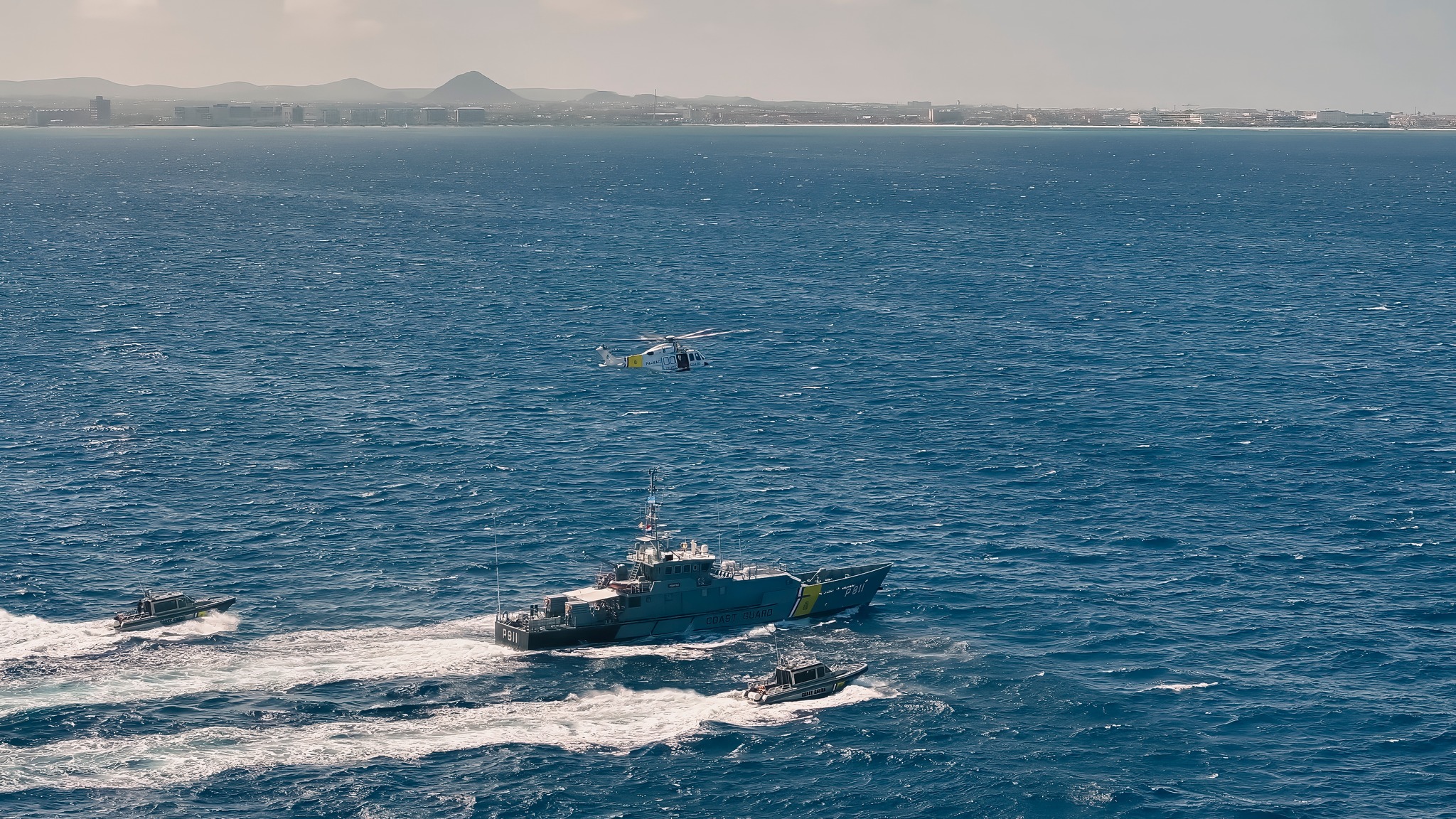
At the same time, the report identifies operational constraints. The Coast Guard achieved fewer cutter sailing days than planned, mainly because of limitations in staffing and reduced material availability. The report says the labor market for specialized cutter functions remained tight, recruitment and retention were difficult, personnel absence reduced operational capacity, and there was a lack of qualified reserve personnel. Aging cutters also required additional unplanned maintenance, while some parts were difficult to obtain.
The regional security environment also affected operations. According to the report, geopolitical developments from August onward created tensions in the region. As a result, the Defense station ship, which is normally periodically made available for Coast Guard operations, was prioritized for monitoring the security situation around the Leeward Islands. This limited its availability for Coast Guard-led counter-drug operations in international waters, although it continued to support the Coast Guard where needed in territorial waters.
The Coast Guard also reported that, despite concerns over regional instability, it did not observe a significant increase in the flow of undocumented persons toward the Kingdom in 2025. In fact, the report states that cases involving suspected human smuggling or trafficking decreased, though the Coast Guard said it had no explanation for the decline. Most undocumented persons encountered came from Venezuela.
The report places strong emphasis on cooperation. In 2025, the Coast Guard worked with justice chain partners, Defense and international partners. It strengthened information-sharing through working groups and coordination platforms focused on cross-border and undermining crime. Internationally, the Coast Guard consolidated cooperation with Colombia and continued cooperation with the United States on law enforcement and rescue-related work, while stating that it did not cooperate or share information with the U.S. national military operation around Venezuela.
The annual report also makes clear that the Coast Guard’s future depends heavily on its long-term planning. In 2025, work continued on the Long-Term Personnel Plan and Long-Term Material Plan, with the broader objective of becoming an independent, 24/7 maritime investigation and enforcement organization based on intelligence-led policing. The report notes that the plan of approach for the next Long-Term Plan covering 2029 to 2038 was approved by the Presidium, with periodic updates provided on its development.
On personnel development, the Coast Guard reported that a new Junior Coast Guard Crew Member training class started in 2025 with 17 participants, including six from St. Maarten. The 2024 class also completed its training, allowing 16 new executive employees to enter the organization across the maritime substations, including six for St. Maarten.
The report’s overall direction is clear: the Coast Guard is moving toward a more intelligence-driven, better equipped, better trained and more continuously deployable organization. However, the report also shows that this goal depends on solving staffing shortages, replacing aging vessels, improving detection capacity, strengthening the information position across the chain, and maintaining cooperation between the countries of the Kingdom and key international partners.
For St. Maarten, the report highlights both operational involvement and areas that require continued attention: stronger border control cooperation with police, added support for patrols in areas such as Simpson Bay, participation in local security coordination, investment in Windward Islands detection capacity, and continued focus on resolving personnel and administrative issues that can directly affect patrol availability.
Join Our Community Today
Subscribe to our mailing list to be the first to receive
breaking news, updates, and more.